John 1:35-51
Introduction: The Power of an Invitation
Life is built on invitations.
Think about it—how many of the most important moments in your life started because someone simply said, “Come and see”? A friend invited you to church. A spouse invited you into a shared life. Even a simple text—“You’ve got to try this place!”—can change the way you spend an evening.
Sometimes an invitation has much more lasting effects. In December 1955, a quiet seamstress named Rosa Parks boarded a city bus in Montgomery, Alabama. When the driver ordered her to give up her seat for a white passenger, she refused. That simple act of courage sparked outrage in the Black community, and within days local leaders began to organize a boycott of the bus system. But here was the problem: who would lead it? Who would stand at the front, rallying people not just for a day or two, but for the long, hard road ahead?
The leaders turned to a young pastor in town, just 26 years old, fresh out of seminary. His name was Martin Luther King Jr. He was eloquent, but he was also new and untested. At first, King was hesitant. He knew the dangers. He had a young wife and a baby daughter at home. He wasn’t sure he wanted to be the face of something so explosive. But when the invitation came, he accepted. He stood before a crowd of thousands at Holt Street Baptist Church and delivered his first major public address. And with that speech, the Montgomery Bus Boycott officially began.
What happened next was not easy. For 381 days, the Black community of Montgomery walked instead of riding the buses. They endured harassment, violence, and intimidation. King’s home was bombed. He was arrested and jailed. But he did not quit. Because he had said yes to the invitation, he became the voice and the moral compass of a movement that would change the course of American history.
And here’s the striking part: none of it would have happened if that invitation hadn’t been made. Community leaders like E.D. Nixon, a longtime civil rights organizer, Jo Ann Robinson, a professor who mobilized thousands of flyers overnight, and Ralph Abernathy, a local pastor and friend, looked to a young, 26-year-old preacher new to town: Martin Luther King Jr. He was untested, still finding his footing, but they saw potential. They extended the invitation: “Will you lead us?”
King became the voice of a movement, but only because others had the courage to call him forward. Their invitation set in motion a chain of events that reshaped a nation.
And if an earthly invitation could raise up a leader like Dr. King, imagine what happens when we accept the invitation of Jesus Christ. He is not only calling us into a cause—He is calling us into the very life of God, into an open heaven. And that invitation has the power to change more than history. It has the power to change eternity.
That’s the power of invitation. It opens doors to something greater than we can imagine. It carries us into a story bigger than our own.
Invitations carry weight because they rarely demand. They open a door. They whisper possibility. They create space for discovery.
That’s exactly how the Gospel of John begins. Before the miracles, before the teaching, before the crowds—there are simple invitations:
- John the Baptist points to Jesus and says, “Look, the Lamb of God!” (John 1:36).
- Andrew tells his brother Simon, “We have found the Messiah” (John 1:41).
- Philip runs to Nathanael and says, “We have found the one Moses wrote about!” (John 1:45)
And each time, the refrain is the same: “Come and see.”
Today I want to look at the last of these three poignant invitations in the bible, the multiple invitations made to Nathanael. Yes, the multiple invitations made to Nathaneal in John 1. When we look at Nathanael in John 1, we see a pattern. Philip simply said, “Come and see.” Nathanael had doubts. We regularly refer to Thomas as the doubter but he wasn’t the first one; Nathaneal is the first reported doubter because he didn’t think anything good could come from Nazareth. But he accepted the invitation with those doubts. And when he did, he met the person who would make the second invitation to him; Jesus—the true ladder between heaven and earth.
For Nathanael, the invitation landed differently. He was skeptical. His first response wasn’t excitement but cynicism: “Can anything good come out of Nazareth?” (John 1:46).
That wasn’t Nathanael being a snob or rude, Nazareth in the first century was a very small village in Lower Galilee—archaeologists estimate it may have had only a few hundred people. It was rural, agrarian, and relatively poor. It never shows up in the Old Testament, in Josephus’ lists of Galilean towns, or in rabbinic literature. In other words, Nazareth was a “nowhere place.” For someone like Nathanael (who likely came from Cana, just a few miles away), Nazareth was the small, unimpressive neighbor village.
Faithful Jews of Nathanael’s time were waiting for Messiah to come from Bethlehem, the city of David (Micah 5:2).
But you, O Bethlehem Ephrathah,
are only a small village among all the people of Judah.
Yet a ruler of Israel,
whose origins are in the distant past,
will come from you on my behalf.
Philip had just said, “We have found the one Moses wrote about, Jesus of Nazareth” (v. 45). That would have sounded wrong to Nathanael—Nazareth doesn’t line up with messianic prophecy. His doubt wasn’t just cultural snobbery; it was theological confusion.
Galilee, the northernmost region of Israel, was sometimes referred to as “Galilee of the Gentiles” (Isaiah 9:1; quoted in Matthew 4:15). This label reflected centuries of Gentile settlement and cultural mixing. After the Assyrian conquest in 722 B.C., many Jews had been deported and Gentile populations resettled there (2 Kings 17:24). By Jesus’ day, Galilee was ethnically and culturally less “pure” than Judea.
Judeans, especially those in Jerusalem, considered themselves the religious standard-bearers. They looked down on Galileans as less educated and less strict in observing the Law.
- Josephus, the Jewish historian, though himself from Galilee, admitted that Galileans were seen as “fond of innovation” and often quick to riot
- The Talmud later records sayings that mocked Galileans for their poor Hebrew pronunciation, confusing guttural consonants
This is likely why in Matthew 26:73, people recognized Peter’s Galilean accent when he denied Jesus: “Surely you are one of them; your accent gives you away.”
Nathanael’s skepticism reminds us that God often chooses the unexpected places and people to reveal His glory. Just as Bethlehem was “too small” to be the birthplace of a king (Micah 5:2), so Nazareth was “too insignificant” to produce a Messiah. But God delights in upending human expectations.
Nathanael didn’t believe anything good could come from Nazareth. But that’s the beauty of the Gospel—God’s greatest work often comes from the places we least expect.
Nathanael’s Encounter – Known and Named
Philip rushes to his friend: “We’ve found the one Moses and the prophets wrote about—Jesus of Nazareth.”
We need to pause here and talk about who Nathaneal was. He never shows up in Matthew, Mark or Luke and when we read John’s Gospel, Nathanael only shows up twice—at his call in chapter 1, and again after the resurrection in chapter 21. That might leave us wondering: who was this man? Why does John highlight him, but the other Gospels never mention him?
The answer many scholars give is that Nathanael and Bartholomew are the same person. In the Synoptic lists of the Twelve, Bartholomew always appears right alongside Philip. And in John’s Gospel, it’s Philip who brings Nathanael to Jesus.
Bartholomew, by the way, isn’t really a first name—it means “son of Tolmai.” It would have been natural for him to be known by another personal name, like Nathanael, which means “gift of God.”
That connection matters, because it shows us Nathanael wasn’t just a curious bystander—he was one of the Twelve. He started as a skeptic, scoffing that anything good could come from Nazareth, but one encounter with Jesus changed him into a bold confessor of faith: “Rabbi, you are the Son of God! You are the King of Israel!” And from that point on, tradition tells us Bartholomew carried the Gospel far beyond Israel—some say to India, others to Armenia—until he gave his life as a martyr. In other words, the man who once doubted that anything good could come from Nazareth became living proof that God can bring something world-changing out of an unexpected place.
How is it that this doubter became someone who would eventually die for Christ, it all started with that conversation that was recorded in verses 47-49:
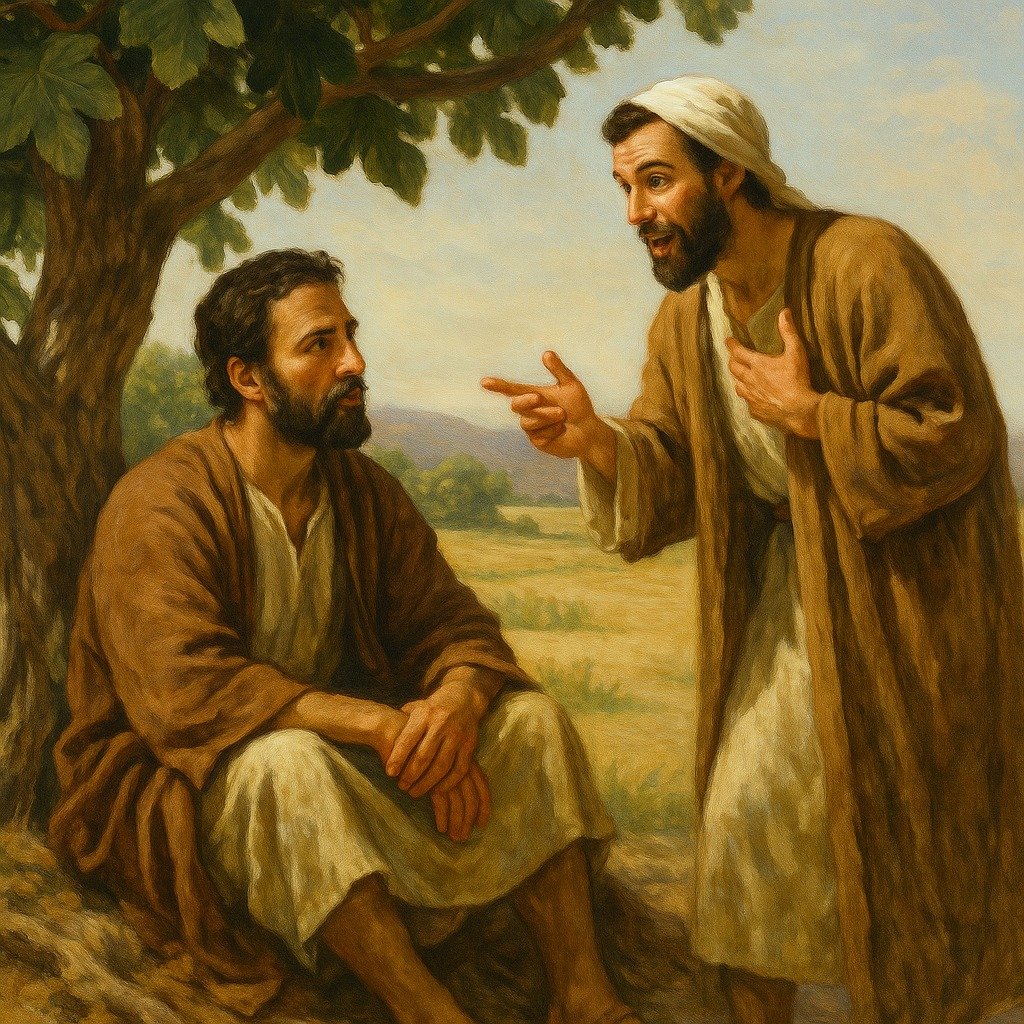
47 As they approached, Jesus said, “Now here is a genuine son of Israel—a man of complete integrity.” 48 “How do you know about me?” Nathanael asked. Jesus replied, “I could see you under the fig tree before Philip found you.” 49 Then Nathanael exclaimed, “Rabbi, you are the Son of God—the King of Israel!”
That’s the turning point. Why? Because the fig tree wasn’t just a random seat. In Jewish tradition, the fig tree symbolized peace, prayer, and the study of God’s Word. Micah 4:4 pictures the Messianic age as a time when “everyone will sit under their own vine and under their own fig tree, and no one will make them afraid.” To sit under a fig tree was to long for Messiah.
So when Jesus said, “I saw you under the fig tree,” He wasn’t saying, “I know your GPS location.” He was saying, “I saw you seeking God. I know your prayers. I hear your longing.”
That’s why Nathanael erupts: “Rabbi, you are the Son of God! You are the King of Israel!”
And then Jesus delivers the bombshell: “You will see heaven open, and the angels of God ascending and descending on the Son of Man.” (John 1:50–51)
The Greek phrase here—ἀναβαίνοντας καὶ καταβαίνοντας (anabainontas kai katabainontas, “ascending and descending”)—is the exact wording from the Septuagint translation of Genesis 28. Jesus is saying:
- I am Jacob’s ladder.
- I am the meeting place of heaven and earth.
- I am the new Bethel, the true house of God.
And that’s why when he actually meets Jesus, something extraordinary happens. Jesus connects Nathanael’s personal story to Israel’s ancient story. He reaches back into Scripture and invokes one of the most mysterious, powerful visions in all of Genesis—Jacob’s ladder.
Why would Jesus end Nathanael’s call with such an odd image? Angels ascending and descending? To understand, we need to remember Jacob’s dream.
Jacob’s Ladder – A Place of Encounter
Genesis 28:10–19 – Jacob, on the run, sleeps with a stone for a pillow, dreams of a ladder (Hebrew: סֻלָּם / sullām – often “stairway”) connecting heaven and earth, with angels going up and down.
The Lord beside Jacob and reaffirms the covenant promises. Jacob wakes and says, “Surely the Lord is in this place, and I did not know it… This is none other than the house of God, and this is the gate of heaven.”
The sullām wasn’t about humanity building a tower like Babel, clawing our way up to heaven. It was about God Himself opening the connection between heaven and earth. Derek Kidner notes: “The dream is not of man’s climbing, but of God’s descent.”
Imagine standing in the flat desert of Mesopotamia, where the horizon seems endless and the sky stretches forever. Rising in front of you is a massive stepped tower—a ziggurat. Layer upon layer of stone and mudbrick stack upward, each terrace smaller than the last, creating the look of a giant staircase carved into the sky. Wide ramps climb the sides, steep stairways stretch toward the top, and at the summit a shrine glimmers in the sun. Ancient people believed the gods could descend those stairs to meet humanity, that this was the bridge between heaven and earth.
Now picture Jacob, alone and running for his life, laying his head on a stone in the wilderness. And suddenly he sees it—his own sullām, a stairway stretching into the heavens. But this wasn’t human-made. This wasn’t Jacob’s attempt to climb to God. The stairway wasn’t crowded with worshippers straining upward—it was alive with angels moving freely up and down, carrying out God’s purposes. And at the very top—or maybe right beside Jacob himself—stood the Lord, not demanding Jacob climb higher, but reminding him: “I am with you… I will not leave you” (Genesis 28:15).
The message was unmistakable: heaven is not locked. The presence of God is not distant. Jacob didn’t have to build a tower or prove his worth. God had already come down.
Jacob names the place Bethel—the “House of God.” Heaven wasn’t closed. Heaven wasn’t far. Heaven was here. At Babel, people built upward to reach God. At Bethel, God came down to reach Jacob. And in Christ, heaven still comes down to us.
Jacob’s ladder wasn’t about climbing our way to God—it was about God opening heaven to come down to us.
The Greater Invitation – Come and See Heaven Open
This isn’t just Nathanael’s story—it’s ours. Jesus doesn’t invite us to climb. He invites us to come and see. He isn’t another teacher pointing toward heaven. He is heaven come down.
The Reformers loved this truth. John Calvin, who I will admit I don’t agree with the core of his theology, wrote: “Christ is the bond by which heaven and earth are joined together, so that the ladder once shown to Jacob is daily set before believers.”
That means:
– You don’t need to build your way to God—He has already come down.
– You don’t need to prove yourself worthy—He has already opened heaven.
– You don’t need to fear being forgotten—He already sees you, just as He saw Nathanael.
And notice this: when Jesus says, “You will see heaven open” (John 1:51), the verb is plural—ὄψεσθε / opsesthe. He’s not just speaking to Nathanael. He’s speaking to all of them. To every disciple. To you and me.
Commentators like Leon Morris and D.A. Carson both highlight that when Jesus tells Nathanael, “You will see heaven open” (John 1:51), the verb “you will see” is plural. Jesus wasn’t promising a private vision to Nathanael alone, but speaking to all the disciples. Morris points out that this means the promise belongs to every follower of Jesus, not just one man. Carson takes it further, showing how this sets the tone for the whole Gospel of John: discipleship is not an individual experience but a shared one. Together they would witness heaven opened through Jesus’ words, His miracles, His cross, and His resurrection. What Jacob glimpsed in a dream, they would all see fulfilled in the Son of Man, who is Himself the new meeting place between heaven and earth. And that’s exactly what we’re going to trace together in our study of John this fall—week by week, watching as the heavens open wider, and seeing more clearly what it means that in Jesus, God has come near.
The Gospel doesn’t invite us to climb higher—it invites us to stay close to Jesus, because He is the ladder that brings heaven down.
Closing: The Invitation Remains
It all comes back to invitation.
John the Baptist said, “Look.”
Andrew said, “We have found.”
Philip said, “Come and see.”
And Jesus said, “You will see heaven open.”
The invitation hasn’t expired. Jesus is still the ladder, the open heaven, the gate of God’s presence.
So what will you do with that invitation? Will you shrug it off like Nathanael almost did? Or will you come and see for yourself, and discover that the God of Jacob has already stepped close in Jesus Christ?
“You will see heaven open, and the angels of God ascending and descending on the Son of Man.” (John 1:51)
Today we’ve heard again the invitation Jesus gave to Nathanael: ‘Come and see.’ That invitation was not just for him—it’s for all of us. Come and see the One who knows you. Come and see the One who brings heaven near. Come and see the Son of Man, who gave His life so that we might live.
And that invitation doesn’t end with words—it continues here at the Table. In this bread and cup, Christ invites us again: Come and see. Come and taste. Come and remember. Come and receive. This is the Lord’s Table, and all who love Him, who seek to follow Him, are welcome here
No responses yet