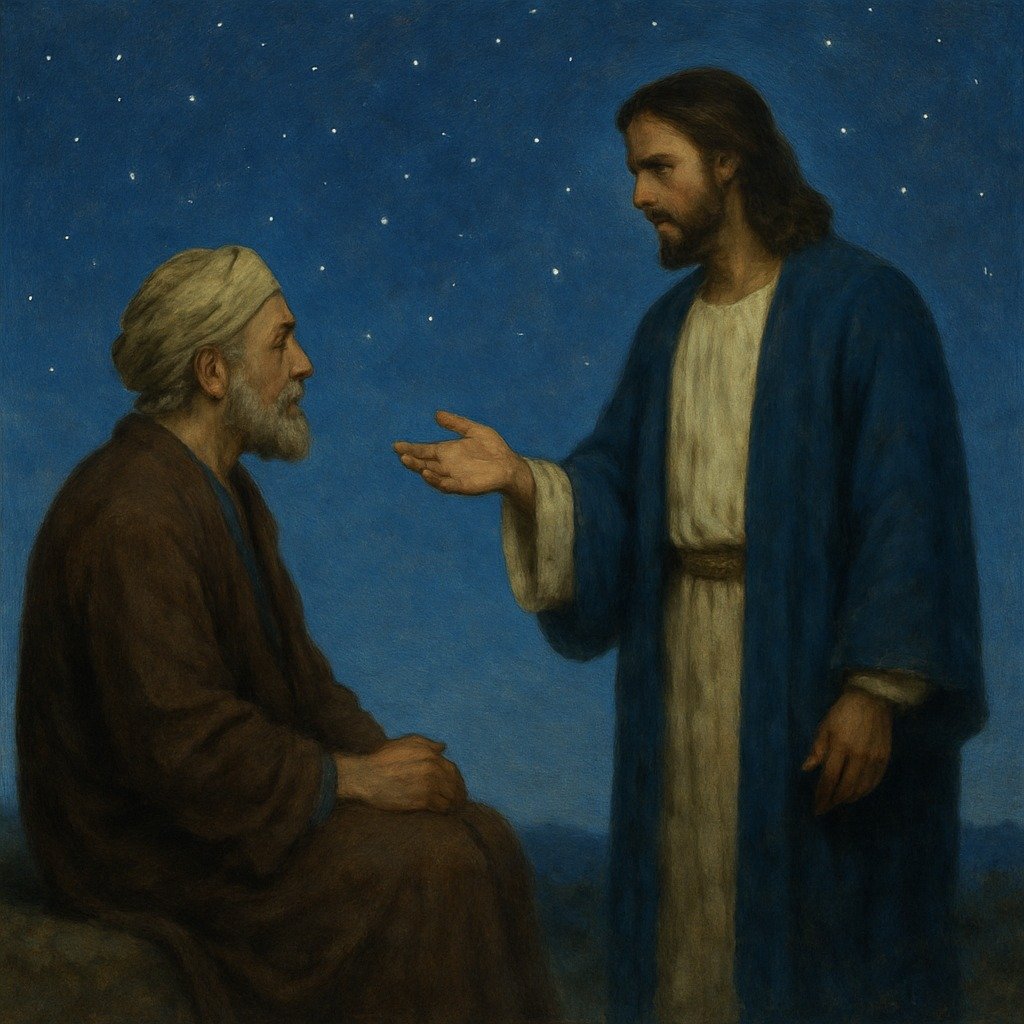
John 3:1–21
Introduction: The Nighttime Visit
Nicodemus wasn’t just any man—he was a Pharisee and a member of the Sanhedrin. That tells us volumes about who he was.
Pharisees – The Pharisees arose during the intertestamental period, after the exile, around the 2nd century BC. Their very name, Pharisee (from the Hebrew perushim, “the separated ones”), shows their desire to be set apart by strict adherence to the Law. They believed in the resurrection of the dead, angels, and the coming Messiah. They weren’t priests; they were laymen devoted to interpreting and applying the Law to daily life. Ordinary Jews often respected them as the “spiritual guardians” of Israel.
Sadducees – The Sadducees, by contrast, were of Levitical dissent more aristocratic. They controlled the Temple and priesthood, rejected belief in resurrection or angels, and clung only to the written Torah (the first five books). Politically, they collaborated with Rome to preserve their power. They were wealthy, but disconnected from the common people.
Sanhedrin – The Sanhedrin was the supreme Jewish council, made up of Pharisees, Sadducees, and elders. They judged matters of law, doctrine, and order. To be a Pharisee was impressive; to be a member of the Sanhedrin was the pinnacle of religious authority.
So when John tells us Nicodemus was both a Pharisee and a ruler of the Jews, he’s saying: this man stood at the very top of Israel’s religious world. If anyone could claim access to God by position or tradition, it was Nicodemus.
The Pharisees had risen up in the centuries before Jesus, determined to preserve holiness through strict obedience to the Law. The Sadducees, mostly priestly and aristocratic families, controlled the Temple and denied beliefs such as resurrection. Together, Pharisees and Sadducees formed the Sanhedrin—the highest religious council in Israel.
And yet—with all this structure and tradition, it is Nicodemus who comes searching in the dark.
Nicodemus is one of those figures in Scripture who makes us pause. On the surface, he was everything a faithful Jewish man might aspire to be: a Pharisee, a teacher of the Law, a respected member of the Sanhedrin. He had position, authority, education, and reputation. If anyone looked “close to God,” it was Nicodemus.
But John frames his visit with a detail too important to overlook: he came at night. Light and darkness are central in John’s Gospel. Light represents God’s truth; darkness represents spiritual blindness. To come “at night” is more than a timestamp—it is a symbol. Nicodemus is curious, but cautious. He recognizes that Jesus is from God because of His miracles, but he is still hesitant, afraid of what others might think, and uncertain about what Jesus’ role in God’s kingdom really is.
And Jesus doesn’t ease him in with pleasantries. He cuts straight to the heart: “Truly, truly, I say to you, unless one is born again, he cannot see the kingdom of God” (John 3:3). Nicodemus thought he needed clarification; Jesus told him he needed transformation.
This conversation is one of the most important in all of Scripture. It holds not only the famous verse of John 3:16, but also a living picture of what John Wesley would later describe as the movements of grace: prevenient grace that draws us to Christ, justifying grace that saves us through faith, and sanctifying grace that reshapes us into holiness. Nicodemus’s encounter with Jesus is not just his story—it is ours.
Here, in the quiet of the night, we hear a conversation that is one of the most important in all of Scripture. It holds not only the famous verse of John 3:16, but also a living picture of how God’s grace meets us. For us as Methodists, it beautifully reflects what John Wesley described as the three movements of grace.
- Prevenient grace — just as Nicodemus was drawn to Jesus in the night, God’s Spirit is always drawing us, stirring questions, preparing our hearts.
- Justifying grace — when Jesus tells him he must be born again, it points to that moment of new birth, when faith in Christ makes us right with God.
- Sanctifying grace — as Nicodemus’ story continues, we see him stepping into the light, growing bolder in faith, a reminder that the Spirit continues to shape us into holiness.
Nicodemus’s encounter with Jesus is not just his story—it is the story of every disciple. In his questions, in his hesitations, and in his eventual courage, we can see our own journey of grace.
Point 1: Nicodemus comes to Christ at night (vv. 1–8)
Prevenient Grace
Jesus doesn’t waste time flattering Nicodemus or affirming his religious credentials. He doesn’t commend his discipline or status. Instead, He cuts right to the heart: “You must be born again.”
That phrase is startling. The Greek word anōthen (ἄνωθεν) carries a double meaning: “again” and “from above.” Nicodemus hears only the first—how could a grown man possibly return to his mother’s womb? But Jesus is speaking of the second. He is pointing to a new birth, not of flesh but of Spirit, a life that comes down from above as a gift of God.
Theologian D.A. Carson explains: “What is crucial is not repetition of birth but the origin of the birth. To be part of God’s kingdom requires birth from above, wrought by the Spirit of God.” In other words, salvation is not about personal effort or human striving. It is about receiving a new nature from heaven itself.
To drive the point home, Jesus uses an image Nicodemus can grasp. “The wind [pneuma] blows where it wishes… so it is with everyone born of the Spirit” (v. 8). The word pneuma in Greek means both wind and spirit. We cannot see the wind, but we feel its effects. In the same way, the Spirit cannot be controlled or charted, yet His work is unmistakable.
This is what John Wesley calls prevenient grace—the grace that goes before. It is the Spirit stirring in the heart, awakening us long before we even know what we’re searching for. Why did Nicodemus risk sneaking out at night to find Jesus? Prevenient grace. Something in his heart was restless. Something whispered, “There must be more.” That same grace works in us. It’s the quiet ache we can’t explain, the tug to pray when we don’t know how, the gentle unease when we’ve settled for less than God’s best.
So let me ask: Where do you sense the Spirit stirring? Where is God nudging you to seek Him more deeply? That restlessness is not an accident—it is prevenient grace. Don’t ignore it. Lean into it. The same Spirit who drew Nicodemus in the night is still drawing hearts today.
He’s saying to us; you don’t need a better version of you. You need a brand-new you.
Point 2: God’s Love Made a Way (vv. 9–17)
Justifying Grace
Nicodemus is baffled. He has spent his life immersed in the Law, teaching others how to obey it, and now Jesus speaks of a new birth from above. “How can these things be?” he asks (v. 9). In response, Jesus does not give him a theological treatise but tells a story Nicodemus already knows well—a story of sin, judgment, and God’s surprising provision of grace.
The Bronze Serpent in the Wilderness
In Numbers 21, the Israelites grew impatient and spoke against God and Moses. In judgment, God sent venomous serpents among them, and many died. When the people repented, God told Moses to make a bronze serpent and lift it on a pole. Whoever looked at it lived.
Jesus takes this familiar story and applies it to Himself: “As Moses lifted up the serpent in the wilderness, so must the Son of Man be lifted up, that whoever believes in Him may have eternal life” (vv. 14–15). The very image of death became the instrument of healing. Likewise, the cross—Rome’s instrument of shame and cruelty—would become the very place where salvation is accomplished.
Cyril of Jerusalem explained: “As at the serpent all who looked were saved, so now all who look in faith on the crucified Jesus are delivered from the poison of the serpent of sin.” In other words, the healing comes not from our efforts, but from God’s provision, received by faith.
The Heart of the Gospel
It is in this moment that Jesus speaks the words that have echoed through history:
“For God so loved the world (kosmos) that He gave His only Son, that whoever believes in Him shall not perish but have eternal life. For God did not send His Son into the world to condemn the world, but in order that the world might be saved through Him” (vv. 16–17).
The word kosmos is striking. It includes not only Israel, not only the religious, not only the good and moral—but the whole of humanity. The Jewish people believed the messiah was coming for the Jewish people alone; and yet here Jesus says that He came for the entire world. This would have be confusing to Nicodemus; why would the Messiah be here for everyone? Wasn’t he supposed to be coming to be the final savior of the Jewish people?
This is not a God who merely tolerates us. This is a God whose very posture toward the world is love. His action is to give. His purpose is to save.
Justifying Grace
Here we see what Wesley called justifying grace—the grace that pardons sin and restores us to relationship with God. In his Sermon on the Scripture Way of Salvation, Wesley defined justification as “pardon, the forgiveness of sins.” Through Christ’s cross, God declares us forgiven, reconciled, and restored.
Importantly, Wesley was adamant that this grace is universal and the United Methodist Articles of Religion affirm: “The offering of Christ, once made, is that perfect redemption, propitiation, and satisfaction for all the sins of the whole world, both original and actual; and there is none other satisfaction for sin but that alone.”
Martin Luther called John 3:16 “the Gospel in miniature.” In it we see:
- The motive: -> God’s love.
- The gift: -> His Son.
- The condition: -> Whoever believes.
- The promise: -> Eternal life.
Faith as Active Trust
But what does it mean to “believe”? Wesley described faith as “a sure trust and confidence that Christ loved me and gave Himself for me.”
Think of sitting in a chair. To believe the chair exists is not enough. To believe the chair can hold you is not enough. You must sit down—place your weight on it. In the same way, saving faith is entrusting your whole life to Christ, resting in His work rather than your own.
Justifying grace is received through this faith. We are not saved by works, by effort, or by ritual. We are saved by grace through faith in Christ alone.
Love, Not Condemnation
Jesus makes this explicit: “God did not send His Son into the world to condemn the world, but to save the world through Him” (v. 17). Too many people imagine God as perpetually disappointed, a harsh judge waiting to strike. But Jesus reveals the Father’s true heart: love. His mission is not condemnation but salvation.
In the Tractates of the Gospel of John, Augustine once preached that Jesus came to judge the world but that through that judgment he saves. Because as any gracious judge it is through judgement that He can “provide pardon, not punishment; salvation, not destruction.”
This is the essence of justifying grace: God moves toward us not in wrath but in mercy, not to reject but to redeem.
Nicodemus and Us
For Nicodemus, this was a personal invitation. He came seeking answers, but Jesus offered him salvation. The path to eternal life was not in more knowledge, stricter law-keeping, or deeper tradition, but in believing in the Son of Man lifted up.
For us, the invitation is the same. Justifying grace declares that God’s love is for the whole world—and that includes you. Christ was lifted up for you. Eternal life is offered to you.
The cross wasn’t proof of God’s anger. It was proof of His love.
Point 3: Step Out of the Darkness into the Light (vv. 18–21)
Sanctifying Grace
Jesus brings the conversation with Nicodemus to a decisive close. It comes down to this: light or darkness. “This is the judgment: the light has come into the world, and people loved the darkness rather than the light because their deeds were evil” (v. 19). Those who reject Him remain in the shadows. Those who believe step into the light, where their lives are opened to God’s truth and transformed by His grace.
Darkness and Light in John’s Gospel
John’s Gospel consistently weaves this theme of light and darkness. From the opening verses we hear: “The light shines in the darkness, and the darkness has not overcome it” (1:5). Later, Jesus will declare: “I am the light of the world. Whoever follows me will never walk in darkness, but will have the light of life” (8:12). Light in John represents God’s truth and holiness, while darkness symbolizes sin, secrecy, and separation from God. To believe in Jesus is to step out of hiding and into the freedom of His light.
Nicodemus’ Journey into the Light
What makes this passage so powerful is that Nicodemus’ story does not end in chapter 3. His life traces a movement from shadows into sunlight, embodying what it means to walk in grace.
- In John 3, he comes by night—curious but cautious, unwilling to be seen.
- In John 7, when the Sanhedrin debates arresting Jesus, Nicodemus speaks up: “Does our law judge a man without first giving him a hearing?” (7:50–51). It is a small step, but it shows growing courage.
- In John 19, after the crucifixion, Nicodemus appears again—this time carrying seventy-five pounds of costly spices to prepare Jesus’ body for burial. No longer hiding in darkness, he acts with bold devotion in broad daylight.
Nicodemus’ journey mirrors the work of grace—slow, steady, and transformative.
Sanctifying Grace
This is what Wesley called sanctifying grace: the ongoing work of the Holy Spirit to shape us into the likeness of Christ. If prevenient grace awakens us and justifying grace pardons us, sanctifying grace is the Spirit’s patient labor to renew our hearts and lives.
Wesley described this as the journey toward Christian perfection—not sinless flawlessness, but a heart so filled with love for God that love drives our every thought and every action. In his sermon The Great Privilege of Those That Are Born of God, Wesley taught that the Spirit delivers us not only from the guilt of sin but also from its power, enabling us to live differently.
The Book of Discipline of the United Methodist Church echoes this: “We hold that the wonder of God’s acceptance and pardon do not end God’s saving work, which continues to nurture our growth in grace. Through the power of the Holy Spirit we are enabled to increase in the knowledge and love of God and in love for our neighbor.” Sanctifying grace is not about instant arrival but lifelong transformation.
The Spirit’s Transforming Work
Sanctifying grace is practical. It teaches us to forgive when forgiveness feels impossible, to serve when service is costly, to stand for truth even when it is unpopular. It moves us beyond nominal faith into living discipleship. Augustine put it simply: “By the Spirit he is made new.” The same Spirit who gave Nicodemus courage gives us strength to walk in the light of Christ.
Wesley emphasized that sanctification happens through means of grace—prayer, searching the Scriptures, receiving the sacraments, fasting, and Christian fellowship.
Application: From Shadows to Light
Remaining in darkness may feel safer. It hides our flaws, preserves our comfort, and shields us from exposure. But Jesus warns that the end of darkness is death. To step into the light may feel vulnerable—our sins revealed, our defenses stripped away. Yet it is only in the light that we find freedom.
Nicodemus shows us that grace does not stop at a midnight conversation. It continues, pulling us from fear into faith, from secrecy into boldness, from shadows into daylight. His journey is a living picture of sanctifying grace—slow, sometimes halting, but undeniably moving toward the light.
The invitation is the same for us. Will we remain hidden, content with partial faith, or will we step into the light where Christ can change us? Sanctifying grace is God’s promise that He will not leave us as we are. He intends to make us holy, to fill us with His love, and to use us as witnesses in the world.
Nicodemus started in the shadows but ended at the cross.
Conclusion: Born Again, Set Free
When we last see Nicodemus in John’s Gospel, it is at the cross. Jesus has been crucified, His body hanging lifeless, His disciples scattered in fear. At this moment of apparent defeat, who shows up? Not Peter, not James, not John. But Nicodemus—the one who first came to Jesus in the shadows.
John tells us that Joseph of Arimathea, a secret disciple, asked Pilate for permission to take Jesus’ body. And who was there with him? Nicodemus. And he did not come empty-handed. He brought a mixture of myrrh and aloes weighing about seventy-five pounds (John 19:39). That is an extraordinary amount, fit for the burial of a king.
Do you see what has happened? The man who once whispered his questions under cover of darkness now steps forward in the light of day with extravagant devotion. The one who feared the opinion of his peers now risks his reputation to honor Jesus. The one who began in secrecy now lives in costly love.
This is what sanctifying grace produces: a life that bears the fruit of love and devotion. It begins with prevenient grace stirring the heart, it deepens with justifying grace bringing forgiveness, and it blossoms in sanctifying grace that leads to bold, tangible action.
Nicodemus’s final act is a testimony: he recognized Jesus not only as a teacher from God but as the true King, worthy of royal honor—even in death. And in doing so, he models for us what it means to let grace have its full work. Sanctifying grace moves us beyond private belief to public devotion, beyond cautious interest to sacrificial love.
This passage isn’t just a story about Nicodemus—it’s the story of us.
– Like him, we may be respectable, religious, and educated—and yet spiritually lost.
– Like him, we must be born again, from above, by the Spirit.
– Like him, we are invited to believe in the Son of God who was lifted up for us.
– Like him, we must decide whether to remain in darkness or step into the light.
The Gospel is not about self-help, moral reform, or religious duty. It is about new birth, God’s love, and freedom in Christ.
No responses yet