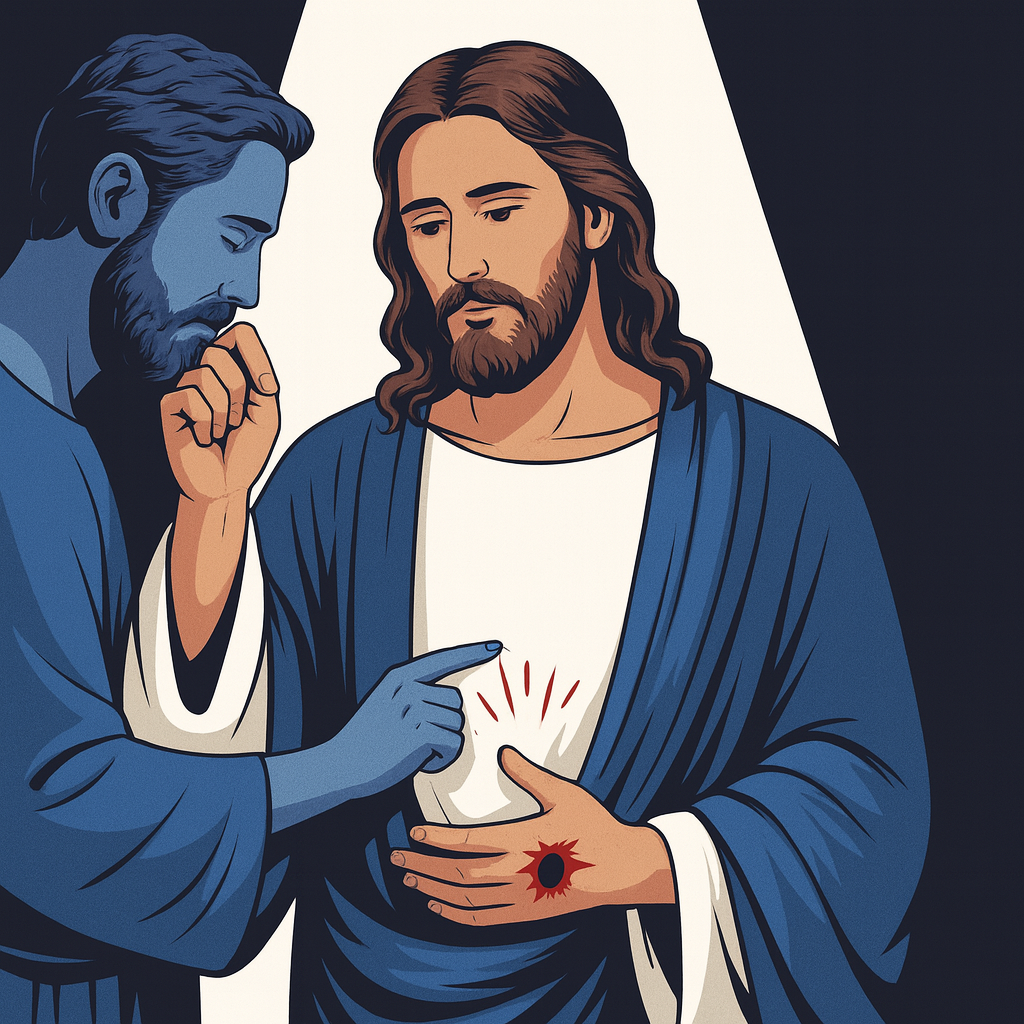
John 20:24–29
There’s a disciple we talk about less than the others—someone who appears only a handful of times in the Gospels, yet each time he steps into the scene, he reveals something honest, courageous, and deeply human.
His name is Thomas.
If you grew up in church, you probably already know his nickname—“Doubting Thomas.” It’s the label we gave him because of one moment, one sentence, spoken out of pain and uncertainty. But the nickname has never done him justice. Because if the New Testament gives us only a few windows into Thomas’s life, each of them shows us a man far more complex, far more faithful, and far more relatable than that one moment suggests.
Every group has a Thomas.
- The honest one.
- The question-asker.
- The one who feels deeply and refuses to pretend.
- The one who wants truth over clichés, reality over platitudes.
- The one who says out loud what everybody else is secretly thinking.
Thomas was that disciple.
Scripture tells us his name in Hebrew/Aramaic was T’ōmā, meaning twin. John gives us the Greek translation Didymus. We never learn who his twin was, but we learn something important—Thomas lived with tension inside him: part faith, part fear, part courage, part confusion, part boldness, part vulnerability. And in that way, he is the twin of every believer who has ever wrestled with doubt and devotion at the same time.
Thomas enters the Gospel story subtly. He was a Galilean Jew, likely from a fishing or tradesman family like the other disciples, called by Jesus early in His ministry. Though the Bible never narrates the moment of his calling, his presence among the Twelve tells us Jesus saw something in him—something steady, something real, something worth building the church upon.
The first time Thomas speaks in Scripture is in John 11, when Jesus decides to return to Judea—a place filled with danger. The other disciples try to talk Jesus out of it: “Rabbi, they tried to stone You there!” But Thomas—this same Thomas—says:
“Let us also go, that we may die with Him.”
Does that sound like a doubter to you? That’s loyalty. That’s courage. That’s devotion deep enough to face death.
The second time he speaks is in John 14, when Jesus tells the disciples, “I am going to prepare a place for you… and you know the way.” Most of them nod along politely. But Thomas is the one honest enough to raise his hand and say: “Lord, we don’t know where You are going, so how can we know the way?” And because he asked that question—because he dared to voice the confusion everyone else felt—Jesus spoke one of the most famous declarations in all of Scripture: “I am the way, the truth, and the life.”
Thomas is not a doubter. He’s a disciple who wants real answers.
He’s the one who follows Jesus with his whole heart—even when he doesn’t fully understand.
Early church history tells us that after the resurrection and Pentecost, Thomas carried the Gospel farther geographically than any other apostle. He traveled east—to Syria, then Parthia, then all the way to India—founding what is now known as the Mar Thoma Church, one of the oldest branches of Christianity in the world. Tradition holds that he was martyred there, speared for his faith, dying with the same bold loyalty he had shown in John 11:
“Let us go with Him, even if it costs us everything.”
So before we get to his moment of doubt, understand this:
- Thomas was faithful.
- Thomas was brave.
- Thomas was honest.
- Thomas was committed.
And that makes John 20 even more powerful—because the man who once said, “Let us die with Him,” is now the man who wasn’t in the room when Jesus appeared.
That’s where we begin.
The One Who Wasn’t There
John tells us something small, almost quiet, but spiritually loaded:
“Now Thomas… was not with them when Jesus came.”— John 20:24
Every time I read that sentence, it hits me in the chest. Because absence always carries a story. When someone isn’t in the room, when someone drifts from church, when someone stops showing up—there’s almost always a reason. And rarely is that reason rebellion. Usually, it’s pain. Disappointment. Exhaustion. Confusion. Grief that runs so deep they don’t know how to be around anyone else. Thomas wasn’t in the room, Not because he didn’t believe, But because he was hurting.
He was a disciple carrying trauma, Imagine what Thomas had seen.
- He watched Jesus betrayed, arrested, mocked, beaten.
- He watched the cross rise into the sky.
- He watched the life leave His body.
- He watched His Teacher—his Rabbi—His Lord—die.
Roman crucifixion was public, humiliating, and traumatizing. It wasn’t a quiet death. It was an act of terror. So when Thomas withdrew, he wasn’t abandoning faith— he was staggering under grief.
Sometimes your heart hurts so much, you don’t have the strength to walk into the upper room. The disciples hid together behind locked doors. But Thomas faced his grief alone. That’s a dangerous place to be.
In an honor-shame culture like first-century Judaism, grief wasn’t hidden. It was expressed loudly, communally. Families tore their clothes. Neighbors mourned together. Loss was carried as a community. Thomas wasn’t in any community. He was wandering alone.
When people today stop coming to church, we often imagine the worst.
- “They’ve drifted.”
- “They’ve lost their way.”
- “They’ve given up.”
But more often than not, the truth is much closer to Thomas’s story. People Don’t Leave Because of Disbelief — They Leave Because of Disappointment .
The ones who disappear usually do so quietly. Not because they’re done with Jesus. But because life hasn’t been kind, and they don’t know how to let others see the ache.
When the disciples find Thomas and tell him, “We have seen the Lord,”
Thomas responds: “Unless I see… unless I put my hand into His side… I will not believe.”
The Greek is emotionally raw:
ἐὰν μὴ ἴδω (ean mē idō) — “Unless I see for myself…”
οὐ μὴ πιστεύσω (ou mē pisteusō) — an emphatic double-negative:
“I absolutely cannot believe right now… not with the state my heart is in.”
- Thomas wasn’t rejecting them.
- He wasn’t rejecting Jesus.
- He was protecting what was left of his heart.
Have you ever hurt so deeply you couldn’t handle hope? That’s where Thomas was standing. Here is the part we often miss. Thomas may have spoken from pain, but notice this: He didn’t walk away from the disciples entirely. He stayed close enough to come back.
Verse 26 says: “A week later… Thomas was with them.”
- A week.
- Seven days of sitting in the tension between other people’s joy and his own sorrow.
- Seven days of listening to stories he wished he had lived.
- Seven days of wondering why Jesus showed up for everyone else but not for him.
But the disciples didn’t push him out. Nobody said, “Well Thomas, if you’re going to be negative, maybe this isn’t the group for you.” Nobody weaponized their experience to shame him. Nobody lectured him. Nobody told him his doubt was offensive. They held space for him.
This is what Wesley meant when he described the church as a “means of grace.” Grace doesn’t just flow through sermons—it flows through community. Through a room full of people willing to embrace you while you wrestle.
The disciples didn’t fix Thomas. They didn’t heal Thomas. They didn’t convince Thomas. They simply made sure he was still in the room when Jesus came back. Sometimes the holiest thing you can do is keep someone close until the Savior arrives.
Can you imagine what that week felt like? On one side of the room: ten disciples filled with joy celebrating resurrection, telling their stories “We saw the Lord! His hands! His side!” On the other side of the room: one heart still broken, one disciple who hadn’t seen anything, one man who wondered why Jesus came for them but not him.
- That tension is real.
- That tension is holy.
- That tension is what authentic community looks like.
Thomas wasn’t the lost disciple. He was the one Jesus was preparing to go back for. While Thomas sat in the upper room feeling left behind, Jesus was already planning a second visit.
What becomes clear in this story is that Thomas’s absence didn’t disqualify him. It didn’t cancel his calling. It didn’t erase his loyalty. It didn’t cause Jesus to move on.
Jesus didn’t say, “Well, Thomas wasn’t there. I guess the ten will have to do.” No—Thomas’s absence becomes the very place where Jesus will reveal His compassion. And that brings us to the turning point of the entire narrative:
Thomas wasn’t in the room the first time… but he will be in the room the second time.
Why?
Because grace doesn’t give up on the one who feels late. And Jesus always comes back for the one who wasn’t there.
The Savior Who Comes Back
John continues the story with a moment so gentle, so unexpected, that it changes everything we think we know about Jesus:
“A week later, His disciples were in the house again, and Thomas was with them. Though the doors were locked, Jesus came and stood among them…”— John 20:26
John makes a point of saying the doors were “locked.” The Greek word is κεκλεισμένων (kekleismenōn) — not “closed,” but barred shut, securely fastened.
In other words: The disciples weren’t just gathered. They were hiding. They were still afraid of the authorities. Still uncertain about the future. Still processing the trauma of Good Friday. Still unsure what resurrection meant for them. Locked doors were their attempt at control, the one thing they could manage when everything else had spiraled beyond them.
But resurrection doesn’t wait for unlocked doors. Jesus comes right through the things fear tries to close.
And then, Jesus Speaks Peace — Again. The very first thing Jesus says is:
“Peace be with you.” Eirēnē hymin. A phrase that carries weight. Eirēnē means much more than “calm down.” It appears 92 times in the New Testament and means inner harmony, prosperity, and reconciliation with God or Shalom — the divine mending of what life has torn apart.
Jesus offered that peace to the ten disciples the first time He appeared. But He repeats it here — for the sake of Thomas.
Christ does not demand that Thomas calm down. He brings the calm, speaks wholeness over the room before He ever speaks correction. He goes straight to Thomas, there is no prompting, no whisper from Peter asking, “Lord, can You talk to Thomas” No explanation from the others.
Jesus turns on His own. His eyes lock on the one who missed the moment. The one who feels behind. The one who feels late to grace. Jesus quotes Thomas’s pain back to him, Jesus says:
- “Put your finger here.”
- “See My hands.”
- “Reach out your hand and put it into My side.”
These are not generic words. These are Thomas’s exact words from one week earlier. No one told Jesus what Thomas said, at least not physically. But Jesus heard him.
- He heard his pain.
- He heard his fear.
- He heard his honest struggle.
- He heard the late-night prayer whispered in frustration.
- He heard the tears Thomas shed when no one else was around.
Jesus always hears the hurting heart.
When Jesus repeats Thomas’s words, He’s not exposing him; He’s reassuring him: “I was listening, even when you didn’t see Me.”
The Greek verbs Jesus uses are in the imperative mood, but they are not forceful commands. They are gentle invitations:
- φέρε (phere) — “Come here. Draw near.”
- ἴδε (ide) — “Look. See deeply.”
- βάλε (bale) — “Reach forward. Don’t hold back.”
Jesus does not shame Thomas for asking. He honors what Thomas needs; and that’s grace.
Then Jesus says: “Do not be unbelieving, but believing.” In Greek: μὴ γίνου ἄπιστος (mē ginou apistos) — “Stop becoming unbelieving.” ἀλλὰ πιστός (alla pistos) — “Become a believer again.”
This is not a rebuke. This is release. Jesus isn’t saying, “Thomas, you’re wrong.” He’s saying, “Thomas, you’re free.”
- Free from fear.
- Free from disappointment.
- Free from the grief that closed your heart.
- Free from the wound that made hope feel dangerous.
It is the same tone Jesus uses when calming storms and raising children from the dead; gentle, steady and reassuring.
Notice what Jesus shows him.
- Not His glory.
- Not His power.
- Not the angels.
- Not the empty tomb.
- Not the earthquake.
- Not the radiant light Mary saw.
Jesus shows Thomas…His wounds. Why? Because Thomas’s heart was wounded. Nothing heals wounded faith like a wounded Savior. The answer to Thomas’s doubt is not evidence — it’s love.
And Thomas does not need to touch the wounds. He only needs to see the One who bears them.
This entire moment is initiated by Jesus. Thomas does not seek Him, Jesus seeks Thomas. If Thomas teaches us anything, it’s this: Jesus does not abandon you when you’re late to the miracle. He comes back to bring you into it.
Everything has been leading to this moment, the stillness in the room, the breathless disciples, the hurting heart, the Savior who steps through locked doors. Something holy is about to erupt. Thomas is about to speak words no disciple has spoken before.
The Faith That Changes Everything
After Jesus invites Thomas to touch His wounds, John does not say Thomas ever reached out his hand. There is no record of him examining the scars or feeling the pierced side.
What John does record is the explosion of faith that rises up inside him — the most powerful declaration in the entire Gospel:
“My Lord and my God!” (John 20:28)
These six words become the hinge of the entire Gospel of John. The prologue began by saying: “The Word was God.” Now Thomas ends by saying: “You are my God.”
The phrase Thomas speaks is short but loaded with meaning:
Ὁ Κύριός μου (Ho Kyrios mou) “My Lord”
Kyrios is the same Greek word used in the Septuagint (the Greek Old Testament) to translate Yahweh — the covenant name of God. It also means Master, the one with absolute authority. Adding “my” makes it intimate, relational, surrendered.
καὶ ὁ Θεός μου (kai ho Theos mou) “and my God”
Theos is the most direct and explicit word for God. In Jewish monotheism, calling a human “God” was unthinkable — unless that human was truly divine.
This is the only place in all four Gospels where a disciple explicitly calls Jesus God to His face.
Thomas is not just convinced — he is compelled. Faith floods him like a breaking wave. Thomas’s confession is the mountaintop of the entire Gospel. Everything John has written aims at this moment and it came from the disciple everyone labels “the doubter.”
To understand the courage behind Thomas’s confession, we need to understand the world he lived in. In the first century Roman Empire Caesar was called “Lord and God.” People were required to say, “Caesar is Lord.” For Thomas to say, “Jesus is my Lord and my God,” he is intentionally rejecting Caesar’s claim. He is publicly aligning himself with a crucified and resurrected King.
This confession is dangerous. It is treason against Rome. It is blasphemy to the Sanhedrin. It is costly in every direction. Thomas risks his entire future with these six words.
The story of Thomas doesn’t end with this declaration. Early Christian tradition tells us that Thomas traveled farther geographically than any other apostle:
- First to Syria
- Then to Mesopotamia
- Then across the Persian Empire
- And finally to the western coast of India
He founded communities of believers along the Malabar Coast — communities that still exist today, known as the Mar Thoma Church, some of the oldest Christian communities in the world.
The disciple who doubted became the apostle who carried the Gospel across continents. The one who missed the moment became the one who helped millions encounter Christ. And according to tradition, Thomas died a martyr.
Thomas’s story teaches us:
- Jesus does not abandon the slow-to-believe.
- Jesus does not shame the latecomer.
- Jesus does not replace the one who wrestles.
- Jesus pursues the one who feels left behind.
- Jesus uses those He restores to restore others.
This is the consistent heart of God, grace always goes back for the one who missed it.
Jesus responds to Thomas’s confession with a gentle blessing:
“Have you believed because you have seen Me? Blessed are those who have not seen and yet believe.”
He is not rebuking Thomas. He is expanding the blessing outward past the locked room, past the disciples, past the first-century world, all the way to you.
- You are in this story.
- Our church is in this story.
- Your “one” is in this story.
The early church never viewed Thomas as “the doubter.” They saw him as:
- Thomas the Missionary
- Thomas the Witness
- Thomas the Evangelist
- Thomas the Martyr
- Thomas the Apostle of India
- Thomas whose confession anchors the Gospel
The world remembers him for one moment of doubt, Heaven remembers him for a lifetime of devotion. And it all began because Jesus came back for the one who missed it.
Thomas’s story has never really been a story about doubt. Not at its core. It’s the story of a Savior who pursues, who notices, who refuses to leave anyone behind even when they’re hurting too much to stay close. When Thomas stepped away, Jesus didn’t lecture him. He didn’t shame him or replace him or whisper, “You missed your chance.” Instead, Jesus returned. He walked right through the locked door of that upper room, straight into the fear and uncertainty the disciples were carrying, and He sought out the one person who hadn’t been there the first time. He went back for Thomas—the one who missed the moment everyone else experienced.
And that, more than anything, reveals the heart of our Savior. It shows us what He values, who He pursues, and how far He’s willing to go to bring someone back into His presence. If this is the heart of Jesus, then it’s meant to become the heart of His church. Because somewhere in your life, there’s someone who isn’t in the room. Someone who once sat beside you in worship. Someone who believed deeply but got wounded along the way. Someone who has questions. Someone who isn’t sure grace still includes them. Someone who feels late to the miracle.
What I’m going to ask you to do isn’t an initiative or a church program—it’s a person. A name. A story with weight and history. It’s a modern day Thomas God has placed in your world.
And like Jesus, we’re called to go back for the one who isn’t here. Not to pressure them or fix them or win them with arguments, but simply to love them with the same love that walked through locked doors for us. Sometimes the most Christlike thing we will do this year is reach out to one person who feels far away. To pray for them. To speak hope over them. To invite them back into community. To keep them close until Jesus meets them again.
Because the resurrection was never meant to be an event we admire from a distance—it’s meant to be a life we imitate. Jesus came back for one. And now He sends us to do the same.
Comments are closed