Learning to Worship When God’s Story Is Bigger Than Our Name
Most of us will never be Billy Graham, and if we are honest, that realization can either discourage us or free us, depending on whether we believe God only works through the visible and celebrated or whether we trust that God delights in faithfulness wherever He finds it. Most of us will never stand on a platform that history remembers or preach to crowds that shape generations, and yet Billy Graham had people who stood beside him long before the world ever knew his name.
Before Billy Graham ever preached to stadiums or spoke to millions, he was just a restless sixteen-year-old farm kid in North Carolina who did not particularly want to go to church and certainly did not imagine that God was about to redirect the entire course of his life. The turning point did not come through a dramatic vision or a lightning bolt from heaven, but through a farmhand named Albert McMakin, a man who worked on the Graham family dairy farm and who had no platform, no pulpit, and no expectation that history would ever remember his name. McMakin simply believed that God was at work in a local revival, and because he believed that, he kept inviting Billy Graham and a friend to go with him night after night, even when Billy resisted and even when the sermons made him uncomfortable.
On the final night Billy attended, he walked forward and committed his life to Christ, a decision Graham would later say set the direction for everything that followed, and yet he never told that story without naming Albert McMakin, because he understood that while he might preach the sermon, someone else had stood quietly at the edge of the moment that made it possible.
Not all of us will be Billy Graham, but some of us will be the ones God uses to get Billy Graham into the room, and heaven remembers that kind of faithfulness just as clearly.
The Kingdom of God has always been built not just by the visible, but by the faithful.
Miriam is one of those people.
She is never the central figure of the Exodus. She never parts the sea. She never stands before Pharaoh. She never enters the Promised Land. And yet, she is present at every moment where God moves the story forward. She stands at the water where a deliverer is preserved. She sings at the water where a people are saved. And she is restored after the water where pride is washed away.
Miriam’s life reminds us that God does not measure significance the way the world does. Some people lead from the front, and others carry the story forward from the edges, but both matter and both are used by God. And in Miriam’s case, she teaches us something even deeper: how to worship when God’s story is bigger than our name.
The Waters of the Bulrushes
Sometimes God Uses Us to Move Someone Else’s Calling Forward
Exodus 2:1–10
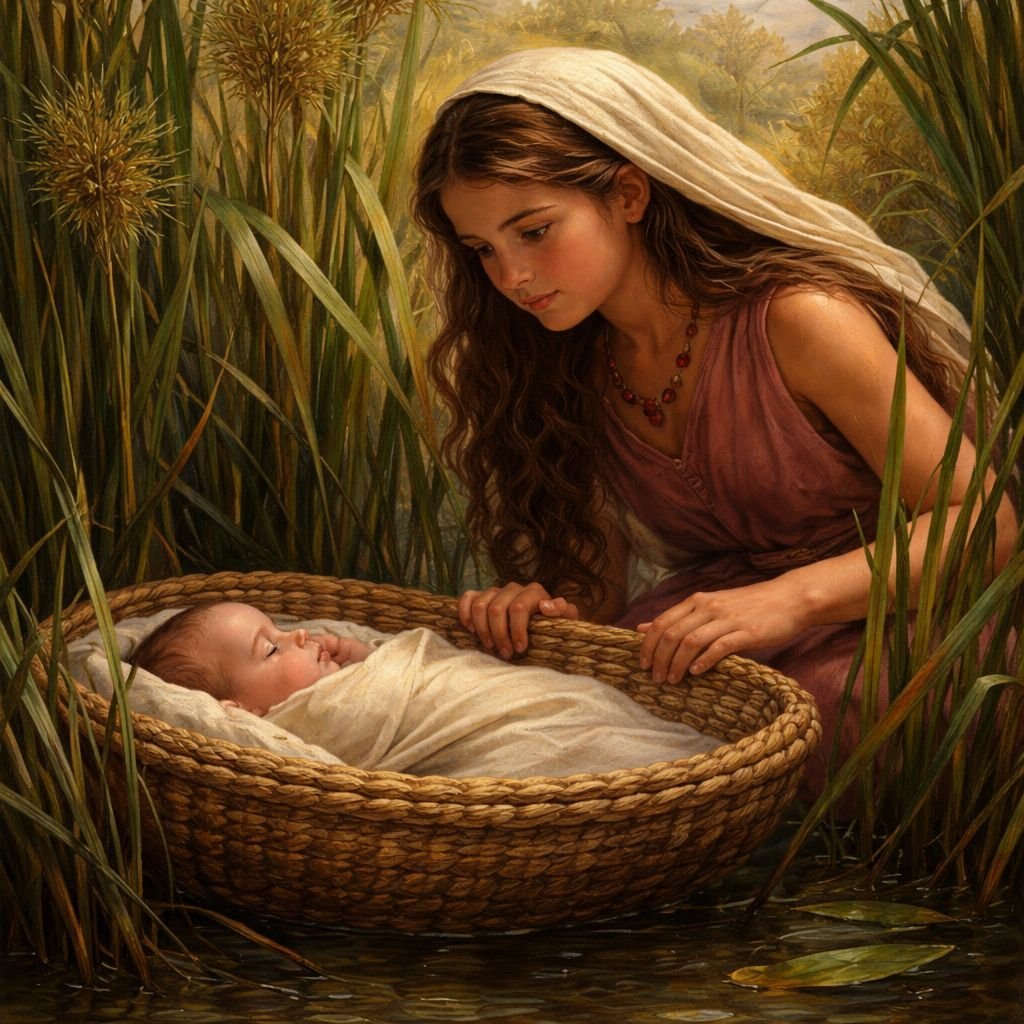
When we first meet Miriam, she is not a leader, a prophet, or a worshiper with a tambourine in her hand; she is a young girl growing up under the weight of fear, living in a world where her people are enslaved and where the future feels both dangerous and uncertain. She is old enough to understand the threat surrounding her family, old enough to grasp what Pharaoh’s decree means, and old enough to know that what happens at the river’s edge may shape the course of her life, and perhaps the life of her entire people.
This is where Miriam’s story begins, and it matters that it begins not with power, but with vulnerability.
She does not yet know that her baby brother will one day confront Pharaoh, or that God will use him to lead a people out of slavery, or that she herself will be remembered as a prophet and a leader of worship. All she knows is that something precious has been placed into the hands of God, and that the only faithful response available to her in this moment is to watch, to wait, and to trust.
That faith is formed in a world shaped by violence.
The Nile in Exodus is not just a river; it is a weapon shaped by fear and wielded by power. Pharaoh, threatened by a people he cannot control, turns what should have been a source of life into an instrument of death, ordering that every Hebrew boy be thrown into its waters. The river that sustains Egypt, the river that fuels its economy and secures its future, becomes a place where hope is meant to drown.
And this detail matters, because in the Egyptian imagination the Nile was not neutral. It was sacred. It was worshiped as the lifeblood of the land, bound up with gods believed to maintain order, fertility, and abundance. What Egypt called divine necessity, Scripture exposes as something far darker: the offering of children to a false god in order to preserve power. This was not merely political violence or population control; it was religious violence, standing in direct opposition to the God of Israel, who would again and again declare that the sacrifice of children is an abomination.
So when Moses is placed into the Nile, he is not being placed into a harmless river; he is being placed into contested ground, into a system of idolatry and death that claims authority over life itself.
And it is precisely there that God chooses to act.
The text tells us that Moses is placed in a basket, but the Hebrew word used is not an ordinary container. It is tevah, the same word Scripture uses for Noah’s ark, and Scripture uses it only twice. In Genesis, God places humanity inside a tevah and carries it safely through the waters of judgment so that creation can begin again. In Exodus, God places a single child inside a tevah and carries him through the waters of oppression so that redemption can begin.
A tevah is not a boat. It has no rudder, no sail, no means of navigation. It is not designed to steer through the water; it is designed to survive it. In both stories, God does not ask His people to control the vessel. He asks them to trust Him with it.
God does not remove Moses from the Nile. He does not dry it up. He does not concede the river to Egypt’s gods. Instead, He places life directly into the very waters Egypt worships and quietly exposes their powerlessness. What Egypt believes belongs to its gods cannot take a life God intends to save. The Nile, revered as divine, is revealed to be subject to the will of the one true God.
And now, with God’s saving work already in motion, Miriam stands at a distance.
She does not rush in. She does not interfere. She does not panic. Scripture tells us she watches, and that quiet detail reveals the kind of faith God is shaping in her long before she ever lifts a tambourine. Miriam understands, perhaps without yet being able to articulate it, that God’s work cannot be forced, only trusted, and that faithfulness sometimes looks like staying present when the outcome is no longer yours to manage.
She is the first witness to what God is doing.
She does not save Moses; God does. But she positions herself close enough to respond when God moves, faithful enough to participate when the moment comes, and humble enough not to demand control over the process. Her role is not deliverance; her role is presence. Her role is not recognition; her role is faithfulness.
And this is an uncomfortable truth for many of us, because we prefer stories where obedience leads directly to visibility, where faithfulness is rewarded with influence, and where calling comes with credit. But sometimes God uses us not to fulfill our own calling, but to protect and propel someone else’s. Sometimes the holiest work we do is standing watch over something that will never bear our name.
Miriam will never be remembered as Israel’s deliverer, but Israel’s deliverer would not exist without this moment of faithful watching. She waters a seed she will never harvest, and Scripture does not rush past that reality. It lingers there, inviting us to consider whether we truly believe that unseen faithfulness matters in the economy of God’s Kingdom.
The apostle Paul would later give language to this truth when he wrote, “I planted, Apollos watered, but God gave the growth.” God’s purposes unfold through a long chain of obedience, much of it hidden, much of it unnamed, but none of it wasted. Miriam stands early in that chain, content not to be the outcome, but to be faithful within the moment God has given her.
Christian worship begins here.
Before a song is ever sung, before a tambourine is lifted, worship begins when we trust that God’s story is moving forward even when we are not at the center of it. Worship begins when we place what we love into God’s hands and choose faithfulness over control. Worship begins when we are willing to say, with our posture if not our words, “God, I trust You to carry this through the waters.”
This is the first lesson Miriam teaches us, and it is the foundation beneath every note she will one day sing.
The Waters of the Red Sea
Worship That Refuses to Claim God’s Victory as Our Own
Exodus 15:1–21
Eighty years have passed since Miriam stood hidden among the bulrushes, watching over a basket she could not steer and a promise she could not force and now we find Miriam just after she and the Hebrews have just crossed the Red Sea. She is no longer a young girl standing at the edge of the Nile, wondering whether God would keep a fragile hope afloat in dangerous waters. She is now a woman who has lived an entire lifetime under oppression, who has carried faith through decades where nothing appeared to change, and who may have wondered more than once whether that moment at the river had meant anything at all.
And now she stands again at the edge of water.
But this time, she is not watching one life drift uncertainly downstream. She has just watched an entire people walk through on dry ground. The promise that began quietly in the reeds has finally reached fulfillment on a national scale, and the God who once preserved a child in secret has now delivered a people in full view of the world. When Miriam lifts her tambourine and calls the people to sing, she is not responding to a sudden emotional high or a single dramatic moment; she is responding to a lifetime of faith finally catching up to God’s timing.
Israel reaches the Red Sea not as confident worshipers, but as frightened fugitives. Pharaoh’s army was behind them, the water was in front of them, and everything about the moment suggested that deliverance had come too late. They cried out, they complained, and accused Moses of leading them into a trap, because fear has a way of making us forget what God has already done.
And then God acts.
The sea does not part because Israel is brave, and it does not part because Moses is persuasive; it parts because God is faithful to His promise. Israel walks through on dry ground, the waters standing like walls on either side, and when Pharaoh’s chariots pursue them into the same path, the very waters that became a way of salvation for God’s people become a place of judgment for their oppressors. The threat that once seemed unstoppable is decisively defeated, not by Israel’s strength, but by God’s power.
And only after the danger has passed does Scripture tell us that the people sing.
That order matters.
Worship in Exodus is not a strategy for victory; it is a response to victory already accomplished. Israel does not sing in order to make God act. They sing because God has acted, and Miriam steps forward to give the people language for what has just happened. Scripture calls her a prophetess, and that title tells us what she is doing in this moment, because prophets do not merely predict the future; they interpret the present. Miriam’s role is to help the people understand what God has done so that they do not misunderstand their place in the story.
She takes a tambourine in her hand, and all the women follow her, and then she sings words that are simple but theologically exact:
“Sing to the Lord, for He has triumphed gloriously; horse and rider He has thrown into the sea.”
In the Hebrew, her command begins with the word shiru, a plural imperative that summons the entire community into worship. This is not performance; it is formation. Miriam understands that if the people do not learn how to name God’s victory now, they will eventually begin to believe that their survival was the result of their own cleverness, resilience, or strength.
Then she declares, “ki ga’oh ga’ah,” a doubled verb that intensifies the action and leaves no room for shared credit. God has not merely won; God has overwhelmingly, decisively prevailed. And finally, she names the defeat of Egypt in unmistakable terms: “The horse and its rider He has thrown into the sea.” Not we threw them into the sea. Not Moses threw them into the sea. God did.
This is worship that guards the heart.
Miriam knows what Israel will be tempted to forget in the wilderness long before the temptation ever arrives. She knows that when fear fades, pride often takes its place, and that people who survive great deliverance sometimes begin to believe they earned it. Her song anchors the truth in the memory of the people while it is still fresh, shaping them for what lies ahead.
The Red Sea is behind them, but the wilderness is still in front of them. Hunger, thirst, failure, and fear are still coming. Miriam does not wait until the Promised Land to sing. She worships in the space between deliverance and fulfillment, because that is where faith must be sustained. That is why Revelation tells us that the redeemed will sing the song of Moses and the song of the Lamb, because the song that begins on the shores of the Red Sea does not end there; it becomes the song of heaven, sung by those who have passed through suffering and discovered that God was faithful all along.
Miriam teaches us that worship is not about claiming credit for what God has done, but about surrendering credit altogether. She shows us that praise is an act of humility, a refusal to place ourselves at the center of a story that belongs to God alone. And she teaches us that worship shaped by long obedience can carry us through whatever wilderness still lies ahead.
The Waters of Cleansing
Grace That Restores What Pride Distorts
Numbers 12; Leviticus 13–14
By the time we reach this moment in Miriam’s life, she is no longer standing quietly in the background or leading worship at the height of deliverance; she is now an older woman, a respected leader, someone whose faithfulness spans decades and whose role in the story of Israel is well established. She has lived long enough to remember the reeds by the Nile, long enough to remember the fear of slavery, long enough to remember watching her baby brother float away while she remained behind, and long enough to carry all of those memories in a very human heart.
Because Miriam’s story, when viewed honestly, includes a tension that is easy to miss if we rush past it too quickly.
She was there at the beginning, watching over Moses when he was helpless and hidden. And then, for the next eighty years, she remained a slave while Moses lived in the palace as a prince, educated, protected, and shaped by a world she would never enter. She remained faithful while he was absent. She waited while he lived a life of privilege. And then, when God finally moved to free His people, it was her baby brother Moses whom God called, Moses whom God spoke through, and Moses whose name would be forever tied to the deliverance of Israel.
Even Miriam’s greatest moment of leadership comes with an asterisk, because she leads the people in worship with a tambourine in her hand, yet Scripture remembers the moment as the song of Moses.
That matters.
It does not excuse her later jealousy, but it helps us understand it. Miriam’s feelings were human before they were sinful, and they were born not out of laziness or rebellion, but out of a lifetime of faithfulness that did not receive the recognition it might have expected. She had watched God work through Moses again and again, and in her fallible, human way, she began to question why the God who had used her so faithfully had chosen to speak so uniquely through him.
Scripture tells us that Miriam and Aaron speak against Moses, and the grammar makes clear that Miriam is the driving voice. She challenges Moses’ authority, and in doing so, she crosses a line that is less about leadership roles and more about trust in God’s ordering of His work. What begins as jealousy quickly reveals itself as pride, because pride is often what grows when long faithfulness goes unacknowledged.
“Miriam and Aaron began to talk against Moses because of his Cushite wife, for he had married a Cushite. “Has the Lord spoken only through Moses?” they asked. “Hasn’t he also spoken through us?” And the Lord heard this.”
Numbers 12:1-2 NIV
And God responds.
Not by erasing Miriam from the story, not by discarding her calling, but by confronting the distortion that pride has introduced. Miriam is struck with leprosy and declared unclean, and for the first time in her life, she experiences separation rather than leadership, exclusion rather than influence, silence rather than song.
This is not punishment for ambition; it is correction rooted in covenant.
Leviticus teaches us that uncleanness does not mean rejection, but it does require distance, reflection, and restoration. Miriam must undergo the process of ceremonial cleansing, the washing that acknowledges both the seriousness of sin and the possibility of renewal. She is sent outside the camp, not forever, but for a season, and Scripture tells us something remarkable: the people do not move on without her.
Aaron pleads. Moses intercedes. And God restores.
The waters of redemption matter because they tell us how God treats His servants when their humanity overtakes their humility. Miriam is not remembered only for her failure, and she is not defined by this moment of pride. She is restored through obedience, prayer, and grace, because the God who uses people to move His story forward also knows how to redeem them when they falter.
And this is where the gospel comes fully into view.
Miriam’s story reminds us that being used by God does not make us immune to struggle, and long faithfulness does not exempt us from temptation. But it also reminds us that God’s grace is not fragile. He does not abandon those who stumble under the weight of comparison, nor does He rewrite history to minimize their contribution. Her story was just as critical and just as necessary to God’s plan as Moses’, even when it unfolded differently.
The waters of redemption tell us that God is not only the one who saves and delivers, but the one who restores and renews. And because of that, Miriam’s song does not end with discipline. Revelation tells us that the redeemed will sing the song of Moses and the song of the Lamb, and in that eternal worship, Miriam’s voice is not absent. The song that began in deliverance and was shaped through failure is perfected in grace.
This is the final lesson Miriam teaches us.
Worship is not reserved for the flawless. It belongs to the redeemed. And the God who calls us to trust Him in the reeds, and to praise Him at the sea, is the same God who washes us clean when pride threatens to distort the story
The Song That Never Ends
Miriam’s life teaches us that worship and obedience are not learned in a moment; they are learned over a lifetime.
She begins as a young girl standing quietly among the bulrushes, watching over a basket she cannot steer and a future she cannot control, learning that faith sometimes means trusting God with what we love most and believing that unseen faithfulness still matters.
She grows into a woman who has carried that faith through decades of silence and suffering, standing at the edge of the Red Sea nearly eighty years later, finally seeing God complete what He began in secret, and leading the people in praise that refuses to take credit for what only God could do.
She ends her story not as a flawless hero, but as a redeemed servant, humbled by pride, restored by grace, and welcomed back into the community she helped form.
These three waters that shape her life: preservation, deliverance, and redemption mirror the three forms of grace; prevenient, justifying and sanctifying. And through all of them, God is faithful, not only to His plan, but to the people He uses to carry that plan forward.
Miriam reminds us that some of us will lead from the front and others will stand faithfully at the edges, but both are essential in the Kingdom of God. Some of us will see the fruit of our faith quickly, and others will wait a lifetime to see whether the moment we trusted God in the reeds truly mattered. Some of us will sing loudly when the sea parts, and others will need the waters of redemption to wash away pride, disappointment, or comparison that crept in along the way. But none of those moments are wasted, because God does not forget the faithfulness He shapes in us over time.
As we transition to the table this morning I want to share that Scripture tells us that Miriam’s song does not end at the Red Sea. Revelation 15 shows us a great multitude standing beside another sea, singing the song of Moses and the song of the Lamb, a song that carries the truth of deliverance from Exodus into the fullness of redemption in Christ. The song that began with a tambourine on the far shore of the sea becomes the song of heaven, sung by people who have passed through suffering and discovered that God was faithful all along.
And now, we are invited to sing that song in a different way.
At this Table, we remember that the same God who preserved life in a basket, who parted the sea for His people, and who restored a faithful servant through grace, has given us Christ as the final and perfect act of deliverance. We do not come because we are strong, or because we have figured out our place in the story, but because God has acted on our behalf.
This Table, like that basket, is where we entrust what we cannot save ourselves.
So we come not as people who have finished the journey, but as people who trust the God who carries us through it. We come to remember, to give thanks, and to worship, not because life is easy, but because God is faithful.
And like Miriam, we lift our hearts and our voices, knowing that the song we sing today is the same song we will sing forever.
Comments are closed