Acts 2:1–4; Acts 8:26–40
When most people picture Pentecost, they picture power.
They picture the sound of rushing wind filling the house. They picture tongues of fire resting above the disciples. They picture crowds gathering in confusion and amazement as ordinary Galileans suddenly begin speaking languages they had never learned. It is dramatic. Loud. Miraculous. And rightly so, because Acts 2 marks one of the great turning points in all of Scripture. The Holy Spirit falls upon the Church, and everything changes.
But I think sometimes we stop reading too quickly.
Because Pentecost was never meant to remain inside the upper room.
The Spirit did not come simply to create an emotional worship experience for believers to hold onto. The Spirit came to send the Church outward. And when you continue reading the book of Acts, that is exactly what begins to happen. The Gospel starts moving beyond the walls of Jerusalem and into villages, homes, marketplaces, prisons, deserts, and distant nations. The fire of Pentecost begins traveling through ordinary people carrying extraordinary hope.
And one of the most important moments in that outward movement does not begin with Peter preaching to thousands.
It begins with an ordinary believer walking down a desert road.
His name is Philip.
And honestly, Philip is not usually the disciple people remember first. Most people can name Peter. John. Thomas. Matthew. But Philip often gets overlooked. Yet maybe that is exactly why his story matters so deeply to us. Because Philip reminds us that Pentecost was never about empowering only famous leaders or gifted speakers or highly visible apostles. Pentecost was about the Spirit working through ordinary believers willing to go wherever God sends them.
The first time we really meet Philip in Acts 6:1-6, he is not preaching to crowds. He is serving tables.
“Now during those days, when the disciples were increasing in number, the Hellenists complained against the Hebrews because their widows were being neglected in the daily distribution of food. And the twelve called together the whole community of the disciples and said, “It is not right that we should neglect the word of God in order to wait on tables. Therefore, brothers and sisters, select from among yourselves seven men of good standing, full of the Spirit and of wisdom, whom we may appoint to this task, while we, for our part, will devote ourselves to prayer and to serving the word.” What they said pleased the whole community, and they chose Stephen, a man full of faith and the Holy Spirit, together with Philip, Prochorus, Nicanor, Timon, Parmenas, and Nicolaus, a proselyte of Antioch. They had these men stand before the apostles, who prayed and laid their hands on them.”
Acts 6:1-6 NRSVUE
Acts 6 tells us that tension had begun developing inside the early Church because some widows were being overlooked in the daily distribution of food. And the apostles chose seven men to help care for those practical needs, men who were described as being “full of the Spirit and wisdom.”
So before Philip ever preached publicly, before he ever encountered the Ethiopian eunuch, before revival broke out in Samaria, he was already full of the Spirit while quietly serving people others overlooked.
That’s important because sometimes we assume the Holy Spirit only shows up in dramatic moments. We associate the Spirit with stages and spotlights and crowds and emotional experiences. But Acts reminds us that the Spirit is just as present in ordinary faithfulness as in extraordinary miracles.
Then persecution breaks out after Stephen’s death, and believers are scattered from Jerusalem. At first glance, it looks like disaster. You’ve got all the makings of a collapse of a following. Fear. Disruption. Chaos. But what the enemy meant to stop, God uses to spread the Gospel outward.
And Philip becomes one of the first examples of that movement.
Not Peter. Not John. Philip.
An ordinary servant carrying Pentecost into the world.
And through his story, we begin to see something beautiful unfold. Pentecost becomes personal. The Gospel moves outward one conversation, one encounter, one life at a time. Because the Spirit did not simply come to fill churches.
The Spirit came to send believers toward people who never expected grace could reach them too.
Pentecost Begins in Power but Moves Toward People
When Acts 2 opens, Jerusalem is crowded with pilgrims from all over the known world gathered for the Feast of Weeks, and that is when what we call Pentecost happens. Luke carefully lists nation after nation, language after language, region after region. Parthians. Medes. Egyptians. Arabs. Romans. Visitors from every direction imaginable.
And suddenly the Spirit falls.
The word Luke uses for Spirit is the Greek word pneuma, which can also mean breath or wind. There is this beautiful image of God breathing new life into His people just as He breathed life into Adam in Genesis. The Church is being born through the breath of God Himself.
And immediately something remarkable happens. The barriers begin falling.
People hear the Gospel in their own language.
That detail is deeply important because Pentecost is, in many ways, the reversal of Babel. In Genesis 11, humanity’s pride led to division and scattered languages. But now, through Christ, the Spirit begins drawing people back together again. The Gospel is no longer confined to one nation or one people group. God’s salvation is moving outward into the world.
The miracle of Pentecost is not merely that the disciples could speak in other languages. The deeper miracle is that God desires to be understood. God moves toward people. He speaks in ways they can hear. He meets them where they are.
And that movement outward becomes the entire heartbeat of the book of Acts.
Jesus had already told the disciples in Acts 1:8:
“You will receive power when the Holy Spirit has come upon you; and you will be my witnesses in Jerusalem, in all Judea and Samaria, and to the ends of the earth.”
That verse becomes the roadmap for Acts itself.
Jerusalem -> Judea -> Samaria -> Ends of the earth.
The Gospel keeps moving outward.
And what is striking is that the movement does not primarily happen through institutions or buildings. It happens through people carrying the Spirit into ordinary life.
That is where Philip enters the story.
After persecution scatters believers from Jerusalem, Philip goes into Samaria preaching Christ. And even that is significant because Jews and Samaritans had generations of hostility between them. There were ethnic tensions, religious tensions, cultural suspicions. Many faithful Jews avoided Samaria entirely.
But the Spirit pushes the Gospel across boundaries people once thought were permanent.
And Philip goes.
That may be one of the most challenging truths of Pentecost for the modern Church. Because we often want the Spirit to make us comfortable while the Spirit continually pushes believers outward.
- Toward difficult conversations.
- Toward unfamiliar people.
- Toward uncomfortable places.
- Toward those standing at the edges.
The Spirit is always moving outward because the heart of God has always moved outward.
The Spirit Sends Philip Toward the Margins
Then Acts 8 shifts from crowds to one individual.
An angel tells Philip: “Get up and go toward the south to the road that goes down from Jerusalem to Gaza.”
And Luke adds this little detail: “This is a wilderness road.” A desert road. An empty road.
Honestly, if we were Philip, this assignment might not make much sense. Revival is happening in Samaria. People are responding. Ministry appears fruitful and successful. And then suddenly the Spirit sends him away from the crowds into the wilderness.
But some of the most important Kingdom moments happen in places that seem empty. Because on that road sits a man searching for God.
The Ethiopian eunuch is a fascinating figure. He is powerful, educated, wealthy, and influential. He oversees the treasury of the queen of Ethiopia. He has traveled all the way to Jerusalem seeking God. And yet despite all his status and effort, there is still distance between him and full inclusion in worship because as a eunuch, he would have excluded from entering the temple or a synagogue because of the rules given in Deuteronomy 23.
Imagine the ache of that. Here is this man who is hungry for God, searching for truth, traveling great distance and yet the Jewish religious system has him standing at the edges.
And then the Spirit sends Philip directly to him.
Church, this is Pentecost becoming personal.
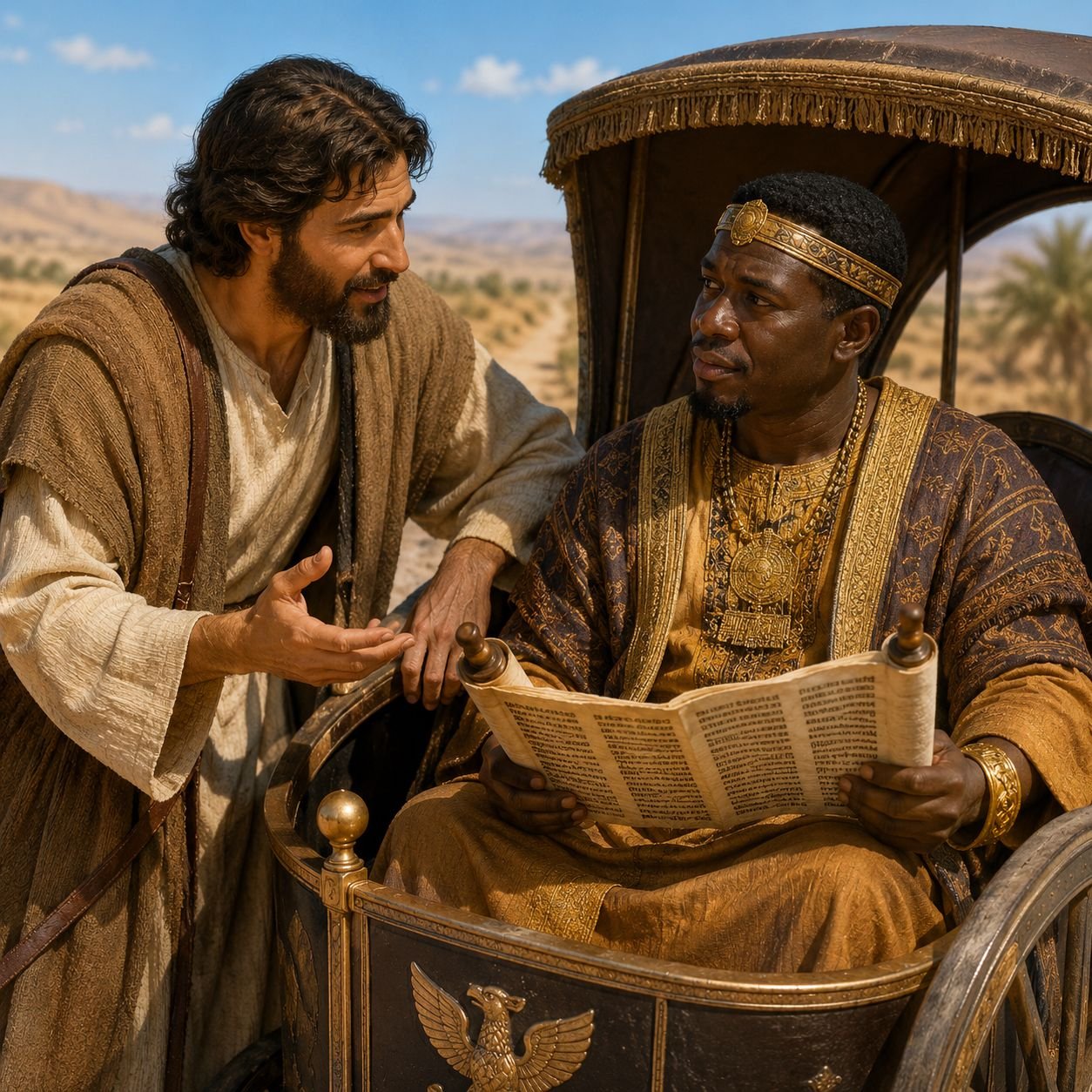
The same Spirit that fell like fire in Jerusalem now leads one ordinary believer toward one wounded soul sitting in a chariot on a desert road.
And what I love most is how Philip approaches him.
The Spirit says, “Go over to this chariot and join it.” And Philip runs!
- He does not hesitate.
- He does not avoid.
- He does not stay distant.
He comes near.
Then he hears the man reading Isaiah 53: “Like a sheep he was led to the slaughter…”
And Philip asks one of the most simple and compassionate questions in Scripture:
“Do you understand what you are reading?”
Philip doesn’t condemn him or confront him with pressure and make him feel like he is not worthy to know what he is reading, he simply offers a compassionate presence.
And the eunuch responds: “How can I, unless someone guides me?”
Honestly, I think many people around us are silently asking the same question. They are spiritually curious. Some are hurting or searching. People are carrying wounds and questions and loneliness.
But do you know what they don’t’ need? They do not need someone shouting at them from a distance. They need someone willing to come near enough to walk beside the chariot.
That is what Philip does.
Beginning with that very Scripture, he tells him the good news about Jesus. And somewhere along that desert road, the Gospel breaks open this man’s heart.
Then comes one of the most beautiful questions in Acts:
“Look, here is water! What is to prevent me from being baptized?”
Do you hear the emotion underneath that question?
What could keep someone like me from fully belonging?
And the answer of the Gospel is astonishing.
Nothing. Because In Christ, the barriers are falling.
The Gospel moves outward toward people who once believed they stood too far away.
The Gospel Still Moves Outward Through Ordinary Believers
I think sometimes we read stories like this and quietly assume they belong to another era.
A time of apostles and miracles and dramatic encounters.
But the truth is, Acts was never written merely to show us what God once did. It was written to show us what the Spirit continues to do through ordinary believers willing to listen and go.
Because Philip was not extraordinary in the way the world measures greatness.
He was simply available.
- Available enough to serve.
- Available enough to listen.
- Available enough to go where the Spirit led.
And because of that willingness, the Gospel crossed another border.
Church history tells us that the Ethiopian Church became one of the earliest Christian communities outside the Roman world. Which means this desert road encounter may have carried the Gospel farther into Africa than Philip himself ever realized.
Think about that, because of one conversation that was born out of an act of obedience and one ordinary believer listening to the Spirit.
We rarely understand the full impact of faithfulness in the moment.
And honestly, that should encourage every ordinary Christian sitting in a pew today.
Because many believers quietly assume they are not equipped enough, gifted enough, theological enough, or important enough to be used by God. We assume the Gospel moves outward through pastors, missionaries, evangelists, or famous Christian leaders.
But Pentecost says otherwise, it says that the Spirit empowers ordinary believers.
Ordinary people who serve quietly, listen compassionately and are willing to notice those at the edges. People willing to walk alongside someone searching for hope.
The greatest challenge of this text is not whether the Spirit is still speaking, we know that he is; the greater question is whether we are willing to go where the Spirit sends us. Because there are still people sitting in metaphorical chariots all around us. Who just like the eunuch are carrying hidden loneliness, wondering if God could ever want someone like them and trying to understand Scripture. These are people searching for meaning and standing quietly at the edges wondering if grace could possibly include them too.
And often the Spirit’s answer comes through ordinary believers willing to come near.
Conclusion
When most people remember Pentecost, they remember the rushing wind and the tongues of fire. And those images matter because Pentecost truly was a moment of divine power unlike anything the world had ever seen.
But when you continue reading Acts, you begin to realize something beautiful, that eventually the sound of Pentecost became quieter. It sounded like footsteps on a desert road. Because the true miracle of Pentecost was never simply that crowds heard the Gospel in many languages.
The deeper miracle is that the Spirit keeps sending ordinary believers outward toward people who never expected grace would reach them too. And that is where this story meets us today.
Because every one of us is probably somewhere in this passage.
Some of us feel like Philip, sensing God nudging us toward conversations we feel nervous to have, toward people we might normally overlook, toward moments of obedience that seem small but may matter more than we realize.
And some of us feel more like the Ethiopian eunuch and are searching, questioning and wondering if we truly belong. Wondering if God’s grace could really include someone like us.
And the good news of Pentecost is this: The Gospel moves outward because the heart of God moves outward.
And through the power of the Holy Spirit, Christ still meets people on desert roads every single day.
Comments are closed