Acts 9:1–19
Most people who are spiritually blind do not realize they are blind.
That is part of what makes blindness so dangerous. We tend to imagine blindness as something obvious, something unmistakable, something a person would immediately recognize within themselves. But often the deepest blind spots are the ones we have learned to live with so comfortably that they simply feel normal. We adjust to them. Build confidence around them. Defend them. Eventually we stop questioning whether we are seeing clearly at all.
That is what makes Saul’s story so unsettling.
Because before Saul became Paul, before he planted churches across the Roman Empire and wrote letters that would shape the New Testament, he believed with complete confidence that he was serving God faithfully. He was not spiritually careless. He was not indifferent toward Scripture. He was not wandering far from religion.
In many ways, Saul was exactly the kind of young man religious leaders hoped to produce.
He was disciplined, educated, respected, and trusted. He knew Scripture deeply. He defended tradition passionately. He pursued holiness seriously. The Sanhedrin trusted him enough to place authority in his hands. He traveled toward Damascus carrying permission from the high priest himself to arrest followers of Jesus and bring them back to Jerusalem in chains.
And yet the man most certain he was honoring God was actually resisting the very Messiah God had sent.
That tension sits at the center of Acts 9.
Because Saul’s story forces us to wrestle with a difficult possibility. A person can know Scripture and still miss Christ. A person can be religious and still spiritually blind. A person can defend truth while resisting what God is doing right in front of them.
And perhaps that is why Saul’s story still speaks so powerfully to the church today. Saul’s blindness did not come from ignorance. It came from certainty. He believed he understood God correctly. He believed he saw clearly. He believed he was protecting truth itself.
But on a dusty road outside Damascus, Saul discovers something that changes his life forever.
- A person can be sincere and still be wrong.
- A person can be passionate and still be blind.
- A person can spend years convinced they are moving toward God while actually moving in the opposite direction.
And in one blinding moment, Saul’s certainty collides with Jesus Himself.
Blindness Hidden Behind Certainty
Luke tells us that Saul was “breathing threats and murder against the disciples of the Lord.” Hatred had become the atmosphere surrounding his life. He was traveling toward Damascus carrying authority from the high priest himself, prepared to arrest followers of Jesus and drag them back to Jerusalem in chains.
Saul was not some unstable extremist operating outside respectable society. He was the future of it.
This was a man trained under Gamaliel, one of the most respected rabbis in Judaism. Saul likely memorized large portions of Scripture from an early age. He understood the Law, the prophets, oral tradition, and theological debate at a level most ordinary people never could. He was also a Roman citizen by birth, something extraordinarily rare for a Jewish man. That citizenship gave him privilege, influence, mobility, and legal protection throughout the empire.
Saul lived in two worlds at once. He understood Jewish theology deeply while also navigating Roman society fluently. Years later, God would use every piece of Saul’s background. His education, his language skills, his understanding of Roman culture, even his citizenship itself would all become tools for spreading the Gospel across the world.
But before Christ opened Saul’s eyes, he used those same gifts against the church.
That is part of what makes Saul’s story so complicated. He was not driven by laziness. He was not careless with Scripture. He was not someone rejecting religion altogether. Saul genuinely believed he was honoring God. From his perspective, Christianity threatened everything faithful Jews had spent generations protecting.
The followers of Jesus were proclaiming a crucified Messiah. To many Jewish leaders, that sounded impossible, offensive, even blasphemous. Rome crucified criminals, rebels, and enemies of the state. How could the promised deliverer of Israel possibly die on a Roman cross? Saul heard the claims about Jesus and believed they threatened the holiness of God’s people, so he fought the church because he believed he was defending truth itself.
And that is what makes spiritual blindness so dangerous.
A person can be sincere and still be wrong.
In Philippians 3, Paul later looks back on his former life and describes the credentials that once gave him confidence. He had done everything expected of a faithful Jewish man. He belonged to the right lineage, followed the law carefully, pursued righteousness seriously, and carried a level of zeal few could rival. If righteousness could have been achieved through discipline, knowledge, and religious devotion, Saul had already reached the summit.
And yet for all his learning, he still could not see Jesus.
Saul could quote the prophets while persecuting the very Savior they pointed toward.
The tragedy was not that Saul ignored Scripture. The tragedy was that he knew Scripture while resisting the One Scripture revealed.
He knew the stories of Abraham, Moses, David, and Isaiah. He knew the promises of a coming Messiah. He understood the language of covenant, holiness, righteousness, and redemption. He had likely spent years studying passages we now immediately connect to Christ.
Yet when Jesus came, Saul could not recognize Him.
Not because Saul lacked intelligence.
Because knowledge alone cannot produce spiritual sight.
And perhaps that is why this story still presses so deeply against the church today. Because it reminds us that a person can know a great deal about God while still remaining spiritually blind. A person can know Bible stories while pride quietly settles into the heart. A person can spend years defending truth while slowly losing compassion. Sometimes people become so committed to protecting their understanding of God that they no longer remain open to the voice of God Himself.
And if we are honest, most of us know how easy it is to slip into that kind of certainty.
We assume we already understand. We stop examining our hearts honestly. Correction begins to feel threatening instead of healing. Conviction feels offensive instead of loving. Over time we stop listening carefully because we have become convinced we already see clearly enough.
That kind of certainty can slowly harden the soul.
It can make us defensive when God is trying to correct us. It can make us resistant when the Spirit is trying to lead us somewhere new. Sometimes we become so focused on preserving our comfort, our assumptions, our traditions, or our pride that we stop asking whether Christ is still shaping us at all.
Saul was certain he understood righteousness. Certain he understood faithfulness. Certain he understood who God was blessing and who God was rejecting. Yet the very certainty he trusted most became the thing preventing him from seeing clearly.
And that tension reaches much closer to home than most of us would like to admit.
Because spiritual blindness rarely looks obvious from the inside.
It usually feels justified.
People rarely wake up one morning intending to become hardened or prideful. More often it happens slowly. We carry hurt long enough that bitterness begins feeling reasonable. We repeat assumptions long enough that they begin sounding unquestionable. We become so convinced we are right that humility quietly disappears from the conversation altogether.
That is why Saul’s story matters so deeply to the church.
Because Saul was not far from religion.
He was immersed in it.
- He knew the prayers.
- He knew the traditions.
- He knew the Scriptures.
- He knew the expectations.
And still he could not recognize Jesus standing directly in front of him. The frightening part of Acts 9 is not simply that Saul was blind, it is that he did not know he was blind.
He believed his blindness was clarity. He believed his anger was righteousness. He believed his violence was faithfulness. He believed his certainty proved his devotion to God. And all the while, he was moving further and further away from the very Messiah he claimed to serve.
That is why Acts 9 becomes more than Saul’s story.
It becomes a mirror.
Because eventually every believer must wrestle honestly with the same question:
Are there places where I have become so certain of myself that I can no longer hear God clearly anymore?
When Christ Interrupts Our False Vision
Then suddenly, on the road outside Damascus, everything changes.
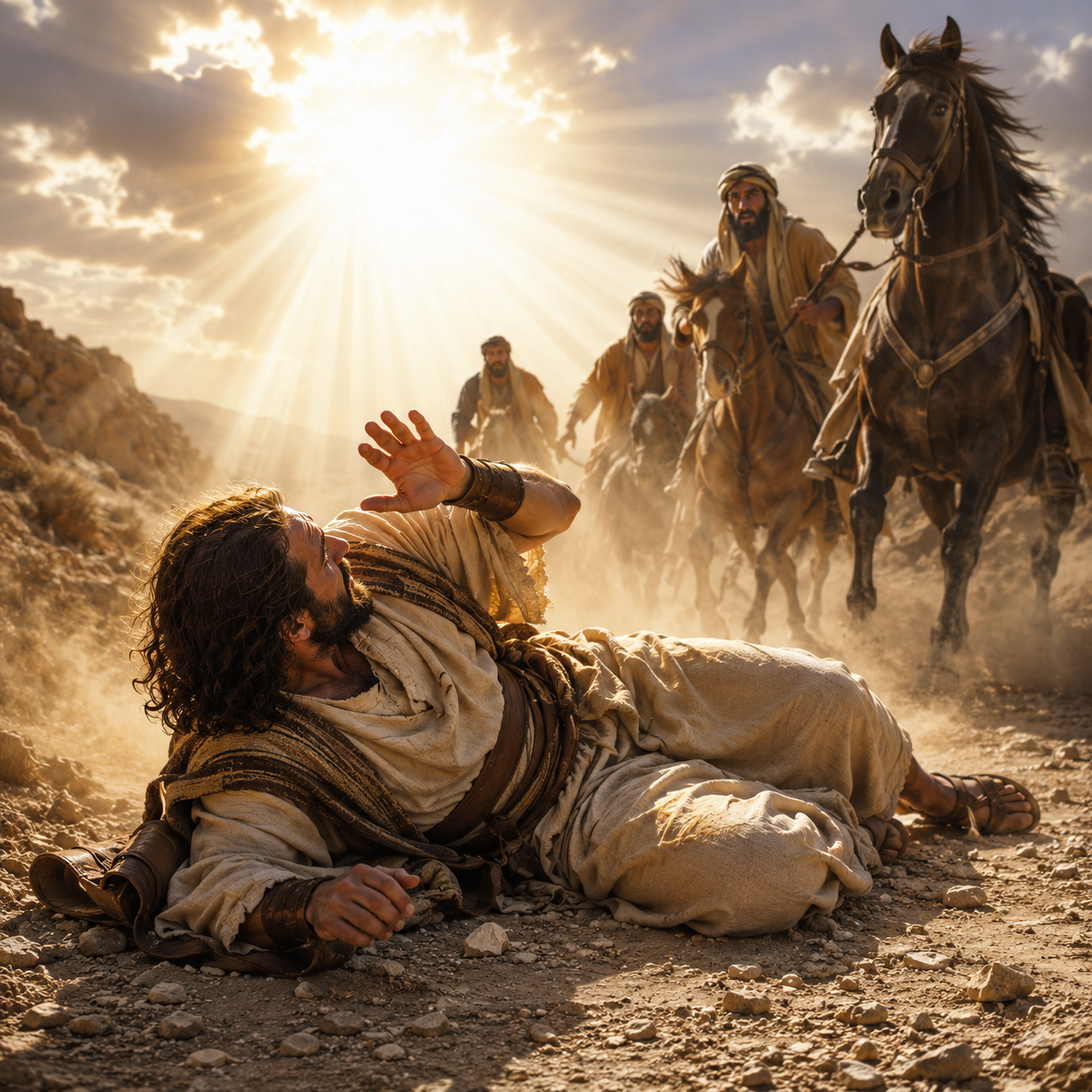
Acts tells us that a light from heaven flashed around Saul, and immediately he fell to the ground. One moment he is traveling confidently toward Damascus carrying authority from the high priest, convinced he is serving God faithfully, and the next moment he is lying helpless in the dust, overwhelmed by something he cannot explain or control.
Then he hears the voice:
“Saul, Saul, why do you persecute Me?”
Everything about that question begins unraveling the world Saul thought he understood. Jesus does not ask, “Why are you persecuting My followers?” He asks, “Why do you persecute Me?” Christ identifies Himself so closely with His people that their suffering becomes His own. The church Saul hated was not abandoned by God. The believers he imprisoned were not standing alone. The risen Christ Himself stood with them.
And in that moment Saul realizes the horrifying truth that changes everything. The Jesus he believed he was defending God against is actually the Lord Himself.
Every certainty he carried begins collapsing at once. The Messiah he rejected is alive. The movement he tried to destroy belongs to God. The righteousness he trusted cannot save him. The confidence that once made him feel strong suddenly leaves him empty and exposed before Christ.
Then comes one of the great ironies in all of Scripture.
The man who believed he saw clearly becomes blind.
Acts says Saul opened his eyes, but he could see nothing. The Pharisee who arrived with confidence and authority must now be led by the hand into Damascus. The man who believed he was leading others spiritually cannot even walk into the city alone.
The image itself carries enormous weight. Saul entered that road certain of himself. Certain of his righteousness. Certain of his understanding of God. Yet when the encounter is over, the powerful persecutor must depend entirely upon others simply to move forward one step at a time.
And perhaps that is part of why this moment feels so deeply personal to so many people. Because Saul’s blindness is not random. It becomes an outward picture of what had already been true inside him spiritually. For years Saul believed he understood God clearly while remaining blind to the very work God was doing through Christ. Then suddenly the blindness living quietly within his heart becomes impossible for him to ignore anymore.
For three days Saul sits in darkness. No food. No sight. No certainty left to cling to. The man who once moved through life with relentless confidence now sits alone with his thoughts, replaying the voice from the road over and over again in his mind.
“Saul, Saul, why do you persecute Me?”
And Luke is very intentional about that number. Three days. Long enough for the early church to hear echoes of another story.
- Three days in darkness.
- Three days between the collapse of the old and the arrival of something entirely new.
- Three days between death of an old life and the birth of a new life.
Saul is not simply changing his opinion about Jesus. The old Saul is dying.
- The certainty he trusted is dying.
- The identity he built is dying.
- The righteousness he depended upon is dying.
And like the disciples after Good Friday, Saul now sits in a place where everything he thought he understood has fallen apart.
The road to Damascus was not simply a conversion experience which is how many of us have learned it. At it’s core it was death and resurrection unfolding inside a human heart.
It is the collapse of an entire way of seeing. The categories Saul trusted no longer work. The assumptions he built his life upon no longer hold together. Everything he thought made him righteous suddenly feels painfully insufficient standing before the living Christ.
Sometimes that is how grace begins.
Not always through comfort, but through interruption. Through moments when Christ lovingly confronts the things we have spent years trusting too heavily. Through moments when our certainty begins breaking apart and we finally realize how much of our lives has been shaped by pride, fear, self reliance, or the desperate need to remain in control.
Most people do not naturally welcome those moments. We prefer clarity. We prefer confidence. We prefer believing we already understand ourselves and God correctly. Yet some of the most transformative moments in life happen when Christ exposes the limits of our own vision. That exposure often feels disorienting before it feels healing.
Saul experiences that disorientation fully. The man who once believed he could judge who belonged to God and who did not now sits helpless and blind, unable to move forward the way he once did. The certainty that once made him powerful now leaves him broken open before Christ.
Even the men traveling with Saul reveal something important in this story. Acts tells us they saw the light and heard the sound. They knew something extraordinary had happened, yet only Saul was transformed by the encounter. Everyone on that road experienced the event, but Saul experienced surrender.
And perhaps that detail matters because exposure to spiritual things is not the same as transformation. A person can sit in church for years without allowing Christ to truly reshape the heart. A person can hear sermons, sing hymns, attend Bible studies, and still resist the deeper work of surrender happening underneath the surface.
Saul knew religion long before Damascus.
What he did not know was Christ.
Then Jesus met him on the road and exposed the blindness Saul had spent his entire life mistaking for clarity.
And perhaps one of the most gracious things Christ still does for us today is refuse to leave us comfortably blind. Because before Christ redirects Saul’s life, He first dismantles Saul’s certainty. Before Saul can become a messenger of grace, he must first understand his own desperate need for it.
And before any of us can truly see Christ clearly, we often must first come face to face with the limits of our own vision.
Grace Gives Saul New Sight
While Saul sits blind in Damascus, the story shifts to a disciple named Ananias.
The Lord speaks to him in a vision and tells him exactly where Saul is staying. “Get up and go to the street called Straight,” the Lord says, “and at the house of Judas look for a man of Tarsus named Saul.” The instruction is specific, direct, and deeply unsettling because Ananias already knows exactly who Saul is.
The church had heard the stories.
Families feared his name. Believers whispered carefully when speaking about him. Saul represented religious authority, political influence, imprisonment, and violence. He had entered Damascus with legal authority to arrest Christians and drag them back to Jerusalem in chains. To the believers in Damascus, Saul was not misunderstood. He was dangerous.
So when the Lord tells Ananias to go to him, Ananias responds honestly.
“Lord, I have heard from many about this man, how much evil he has done to Your saints in Jerusalem.”
There is something deeply human about that response. Ananias does not pretend the fear is not real. He does not immediately sound courageous or heroic. He simply tells the truth. Saul has hurt people. Saul has terrified the church. Saul has come here with authority to do it again.
Everything Ananias fears is completely understandable.
Yet God responds with words that completely reframe Saul’s future:
“He is a chosen instrument of Mine.”
In a single sentence, the Lord speaks about Saul differently than anyone else around him.
The church knew Saul by his worst actions, but God already knew him by his calling.
Where others saw danger, God saw purpose. Where others saw an enemy, God saw a messenger. Where others saw someone beyond redemption, God saw a life grace was already beginning to transform.
And perhaps that is one of the most beautiful things about this story. God sees people not only for who they have been, but for who grace can still make them become.
The believers in Damascus could only see Saul’s past. Christ could already see Saul preaching the Gospel, planting churches, writing letters, and carrying the message of salvation across the Roman world. The church saw the persecutor. Jesus already saw the apostle.
Eventually Ananias obeys.
He walks into the house where Saul is staying and places his hands upon the same man who once came to arrest believers like him. Then Ananias speaks two words that must have felt astonishing in that room:
“Brother Saul.”
Not enemy.
Not persecutor.
Not threat.
Brother.
Before Saul has preached a sermon, before he has proven himself trustworthy, before he has done anything to rebuild his reputation, grace has already begun rewriting his identity.
And that is the Gospel.
Christ does not wait for Saul to earn restoration before extending mercy to him. The transformation has already begun because Jesus Himself has intervened. Saul’s standing before God is no longer defined by his past violence, his pride, or his failures. Christ has claimed him.
Then Acts tells us that something like scales fell from Saul’s eyes, and immediately he regained his sight.
The image is powerful because Saul does not merely recover physical vision. He begins seeing clearly for the first time in his life. The man who once viewed Christians as enemies now sees them as brothers and sisters. The man who once viewed Jesus as a threat now sees Him as Lord. The man who once trusted his own righteousness now understands his desperate need for grace.
And what makes Saul’s transformation so remarkable is that God does not erase his past education, personality, or experiences. Instead, Christ redirects them. Saul’s knowledge of Scripture now helps him preach Jesus. His understanding of Roman culture helps him carry the Gospel into Gentile cities. Even his Roman citizenship eventually becomes part of how God protects and positions him for ministry.
The very things Saul once used against the church become tools Christ now uses for the Kingdom.
Years later, the same man who once treasured his religious credentials would write these words in Philippians:
“Whatever gains I had, these I have come to regard as loss because of Christ.”
Saul’s entire understanding of righteousness changes after meeting Jesus. The status he once prized no longer defines him. The certainty he once trusted no longer holds the same power over his life. Everything is now measured against knowing Christ.
Tradition tells us Paul would eventually die as a martyr under Roman persecution. The Roman citizenship that once elevated his social standing could not ultimately shield him from suffering for Christ. Yet by then Paul understood something he could not see before Damascus.
Following Jesus was never about protecting his status it was about surrendering his life.
And perhaps that is one of the clearest signs that Christ has truly opened someone’s eyes. The center of life begins shifting away from self and toward Him. Pride slowly gives way to humility. Certainty gives way to dependence. Religion gives way to relationship.
Saul entered Damascus blind, broken, and stripped of everything he once trusted.
He leaves Damascus seeing clearly for the very first time.
Conclusion
Acts 9 leaves us with a question that reaches far beyond Saul himself.
Are we spiritually blind in places we have not recognized yet?
Are there assumptions we have stopped questioning? Places where pride has quietly shaped our vision? Places where certainty has replaced humility? Places where we know about God while resisting what He is trying to do within us?
Because spiritual blindness rarely feels like blindness while we are inside it.
Saul thought he saw clearly right up until the moment Christ met him on the road.
And perhaps that is why this story still carries so much weight for the church today. Because it reminds us that a person can be deeply religious while still needing transformation. A person can know Scripture and still need surrender. A person can spend years convinced they are moving toward God while actually moving in the wrong direction.
But Acts 9 is not ultimately a story about Saul’s failure.
It is a story about Christ’s mercy.
Jesus did not meet Saul on the Damascus Road to destroy him. He met him there to save him.
The same man who had terrified Christians would eventually strengthen them.
The same man who once entered cities carrying arrest warrants would later enter cities carrying the Gospel.
The same man who once tried to silence the name of Jesus would eventually spend the rest of his life proclaiming it.
And all of it began with Christ opening his eyes.
That is why Saul’s story gives hope to every person who feels too far gone, too proud, too broken, too ashamed, or too lost for God to redeem.
Because if grace could transform Saul, grace can transform anyone.
But this story also asks something personal of us.
Not simply whether other people are spiritually blind.
Whether we are.
Sometimes we become blind to our own pride.
Blind to bitterness we have carried for years.
Blind to the ways fear shapes our decisions.
Blind to the people around us who are hurting because we have become too distracted or too comfortable to notice them anymore.
Sometimes spiritual blindness develops quietly over time. We stop listening carefully. Stop examining our hearts honestly. Stop asking God to search us because we assume we already see clearly enough.
Saul thought the same thing.
Then Christ met him on the road.
And perhaps one of the greatest acts of grace in our lives is when Jesus refuses to leave us comfortably blind.
Because the goal of grace is not simply to make us religious. The goal of grace is to bring us into true relationship with Christ Himself.
Jesus still opens eyes.
He still interrupts lives headed in the wrong direction.
He still transforms people no one expected Him to use.
He still meets proud hearts with grace.
And sometimes the first miracle He performs is helping us finally see clearly again.
Comments are closed