Matthew 3:1-12
In 1939, King George VI and Queen Elizabeth made a historic visit to North America. It was the first time a reigning British monarch had ever visited either Canada or the United States. Long before their ship arrived, preparations were already underway. Cities planned parade routes. Streets were decorated. Crowds gathered along miles of roadways hoping to catch even a brief glimpse of the royal procession. Red carpets were laid. Government officials coordinated every detail. At Hyde Park, even the Roosevelt family prepared their home for the King’s arrival. Months of preparation went into a visit that would last only a few days.
What fascinates me about stories like that is that the preparations were never really about the roads, the decorations, or the ceremonies. They were about recognition. People understood who was coming.
Nobody would have said, “Why are we making such a fuss?” The answer was obvious. The King was coming.
Throughout history, that has been true whenever a king was expected. Roads were repaired. Cities were cleaned. Messengers were sent ahead. Preparations were made. The greater the king, the greater the preparation.
When we come to Matthew chapter 3, that is exactly the image Matthew wants us to see.
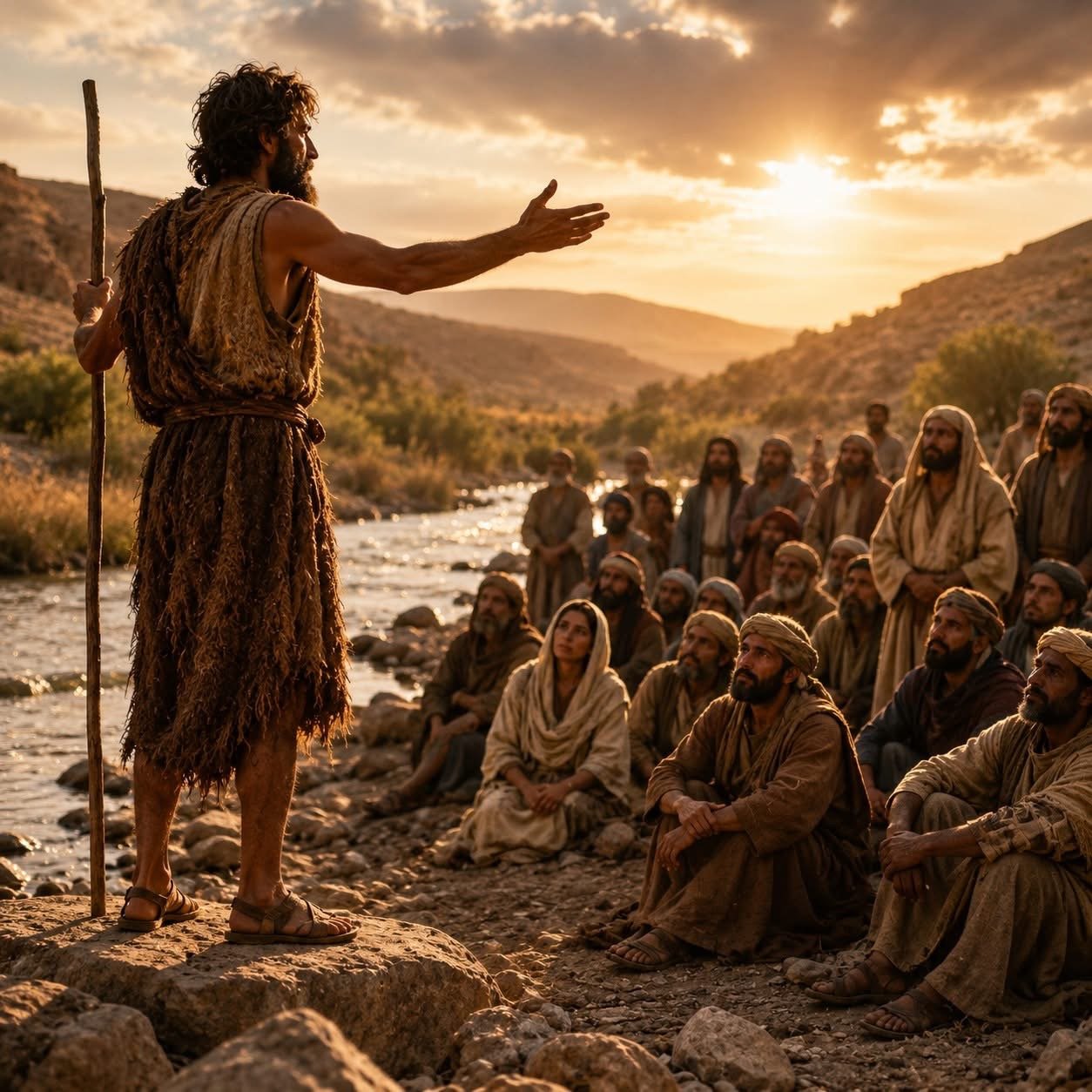
John the Baptist appears in the wilderness announcing that the King is coming.
Yet this King is unlike any king the world has ever known.
· His kingdom will not be built through armies.
· His throne will eventually be a cross.
· His crown will be made of thorns.
And the preparation He seeks is not found in roads, buildings, or ceremonies. He is preparing hearts.
For four hundred years God’s people had waited. The final words of the Old Testament had promised that Elijah would come before the great day of the Lord. Then generation after generation passed in silence. No prophets. No new revelation. No voice from God. Many wondered if the promises had been forgotten.
Then one day, out in the wilderness, a voice began to cry out once again.
“Prepare the way of the Lord.”
The silence was ending, the King was near and God was preparing His people for what He was about to do.
God Was Preparing Long Before Anyone Realized It
One of the most difficult experiences in the life of faith is waiting when we cannot see what God is doing.
Most of us do not struggle to trust God when the answers are obvious. We struggle when the prayers seem unanswered. We struggle when the circumstances remain unchanged. We struggle when the future feels uncertain and heaven appears quiet.
I imagine that must have been how many in Israel felt during the centuries before John the Baptist appeared.
The last prophet they had heard was Malachi. The final words of the Old Testament contained both a promise and a hope. God declared that before the great day of the Lord arrived, He would send Elijah. Then the prophetic voice fell silent.
· Years passed.
· Then decades.
· Then centuries.
Children grew up hearing the stories of Abraham, Moses, David, Isaiah, and Elijah, yet no new prophet appeared among them. Grandparents told their grandchildren about God’s promises, and still they waited. Entire generations lived and died without hearing a fresh word from the Lord.
From a human perspective, it must have felt as though nothing was happening.
Yet Scripture repeatedly teaches us that God is often accomplishing His greatest work in seasons that appear uneventful to us. While Joseph sat in an Egyptian prison, God was preparing the salvation of Jacob’s family. While Ruth gathered grain in the fields of Bethlehem, God was preparing a family line that would one day lead to David. While Israel languished in exile, God was preparing a return home.
Again and again, God’s people discover that what looked like inactivity was actually preparation.
Then one day, the silence ended.
· Not in Jerusalem.
· Not in the Temple.
· Not among the religious leaders.
Out in the wilderness a voice began calling people to come and listen.
Matthew describes John in a way that almost seems unnecessary to modern readers. He tells us that John wore clothing made of camel’s hair with a leather belt around his waist. We might read those words and simply picture a strange wilderness preacher. Matthew’s first readers would have seen something else entirely.
They would have remembered Elijah.
The description is too familiar to ignore.
It is as if Matthew is quietly nudging his readers and saying, “Do you see it? Do you remember the promise?”
For four hundred years God’s people had been waiting for the prophet Malachi spoke about. For four hundred years they had wondered when God would act. For four hundred years they had waited for the next chapter of the story.
And now, standing in the wilderness, was a man who looked remarkably like Elijah and sounded remarkably like Elijah. To the people of Israel this told them that their period of waiting was ending and God’s promises were moving toward fulfillment. God who seemed silent had never stopped working.
I think there is comfort in that for us because most of us spend far more time in preparation than we do in fulfillment. We celebrate the moments when God answers the prayer, opens the door, heals the relationship, provides the opportunity, or reveals the next step. Yet those moments are often preceded by months or years when we cannot see what He is doing.
The people who traveled into the wilderness to hear John could not yet see the cross. And if they could not see the empty tomb, they certainly could not see Pentecost or the Church spreading throughout the world. All they could see was a prophet standing in the wilderness.
What they did not yet understand was that God had been arranging this moment for generations.
And perhaps that is the first lesson John teaches us. God’s preparation often begins long before we recognize it. The silence does not mean God has forgotten and a season of waiting does not mean God is absent. Sometimes the very season that feels uneventful is the season in which God is laying the foundation for what comes next.
For four hundred years God was preparing His people for the arrival of the King.
And when the time was right, the voice of Elijah was heard once again.
The Invitation to Turn
When the crowds gathered around John in the wilderness, his message was remarkably simple:
“Repent, for the kingdom of heaven has come near.”
Those words are familiar enough that we can almost hear them without really hearing them. We know the word “repent.” We have heard it in sermons. We have read it in Scripture. Yet the word often carries baggage that Matthew never intended.
For many people, repentance sounds like guilt. It sounds like condemnation. It sounds like someone standing over us reminding us of our failures. Yet when John preached repentance, he was not announcing bad news. He was announcing that God was drawing near.
The word Matthew uses is the Greek word metanoia. At its simplest, it means a change of mind. Yet in Scripture it describes something deeper than simply changing an opinion. It is a change of heart and mind so profound that it changes the direction of a person’s life.
Repentance is not merely feeling sorry, repentance is turning.
As I thought about the preparations that cities made for the arrival of a king, I found myself imagining something almost absurd. Imagine standing along the parade route for hours waiting for the royal procession to arrive. The streets are lined with people. The excitement builds and the crowd begins to cheer. Why? Because the king is passing by. Yet through the entire event, you are facing the wrong direction. You are physically present. You are standing exactly where you are supposed to be. Yet you miss the arrival because your attention is fixed somewhere else.
The problem was not that the king failed to come.
The problem was that you were looking the wrong way.
In many ways, that is the picture John gives us of repentance. Repentance is turning our hearts toward what God is doing. It is reorienting our lives toward the God who is already drawing near.
The prophet Isaiah captures this beautifully when he writes:
“Seek the Lord while he may be found; call upon him while he is near; let the wicked forsake their way, and the unrighteous their thoughts; let them return to the Lord.” (Isaiah 55:6-7)
Notice how Isaiah describes repentance. It is not merely abandoning something. It is returning to Someone.
That is why repentance is ultimately good news.
John was not standing in the wilderness declaring that God was moving away from His people. He was announcing that the kingdom of heaven had come near. The Messiah was near. The promises of God were unfolding before their eyes. God was acting, and because God was drawing near, His people were invited to turn toward Him.
That invitation remains just as relevant today as it was beside the Jordan River.
Certainly, repentance does involve confessing sin. There are moments when we need to acknowledge attitudes, actions, or habits that have drawn us away from God. Scripture never minimizes that reality.
Repentance takes the confession and turns it into an action of restoration.
· Sometimes repentance means turning away from fear and toward trust.
· Sometimes it means turning away from bitterness and toward forgiveness.
· Sometimes it means turning away from self-sufficiency and toward dependence on God.
· Sometimes it means turning away from old assumptions so we can see where Christ is leading us next.
Because the Christian life is not a single turn made long ago. It is a lifelong practice of continually reorienting ourselves toward the God who is always calling us deeper. For someone who is just beginning to explore faith, repentance may be the first turning toward Christ. For someone who has walked with Christ for fifty years, repentance may be the hundredth turning toward Him.
That is what John was doing in the wilderness. He was not simply gathering crowds or administering baptisms. He was helping people turn their hearts toward God so that when the King arrived, they would be ready to recognize Him.
Just like the Jewish people all those years ago, when we read Matthew 3, John the Baptist is still asking us the same questions. Where is God calling us to turn? What is keeping us from seeing what He is doing? What fear, what habit, what assumption, what distraction has captured our attention?
Because the good news of repentance is not that God is waiting for us to find Him. The good news is that God has already drawn near, and He lovingly invites us to turn and face Him.
When We Stop Turning
“But when he saw many of the Pharisees and Sadducees coming for his baptism, he said to them, “You brood of vipers! Who warned you to flee from the coming wrath? and do not presume to say to yourselves, ‘We have Abraham as our ancestor,’ for I tell you, God is able from these stones to raise up children to Abraham. Even now the ax is lying at the root of the trees; therefore every tree that does not bear good fruit will be cut down and thrown into the fire.”
Matthew 3:7, 9-10 NRSVUE
As Matthew continues the story, a different group begins to emerge from the crowd. Along with the ordinary people who were traveling into the wilderness to hear John preach, Matthew tells us that Pharisees and Sadducees also came to the Jordan River.
Most of us have heard enough sermons to immediately assume we know their role in this part of the story. We know the Pharisees will eventually oppose Jesus. We know they will become some of His strongest critics. We know how the story ends. Yet standing beside the Jordan River, none of that has happened yet.
What strikes me is that they came. At this point in the story of the coming Messiah, neither John the Baptist nor Jesus were a threat to them. They came to find out if this was another prophet sent by God and if the years of silence were finally over.
They heard about John and made the journey into the wilderness just as everyone else did. They stood near the water and listened to the same message everyone else heard. They were present for the same moment of preparation. Yet John immediately senses something is different.
At first, his response almost feels jarring. After speaking to crowds of people who were confessing their sins and being baptized, he turns toward these religious leaders and says, “Bear fruit worthy of repentance.”
The more I have sat with those words this week, the more I have wondered if John’s concern was not that they were too religious, but that they had become too comfortable.
After all, these were people who knew the Scriptures. They knew the promises. They knew the stories of Abraham and Moses and David. They knew about Elijah. They knew about the coming Messiah. If anyone should have recognized what God was doing, it should have been them.
Yet John seems to recognize a danger that can quietly develop in every heart. It is the danger of believing we no longer need to turn.
That is why he warns them not to rely on their connection to Abraham. Their heritage was a gift, but it could not substitute for a living relationship with God. The faithfulness of previous generations could not replace their own response to the Lord.
As I thought about that this week, I realized how easy it is to understand their temptation.
There is something comforting about looking backward. We remember moments when God felt especially near. We remember seasons of growth. We remember prayers that were answered and lessons that were learned. Those memories become part of our testimony, and rightly so.
Yet there is a subtle difference between remembering what God has done and assuming there is nothing more for God to do. One leads to gratitude, the other can lead to complacency.
That is why repentance remains such an important part of the Christian life. Repentance is not something we leave behind once we become mature believers. In many ways, spiritual maturity deepens our capacity for repentance because the closer we walk with Christ, the more aware we become of the places where He is still shaping us.
A new believer may be learning to trust Christ for the very first time. A lifelong believer may be learning to trust Him in circumstances they have never faced before. One may be taking the first steps of faith while the other is taking the next steps of faith, but both are still being called forward.
· Both are still turning.
· Both are still growing.
· Both are still responding to the invitation of God.
I think that is what John understood as he stood beside the Jordan River. The goal was never simply to get people into the water. The goal was to prepare people to recognize the One who was coming after him.
The tragedy would not have been missing John’s sermon. The tragedy would have been standing in the very generation when God’s promises were being fulfilled and failing to recognize it because your heart had stopped turning toward Him.
Perhaps that is why repentance remains such a gift. It keeps our hearts soft. It keeps us attentive. It keeps us open to the possibility that God is still working, still speaking, still leading, and still inviting us deeper.
Whether we have followed Christ for fifty years or fifty days, the invitation remains the same, keep turning toward Him.
For the people who recognize the King are not the people who have arrived. They are the people who never stop following.
Conclusion
As we come to the end of Matthew’s account, I find myself thinking again about all the preparation that takes place before the arrival of a king.
When King George VI visited North America in 1939, cities spent months preparing for his arrival. Streets were decorated, parade routes were mapped out, and thousands of people gathered in anticipation, all because they understood the significance of the moment. Everywhere the king was expected to travel, preparations were made ahead of time because people wanted everything to be ready when he finally arrived.
That is exactly what John was doing beside the Jordan River. He was preparing people for the arrival of the King.
Yet unlike earthly kings, Jesus was not looking for repaired roads, decorated streets, or carefully organized ceremonies. He was preparing hearts. That is why John’s message was so simple and yet so profound: “Repent, for the kingdom of heaven has come near.”
Over the years, many people have come to think of repentance as a harsh word. It sounds uncomfortable. It sounds like criticism. It sounds like something we would rather avoid. Yet when we listen carefully to John’s message, we discover that repentance is actually one of God’s greatest gifts.
Repentance is what happens when God loves us too much to leave us where we are. It is His invitation to stop walking away from Him and begin walking toward Him. It is not God pushing us away because we have failed. It is God drawing us closer because He has not given up on us.
That was true for the crowds standing beside the Jordan River, and it remains true for us today.
As I look around this sanctuary, I know that every person here comes with a different story. Some have followed Christ for many years and have witnessed His faithfulness through joys and sorrows, victories and disappointments. Others are still exploring what faith means and what it might look like to trust Christ with their lives. Yet regardless of where we find ourselves on that journey, the invitation of repentance remains the same.
For some, it may involve confronting a sin that has quietly taken root in the heart. For others, it may mean releasing a fear that has become more influential than faith. For some, it may involve extending forgiveness that has been withheld for far too long. For others, it may mean surrendering the illusion that we can manage life on our own without God’s help.
The circumstances are different, but the movement is always the same. Repentance is turning toward God.
The people who gathered around John could not yet see everything God was doing. They could not see the cross. They could not see the empty tomb. They could not see the coming of the Holy Spirit or the birth of the Church. What they could see was a prophet standing in the wilderness proclaiming that God was near.
Every generation faces the same choice. Will we continue facing our fears, our assumptions, our distractions, and our own understanding of how life should unfold or will we turn toward the God who has drawn near to us in Jesus Christ? Will we trust the One who keeps His promises even when we cannot yet see how the story will unfold?
John’s message has endured for two thousand years because it continues to speak to every human heart. The kingdom of heaven has come near. The King has arrived. And the invitation remains open to all who are willing to turn and follow Him.
Comments are closed