August on the Eastern Shore has a rhythm all its own. The roads are fuller than they have been all year. Restaurants are bustling from morning until long after the sun goes down. Businesses are serving the final weeks of what has often been months of preparation, while farmers are watching the weather and the fields with careful attention as harvest draws near. Families are trying to fit one more vacation into the calendar before school begins, children return to sports, and the routines of autumn quietly reclaim the days. Ask almost anyone how life is going this time of year, and the answer is usually the same: “Busy.”
There is nothing inherently wrong with being busy. Most of what fills our calendars are good things. Caring for a family is a good thing. Building a business is a good thing. Working the fields is a good thing. Investing in our communities is a good thing. God has never called His people to withdraw from ordinary life; in fact throughout scripture, faithful men and women served Him in the midst of farms, marketplaces, fishing boats, workshops, homes, and places of business. The problem is rarely that our lives become filled with bad things. More often, they become so filled with good things that we slowly lose sight of the greatest thing.
That is precisely where Jesus meets us in today’s Gospel. At first glance, the Parable of the Wedding Banquet appears to be a story about invitations, but as we linger in the story we begin to realize that it is really about priorities, allegiances, and the subtle ways ordinary responsibilities can crowd out the voice of God in our lives. We are going to see the people Jesus describes are not notorious sinners. They are people with farms to tend, businesses to run, and schedules to keep. They are, in many ways, people very much like us.
Yet hidden within this familiar story is a question that refuses to let us remain comfortable. It is not simply whether we have ever received the King’s invitation, nor even whether we once accepted it. The question Jesus gently places before every disciple is far more personal and far more present: Are we accepting the invitation? Because every time the King calls, each of us must decide whether our lives are arranged around His kingdom, or whether His invitation will simply have to wait until we have finished everything else we have decided is more important.
The Invitation Had Already Been Accepted
“The kingdom of heaven may be compared to a king who gave a wedding banquet for his son. He sent his slaves to call those who had been invited to the wedding banquet, but they would not come.”
Matthew 22:2–3
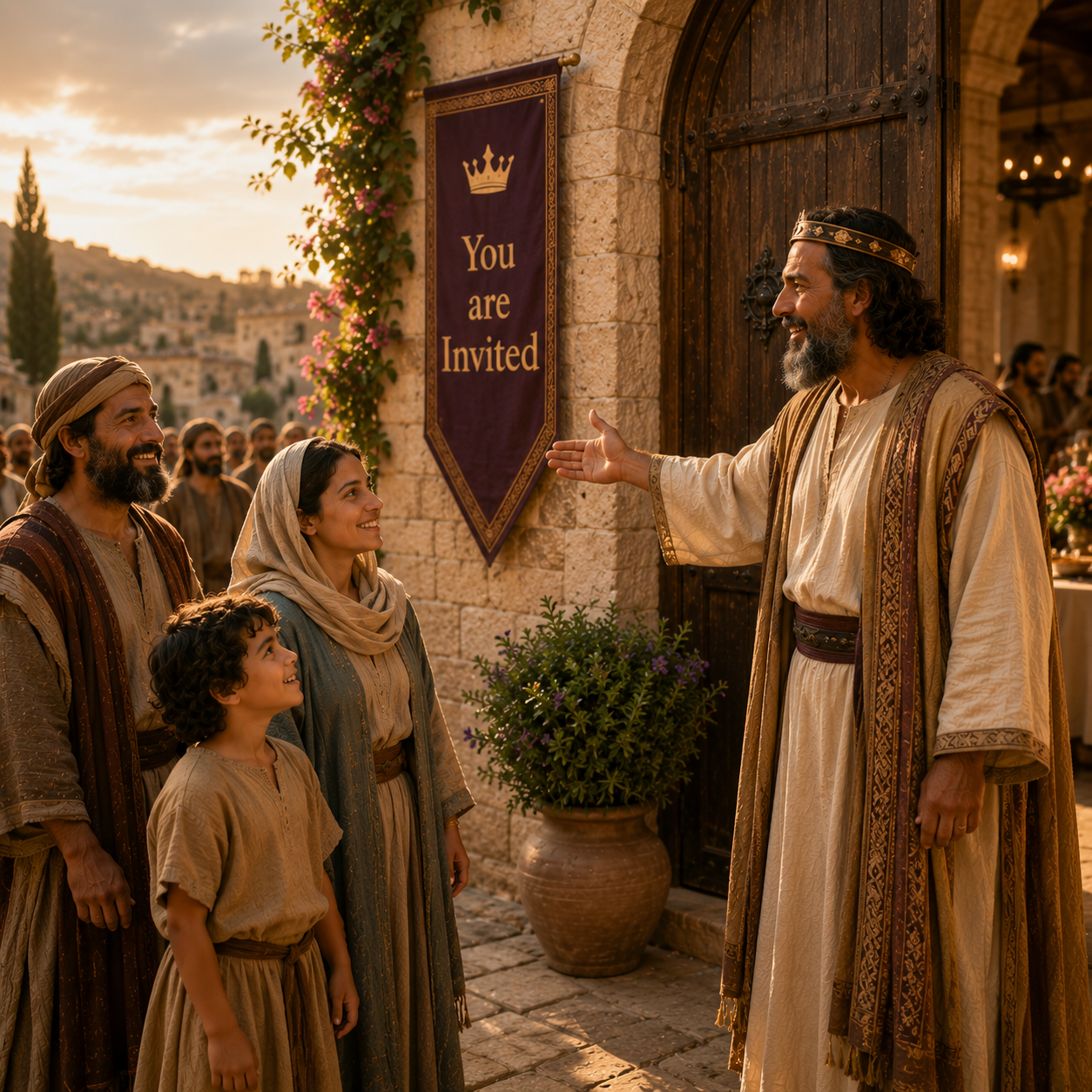
Jesus begins with an image that would have stirred the imagination of everyone listening. A king is preparing a wedding banquet for his son. This is not an ordinary family celebration but a royal feast, the kind of occasion people would remember for the rest of their lives. The finest food has been prepared, the musicians are ready, and the tables have been set. The palace is alive with anticipation because the day that has been planned for so long has finally arrived. Every detail has been carefully arranged, and now there is only one thing left for the king to do. He sends his servants to gather the guests.
At first, nothing about the story seems unusual. In fact, Jesus tells it in such a way that His listeners would naturally assume they already know how it will end. Of course the guests will come. Who would decline an invitation from the king? Who would willingly miss a celebration like this? Yet before we can answer those questions, it helps us to understand something about weddings in the ancient world that is easily missed today.
When we receive a wedding invitation, everything is already printed on the card. We know the date, the time, and the location. We simply decide whether we will attend and return our RSVP as appropriate. Royal weddings in the first century often unfolded differently because they took place in stages. The first invitation announced that the banquet was being prepared and asked the invited guests to commit themselves to attending. Once all the preparations had been completed, the king would send his servants again with what was less an invitation and more like a royal summons. The message was simple: “Everything is ready. Come to the banquet.”
That small historical detail changes the entire story. Matthew even hints at it in the language he chooses. He tells us that the king sent his servants “to call those who had been invited.” The verb is καλέω (kaleō), “to call” or “to invite,” but the grammar is even more revealing. The guests are described as people who already stood in the condition of having been invited. Matthew is reminding us that this is not the first invitation. The servants are not asking the guests whether they would like to come, they are announcing that the long-awaited day has finally arrived.
Imagine those servants as they leave the palace. They know what the king has invested in this celebration. They have watched the preparations unfold day after day. They know the feast is ready, the tables are waiting, and the king is eager to celebrate with those he has invited. As they walk from home to home, they are not wondering whether the guests will come. They expect smiles. They expect excitement. They expect families gathering their children and making their way toward the palace because this is the day everyone has been waiting for.
Instead, they hear words they never imagined they would hear. Matthew records them with remarkable simplicity: “But they would not come.” There is no lengthy explanation because none is needed. The silence surrounding those words is part of their weight. The king has already prepared everything. The feast is waiting. The sacrifice has already been made. Nothing more is required of the guests except to come and receive what has already been provided for them.
It is difficult not to hear the Gospel echoing through this scene. Long before we ever turned toward God, He had already moved toward us. Before we could earn His favor, Christ had already borne the cost of restoring our relationship with the Father. The cross was not God’s response to our faithfulness; it was the demonstration of His grace while we were still far from Him. Just as the banquet had already been prepared before the guests ever arrived, our salvation has been accomplished through the finished work of Jesus Christ. The invitation has never been, “Come and earn your place.” It has always been, “Everything is ready. Come.”
That is why the refusal in this parable is so heartbreaking. The guests are not rejecting an idea. They are turning away from a gift that has already been prepared at the king’s expense. They are refusing a joy they did not have to create, a feast they did not have to purchase, and a welcome they did not deserve. Before we ask why they refused, Jesus invites us to sit quietly with one question. How are we responding to the invitation we have already received? Every one of us has been met by the grace of God in Jesus Christ. The banquet has been prepared. The way has been opened. The King still says, “Everything is ready. Come.” The question that lingers over this opening scene is not whether the invitation has been extended, but whether we are responding when the King calls.
When the King Calls, What Are You Willing to Leave Behind?
4 Again he sent other slaves, saying, ‘Tell those who have been invited: Look, I have prepared my dinner, my oxen and my fat calves have been slaughtered, and everything is ready; come to the wedding banquet.’ 5 But they made light of it and went away, one to his farm, another to his business, 6 while the rest seized his slaves, mistreated them, and killed them. 7 The king was enraged. He sent his troops, destroyed those murderers, and burned their city. 8 Then he said to his slaves, ‘The wedding is ready, but those invited were not worthy. 9 Go therefore into the main streets, and invite everyone you find to the wedding banquet.’ 10 Those slaves went out into the streets and gathered all whom they found, both good and bad, so the wedding hall was filled with guests.
Matthew 22:4–10
The story could have ended with the king accepting the refusal of his invited guests, but instead Jesus reveals something extraordinary about the heart of the King. He sends more servants. Once again they carry the same gracious message: “Everything is ready. Come to the wedding banquet.” The meal has been prepared. The celebration is waiting. Nothing more needs to be accomplished before the guests arrive. The king has already done everything necessary for them to share in his joy. Before this parable ever confronts us with a warning, it first overwhelms us with grace. The King continues to pursue those who have stopped responding because His deepest desire is not an empty banquet hall but a house filled with joyful guests.
Matthew then describes the response with heartbreaking simplicity. “They made light of it.” Rather than treating the king’s invitation as the defining moment of their day, they treated it as though it could wait. One returned to his farm. Another went back to his business. Jesus could have described them pursuing sinful or immoral lives, but He deliberately chose examples that were entirely ordinary. Farming was an honorable vocation. Running a business was an honorable vocation. The tragedy is not that they chose evil over good. The tragedy is that good things quietly became greater things. They allowed the ordinary responsibilities of life to crowd out the extraordinary invitation of the King.
Then, just as suddenly as the story seems headed toward disappointment, everything changes. The king tells his servants to leave the expected places and go into the streets, inviting everyone they can find. Matthew tells us they gathered “both bad and good,” a reminder that entrance into the kingdom has never depended upon human worthiness. The invitation is extended because of the generosity of the King, not because of the merit of the guests.
Jesus’ first hearers would have recognized another layer unfolding beneath the story. The first invited guests represent God’s covenant people, who had received His promises and long awaited the coming of the Messiah. Throughout Israel’s history, God had repeatedly sent prophets who were calling His people to return to Him. Now, in Jesus Christ, the invitation had reached its fulfillment. Yet when many refused to respond, the King’s invitation did not end. Instead, it grew wider. The roads and the streets became filled with unexpected guests. Matthew’s readers, many of whom were Gentile believers, would have recognized themselves in this astonishing moment. They were not God’s backup plan. They were living proof that the King’s desire had always been to fill His banquet hall with people from every nation who would gladly receive His invitation.
That should fill our hearts with gratitude, because the same grace that reached those first Gentile believers has reached us as well. None of us has earned a place at the King’s table. We are here because the invitation continued moving outward until it reached people like us. Yet the parable still asks a searching question of every generation. As Matthew has unfolded his Gospel, we have watched Peter leave his fishing nets, Matthew leave his tax booth, and we have seen the rich young ruler unable to leave behind his wealth. Now we meet guests who cannot leave behind their farms and businesses. Different stories, but the same question echoes through each one: When the King calls, what are we willing to leave behind?
That question is not meant to burden us with guilt over the ordinary responsibilities of life. Scripture never teaches that faithful disciples abandon their families, their work, or their callings. Instead, Jesus is asking what occupies the center of our lives. Do our responsibilities revolve around the King, or do we expect the King to revolve around our responsibilities? There is a world of difference between serving Christ in the midst of ordinary life and asking Christ to wait until ordinary life has finally slowed down.
The sadness of the story is not that the King somehow fails in His purpose. His banquet will be filled and His joy will be shared. The tragedy is never that God loses guests; the tragedy is that guests lose the banquet. They miss the joy that has been freely prepared for them, not because there was no room at the table, but because something else quietly became more important than responding when the King called.
Receiving the King’s Invitation on the King’s Terms
“But when the king came in to see the guests, he noticed a man there who was not wearing a wedding robe, 12 and he said to him, ‘Friend, how did you get in here without a wedding robe?’ And he was speechless. 13 Then the king said to the attendants, ‘Bind him hand and foot, and throw him into the outer darkness, where there will be weeping and gnashing of teeth.’ 14 For many are called, but few are chosen.”
Matthew 22:11–14
If the parable had ended with the banquet hall filled with guests gathered from the streets, we might assume the story was simply about extending God’s invitation to everyone. Instead, Jesus adds one final scene, and at first it feels almost jarring. The king enters the banquet hall, notices a guest who is not wearing a wedding garment, and suddenly the tone of the story changes. For many readers, this has become the most difficult part of the entire parable because we instinctively imagine someone who simply arrived underdressed. We picture a man wearing blue jeans while everyone else is dressed for a formal wedding, and the king appears harsh for expecting more.
Yet that is almost certainly not what Jesus’ listeners would have imagined. In a royal wedding, it was customary for the host to provide garments appropriate for the celebration, particularly for guests who could never have afforded such clothing themselves. Whether they had come from the marketplace, the roadside, or the edges of society, every guest could enter the banquet dressed in what the king himself had graciously provided. No one needed to earn the garment or needed the wealth to purchase it. The garment itself was another gift flowing from the generosity of the king.
That changes everything. The man is not speechless because he forgot to bring appropriate clothing or because he was too poor to obtain it; he is speechless because he has no excuse. The king had already provided everything necessary for him to share fully in the celebration. The only explanation left is that he had chosen not to receive what had been freely offered.
Notice how beautifully this completes the movement of the parable. The first guests wanted the king to arrange the banquet around their schedules. They would come if it fit conveniently into their lives. This final guest has come to the banquet, but he still wants to participate on his own terms. He desires the feast while refusing the king’s provision. He wants the celebration without receiving the gift that would prepare him for it. Although their actions are different, both responses reveal the same heart. Neither has truly surrendered to the gracious invitation of the king.
That is why this story is ultimately not about a wedding or clothing at all but rather it is about grace. From the very beginning, every part of the banquet has been provided by the king who planned the celebration, prepared the feast and sent the invitations. The king even sent the invitations again when the first invitation was ignored. When he was finally refused by the originally invited guests, he opened the doors to people who never expected to receive such an honor. Finally, he even provided what his guests needed in order to take their place at the table. At every turn, the king’s grace moved toward the guests long before the guests ever moved toward the king.
The invitation of Jesus Christ still comes to us in exactly the same way. We are invited, welcomed, forgiven and transformed by grace. The Christian life has never been about earning a place at the King’s table. It has always been about joyfully receiving everything the King has already provided. Every time we attempt to approach God on our own terms, trusting our own righteousness, our own priorities, or our own understanding instead of His gracious provision, we quietly repeat the mistake of the guest who stood speechless before the King. The invitation has always been free, but it has never ceased to be the King’s invitation, received with grateful hearts on the King’s gracious terms.
Conclusion
As we leave this parable, I cannot help but think again about life here on the Eastern Shore in the middle of August. Tomorrow morning, the roads will still be busy, businesses will still open their doors and the fields will still need attention. Our calendars will still be full of responsibilities that are good, necessary, and God-honoring. Jesus never suggests otherwise. He is not calling us to abandon ordinary life rather He is calling us to live ordinary life with an extraordinary King at its center.
That is the invitation that has quietly echoed through every scene of this parable. The King has done everything necessary. He prepared the banquet, sent the invitations, patiently invited again when the first invitation was ignored and widened the invitation until people who never imagined themselves welcome found a place at His table. He even provided the garments His guests needed to share fully in the celebration. From beginning to end, this has been a story about grace. Every step toward the banquet began with the gracious heart of the King.
Perhaps that is why Jesus leaves us with a question rather than a checklist. This is not ultimately a question about how full our calendars are. It is not even a question about whether we believe the invitation is genuine. It is a question of allegiance. Around whom is my life arranged? Have I simply tried to fit Christ into an already crowded schedule, or have I allowed every other part of my life to find its proper place around Him?
So when the roads fill once again, when the calendar begins to overflow, and when life settles back into its familiar rhythm, may one quiet question remain in our hearts a question we carry not with fear but with gratitude for a King who never stopped inviting us:
Are we accepting the invitation?
Comments are closed