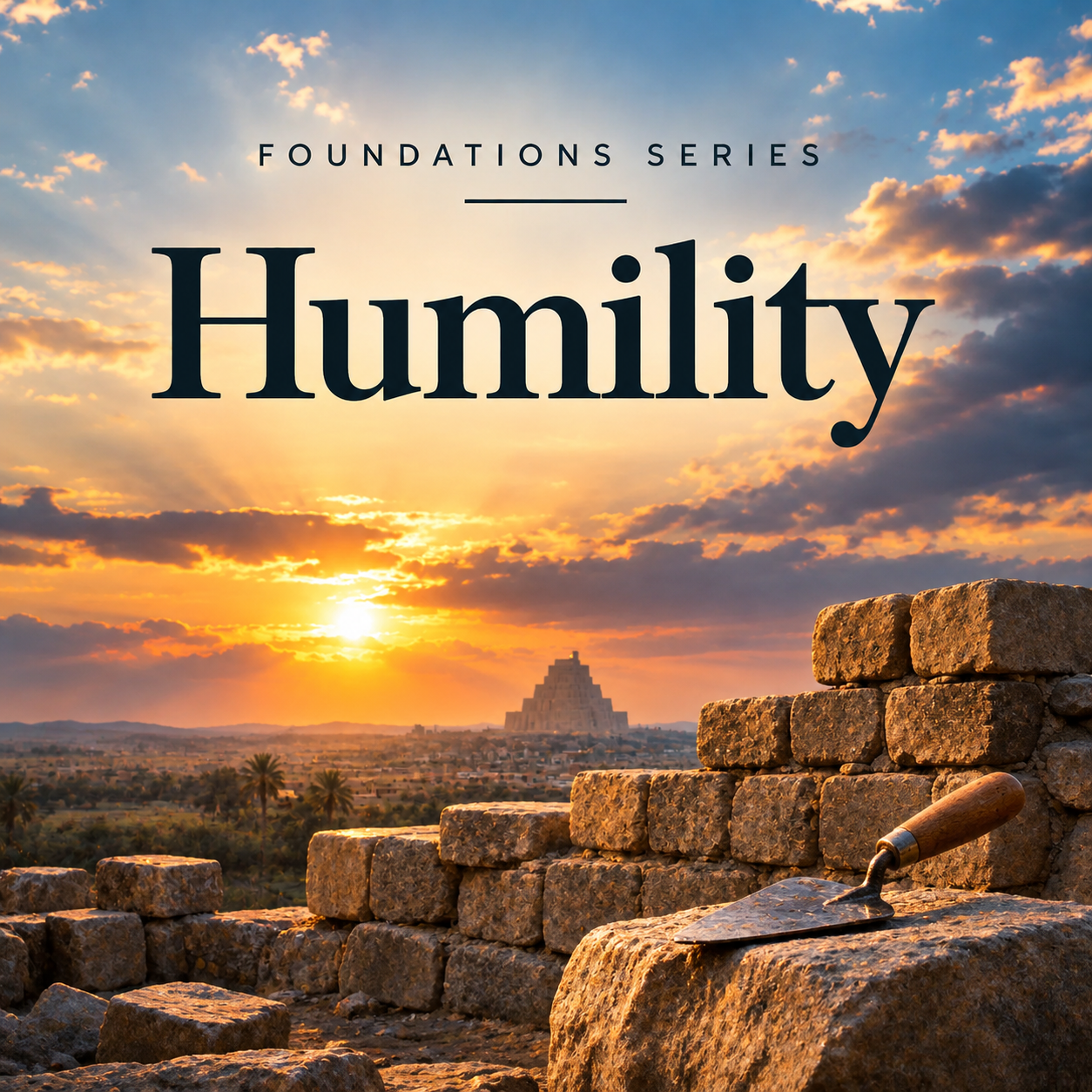
Foundations: The Foundation of Humility
Genesis 11:1–9
Last Sunday, we spent some time with Noah and his family as they navigated one of the most extraordinary experiences recorded in Scripture. We watched Noah trust God enough to build an ark when there was no apparent reason to do so, follow God’s instructions even when he couldn’t see what was coming, and remain faithful through a storm that changed the world around him.
When Noah and his family finally stepped out of the ark, they were entering a world that had been given a fresh beginning. Everything they had known before the flood was gone, and the future of humanity rested with just eight people. God blessed them, renewed His command to be fruitful and multiply, and established His covenant with Noah and every living creature.
You might imagine that after witnessing such an extraordinary demonstration of God’s power, humanity would never again question its dependence upon Him. Surely the story of the flood, passed down from parents to children and grandchildren, would have been enough to remind every generation of the importance of trusting God.
Yet as we continue through Genesis, we discover that while the flood had changed the world, it had not changed the human heart.
And perhaps that shouldn’t surprise us as much as it does. We have a remarkable ability to remember what God has done for us in one season of life, only to begin relying on ourselves in the next. We pray fervently when circumstances are beyond our control, but when life becomes comfortable and our plans begin coming together, it’s easy to forget just how dependent upon God we really are.
This morning, we’re going to look at the descendants of Noah and encounter a civilization that had accomplished remarkable things in a relatively short period of time. While Scripture doesn’t tell us exactly when the Tower of Babel was built, the genealogies in Genesis suggest that it may have been within just a few centuries of the flood. In that relatively short period, humanity had grown into a civilization possessing intelligence, creativity, ambition, and the ability to work together toward a common purpose. None of those qualities were inherently wrong. They were expressions of the abilities God had given humanity.
But somewhere along the way, their confidence in what they could accomplish began to overshadow their recognition of the One who had given them those abilities in the first place.
And in the story of the Tower of Babel, we’re going to discover why humility is such an essential foundation for our relationship with God.
How Quickly We Forget Our Dependence on God
11 Now the whole earth had one language and the same words. 2 And as they migrated from the east, they came upon a plain in the land of Shinar and settled there. 3 And they said to one another, “Come, let us make bricks and fire them thoroughly.” And they had brick for stone and bitumen for mortar. 4 Then they said, “Come, let us build ourselves a city and a tower with its top in the heavens, and let us make a name for ourselves; otherwise we shall be scattered abroad upon the face of the whole earth.”
Genesis 11:1–4
As we enter the eleventh chapter of Genesis, we find humanity beginning to settle into a new way of life. Scripture tells us that the people shared a common language, and as they migrated eastward, they discovered a plain in the land of Shinar where they decided to settle. Rather than continuing to spread throughout the earth, they found a place where they could establish themselves, build a community, and begin shaping their own future.
I also want to talk about something that has always intrigued me. We have already discussed how much time may have passed since Noah and his family stepped off the ark and that while Scripture doesn’t give us an exact date for the Tower of Babel, the genealogies suggest that we may be looking at only a few centuries. We also know that only eight people survived the flood and these two things together raise an interesting question that many people have wondered over the centuries. How could eight people become a civilization capable of building an entire city in such a relatively short period of time?
Let’s consider a little hypothetical math. If we begin with Noah’s three sons and their wives, assume each couple had six children who survived to adulthood, and those children began having families of their own between the ages of 20 to 30 years old, the population would grow exponentially. If we also assume people lived approximately ninety years, allowing several generations to overlap, then after 350 years our not-so-simple calculation produces a population of more than two million people. Now, Scripture doesn’t tell us how many people lived at Babel, and this calculation assumes every family followed the same pattern, which certainly wouldn’t have happened in reality. But it does help us appreciate how quickly a population could grow when each generation was having children and those children were establishing families of their own.
And as that population grew, so did humanity’s ability to accomplish things that would have been unimaginable to the eight people who first stepped off the ark. Genesis tells us that the people had learned to make bricks and harden them with fire, using bitumen as mortar. In a region where building stone was not readily available, they had developed the technology to construct something substantial and lasting. That tells us that Noah and his descendants weren’t simply surviving anymore; they were organizing, innovating, and building a civilization.
The sad part is that when we listen to the conversation recorded in verse four, we begin to recognize that something had gone wrong. The people said, “Come, let us build ourselves a city, with a tower that reaches to the heavens, so that we may make a name for ourselves; otherwise we will be scattered over the face of the whole earth.”
Notice what they were hoping to accomplish. They wanted to establish their own greatness, secure their own future, and prevent themselves from being scattered. Yet God had already commanded Noah and his descendants to be fruitful, multiply, and fill the earth. The very thing God had called them to do was what they were now organizing themselves to avoid. They weren’t merely building a city. They were building a future around their own ambitions rather than God’s direction.
And I think we need to be careful here, because the problem wasn’t their intelligence, their creativity, or even their desire to accomplish something significant. The ability to create, cultivate, and build are gifts God had given humanity to empower us to do what He had commanded. The problem was that their ambition had become pride, and Scripture is remarkably clear that pride is not simply an unfortunate personality trait. It is sin.
Proverbs 16:5 tells us, “The LORD detests all the proud of heart. Be sure of this: They will not go unpunished.” Those are strong words, especially when we consider how easily pride can disguise itself as something admirable. We celebrate independence, determination, hard work, and the ability to stand on our own two feet. There is certainly nothing wrong with working hard or taking responsibility for the lives God has entrusted to us. The challenge is presented somewhere between recognizing the abilities God has given us and believing we no longer need His guidance, which is a dangerous change that can take place in the human heart.
Most of us would never stand before God and announce that we intend to live without Him. Yet how often do we make decisions about our careers, our finances, our families, or our futures without first seeking His direction? We can spend weeks developing a plan, gathering the resources, and arranging everything exactly as we want it, only to turn to God when something doesn’t work out. We haven’t necessarily rejected God with our words, but we’ve begun living as though the success of our plans depends entirely upon us.
That’s what makes the story of Babel so uncomfortable. These were the descendants of a family whose very existence was only due to God’s mercy and protection. Their ancestors had survived because Noah listened when God spoke, trusted when he couldn’t see the outcome, and followed instructions that must have seemed extraordinary at the time. Yet within a relatively short period, humanity was once again organizing its future around what it could accomplish for itself.
And perhaps the most revealing words in the entire passage are the ones that give this morning’s message its title. They wanted to make a name for themselves. They weren’t asking how their abilities might glorify God or how their growing civilization might fulfill His purposes. They were concerned with establishing their own significance, ensuring that the world would remember what they had accomplished.
The question this passage begins to raise for us is not whether we’re capable of accomplishing great things. God has given us extraordinary abilities, and He calls us to use them faithfully. The question is whether, somewhere along the way, we’ve begun taking credit for what was only possible because of His grace. Because when our confidence in ourselves begins to replace our dependence upon God, even the things we build with the best of intentions can become monuments to our own pride.
What Does It Really Mean to Be Humble?
5 The Lord came down to see the city and the tower, which mortals had built. 6 And the Lord said, “Look, they are one people, and they have all one language, and this is only the beginning of what they will do; nothing that they propose to do will now be impossible for them. 7 Come, let us go down and confuse their language there, so that they will not understand one another’s speech.”
Genesis 11:5–7
This passage always makes me laugh because there’s something about the way scripture describes what happens next that makes me think about just how ridiculous our thought that we can do things without God really is. The people of Babel had set out to construct a tower that would reach into the heavens, a monument to their ingenuity and greatness. Yet when we arrive at verse five, we’re told that the Lord came down to see the city and the tower they had built. What they believed was reaching toward heaven was still so far beneath the greatness of God that Scripture describes Him as having to come down just to look at it.
Of course, this doesn’t mean that God was unaware of what humanity was doing or that He needed to travel somewhere to discover their plans. The language is intentional, inviting us to see the contrast between how the builders understood their accomplishments and how those same accomplishments appeared in the presence of Almighty God. What humanity considers an extraordinary achievement is still infinitely beneath the greatness of God. How can anything we do as mere humans out-perform that power of the Creator of the universe who simply spoke things into existence! Yet the remarkable thing about this passage that I love is that God does not condemn the people for possessing the ability to build something extraordinary. His concern runs much deeper than the height of their tower.
In verse six, God acknowledges their unity and their shared language, observing that their ability to work together has opened the door to tremendous possibilities. There’s no suggestion that intelligence, cooperation, or human progress are inherently sinful. After all, these are among the very gifts that allow us to care for one another, provide for our families, develop communities, and participate in the work God has entrusted to humanity. But those same gifts can become dangerous when the human heart begins to believe that its abilities place it beyond the need for God’s wisdom and direction. The concern is not simply what humanity has become capable of accomplishing, but what humanity may become willing to pursue when its ambitions are no longer guided by obedience to God.
And this brings us to a question that I think we need to ask ourselves. What does it actually mean to be humble? We often associate humility with being quiet, modest, or reluctant to acknowledge our accomplishments. We might picture someone who never draws attention to themselves, who consistently puts others first, or who brushes aside a compliment even when they’ve done something genuinely remarkable. Those can certainly be expressions of humility, but they don’t necessarily tell us what’s happening within a person’s heart.
Biblical humility is not pretending that we lack the abilities God has given us, nor is it diminishing our worth or convincing ourselves that we have nothing meaningful to contribute. If God has blessed someone with wisdom, creativity, leadership, or the ability to accomplish something extraordinary, acknowledging those gifts is not pride. In fact, refusing to recognize what God has entrusted to us can prevent us from using those gifts for the purposes He intended. Humility begins when we understand that our abilities, opportunities, and accomplishments do not make us independent of the God who gave them to us.
The Apostle Paul speaks to this in Romans 12:3, encouraging believers not to think of themselves more highly than they ought, but instead to think with sober judgment. Paul isn’t asking us to think poorly of ourselves. He’s inviting us to see ourselves truthfully, neither exaggerating our importance nor denying the gifts God has placed within us. We can recognize that we have worked hard, developed skills, and accomplished meaningful things while still acknowledging that our lives are sustained by God’s grace. Humility allows us to be grateful for what we’ve accomplished without allowing those accomplishments to become the source of our identity.
And perhaps one of the clearest pictures of this kind of humility is found in the life of Jesus. In Philippians 2, Paul reminds us that Christ, though possessing the very nature of God, did not use His position for His own advantage. Instead, He humbled Himself, took the nature of a servant, and became obedient even to death on a cross. Jesus did not become humble because He lacked power, authority, or significance. He demonstrated humility precisely because He possessed all of those things and willingly chose to use them in obedience to the Father and for the sake of others.
That changes the way we understand humility in our own lives. A humble person can be confident without being arrogant, accomplished without being self-important, and capable of leading without needing to be the center of attention. Humility doesn’t require us to surrender the gifts God has given us. It invites us to surrender the belief that those gifts exist primarily for our own advancement. When we begin to see our abilities as something entrusted to us rather than something that makes us greater than others, our understanding of success begins to change.
And when we return to the people of Babel, we can begin to appreciate what they were missing. They had learned how to build a tower, but they had not learned how to place their ambitions beneath the wisdom of God. They understood the strength that came from working together, but they had not considered what it meant to submit their shared purpose to His direction. Their problem was not that they thought too highly of what humanity could accomplish. It was that they had lost sight of the One before whom even their greatest accomplishments were small.
Perhaps that’s where humility begins for us as well, not with a smaller understanding of ourselves, but with a greater understanding of God. As we grow in our awareness of His holiness, His wisdom, and His grace, we begin to recognize that our significance was never meant to rest upon what we could build, achieve, or preserve. And once we begin to understand that, the question becomes how we can learn to live with that kind of humility in the ordinary decisions and relationships that shape our lives.
How Do We Cultivate Humility?
8 So the Lord scattered them abroad from there over the face of all the earth, and they left off building the city. 9 Therefore it was called Babel, because there the Lord confused the language of all the earth, and from there the Lord scattered them abroad over the face of all the earth.
Genesis 11:8–9
When we reach the final verses of this story, something remarkable happens. The people who had gathered together because they were afraid of being scattered suddenly find themselves unable to understand one another. The language they had shared, which had allowed them to organize and accomplish so much, became a barrier between them. Genesis tells us that the Lord confused their language, and the very project they believed would secure their future came to an end. They stopped building the city, and from that place God scattered them across the face of the earth.
It’s interesting that God didn’t just give up on humanity all together as a lost cause, destroy their tower or bring another flood upon the earth. Instead, He interrupted their plans by taking away the one thing that had made their shared ambition possible. Their ability to communicate had allowed them to accomplish extraordinary things together, but now they had to confront the limits of their own control. It’s sad to realize it, but the whole reason they were being scattered is so that they would move into the very world God had instructed humanity to fill.
There’s a temptation to read this story and imagine that pride must always look like the arrogance of someone who openly boasts about their accomplishments or believes they’re better than everyone around them. Those expressions of pride are easy enough to recognize, especially when we see them in someone else. The more difficult kind of pride to confront is often the kind that doesn’t draw attention to itself at all.
Someone can be outwardly gracious, generous, and modest while inwardly believing that their success, security, or significance depends entirely upon themselves and it’s my belief that’s closer to what we’re seeing at Babel. The builders of that tower didn’t announce that they hated God, and candidly, the scripture didn’t say that they did hate God at all. They simply organized their future around their own ambitions. Their confidence had become so firmly rooted in what they could accomplish that they had stopped considering whether the future they were building was the future God was calling them toward.
I wonder how often we find ourselves in that same position without recognizing it. We may faithfully attend worship, pray for the people we love, and genuinely desire to follow Christ, yet still approach much of our daily lives with the assumption that we’re the ones responsible for making everything work. We carry the weight of decisions, responsibilities, and expectations as though everything depends upon our ability to hold it all together. Sometimes what appears to be confidence on the outside is actually an exhausting attempt to maintain control over things we were never meant to control.
The Apostle James addresses this very tendency in the fourth chapter of his letter. He describes people who confidently announce that they will travel to a particular city, spend a year doing business, and make a profit, even though they cannot know what tomorrow will bring. James isn’t condemning their desire to work, plan, or provide for themselves; what he’s doing is challenging the assumption that they can speak about their future as though it belongs entirely to them. Instead, he encourages them to say, “If it is the Lord’s will, we will live and do this or that.” James then identifies the arrogance of boasting about plans made apart from God.
So that leads to the ultimate question of the day; how do we begin cultivating the kind of humility that recognizes God’s place in our lives without becoming fearful of making decisions or pursuing the opportunities He places before us? I think Scripture gives us several practices that can gradually reshape the way we understand ourselves and our relationship with Him.
One of those practices is gratitude. In 1 Corinthians 4:7, Paul asks a question that has a way of putting our accomplishments into perspective: “What do you have that God hasn’t given you?” Think about the implications of that question for a moment. Our abilities, our opportunities, the people who have encouraged us, the strength to work, and even the breath in our lungs are gifts we did not create for ourselves. That doesn’t diminish the effort we’ve invested in our lives, but it does change the way we understand the source of what we’ve been able to accomplish. When gratitude becomes part of our daily relationship with God, it becomes increasingly difficult to treat His blessings as though they were entirely our own doing.
Another practice is surrender, and perhaps this is where humility becomes most challenging. Proverbs 3:5–6 encourages us to trust in the Lord with all our hearts, not to lean on our own understanding, and to acknowledge Him in all our ways. Those words don’t ask us to abandon reason or stop making plans. They invite us to recognize that even our best understanding is limited, while God’s wisdom is not. Surrender means becoming willing to let God redirect a plan we’ve worked hard to develop, open a door we hadn’t considered, or close one we were certain we needed to walk through. It means seeking His direction before our plans are finalized rather than asking Him to bless decisions we’ve already made.
And then there’s service, which has a remarkable way of changing where we place our attention. In Philippians 2:3–4, Paul encourages believers to do nothing out of selfish ambition or vain conceit, but in humility to value others above themselves, looking not only to their own interests but also to the interests of others. When we begin asking how our gifts can serve someone else rather than how they can establish our own importance, our ambitions begin to take on a different purpose. The abilities God has given us become opportunities to encourage, strengthen, and care for the people He has placed in our lives.
None of these practices will eliminate pride from our hearts overnight. Humility is something God continues to cultivate within us as we grow in faith, often revealing areas of our lives where we’ve become more dependent upon ourselves than we realized. And there is grace in that process, because the God who calls us to humility is also the One who patiently teaches us how to walk with Him. We don’t have to become perfectly humble before we can seek His guidance. We begin by acknowledging our need for Him and allowing His grace to reshape the way we live.
By the end of Genesis 11, the builders have been scattered, their great project remains unfinished, and the name they accomplished what they hoped to achieve. They certainly made a name for themselves; however, unfortunately, it becomes associated with confusion and not the greatness to which they aspired. They had set out to create something that would guarantee their significance, yet what endures from their story is a reminder of the limits of human ambition apart from God.
And perhaps that leaves us with a different question to carry into the week ahead. Rather than asking what we can accomplish that will cause others to remember our names, what might happen if we began asking how the lives we’ve been given could reflect the goodness of the God who knows our names already?
Conclusion
The story of the Tower of Babel really challenges us about the things we hope to leave behind. Most of us aren’t trying to build towers that reach into heaven, but we are building something with our lives. We’re raising families, developing careers, serving our communities, and making decisions that will shape the people and places around us long after we’re gone. There’s nothing wrong with wanting those efforts to mean something, and there’s certainly nothing wrong with hoping that the lives we’ve lived will have made a difference. Perhaps, however, we need to ask ourselves whether we’re more concerned with being remembered for what we’ve accomplished or with being faithful to what God has called us to do.
One of the beautiful things about following Jesus is that we don’t have to spend our lives trying to establish our own worth. Through Christ, we discover that our value has never depended upon how impressive our accomplishments appear to the world. We are loved by the God who created us, invited into a relationship with Him through His Son, and given the opportunity to participate in His work through the grace of the Holy Spirit. That frees us from the exhausting need to prove ourselves and allows us to approach each day with a different purpose.
So as we leave worship this morning, the invitation being offered to us is simply to begin looking at the things we’re building through a different lens. When we’re making decisions, we can seek God’s wisdom before relying entirely on our own understanding; when we experience success, we can give thanks for the gifts and opportunities that made it possible, and when we encounter someone who needs our help, we can remember that the abilities God has entrusted to us were never intended to benefit only ourselves.