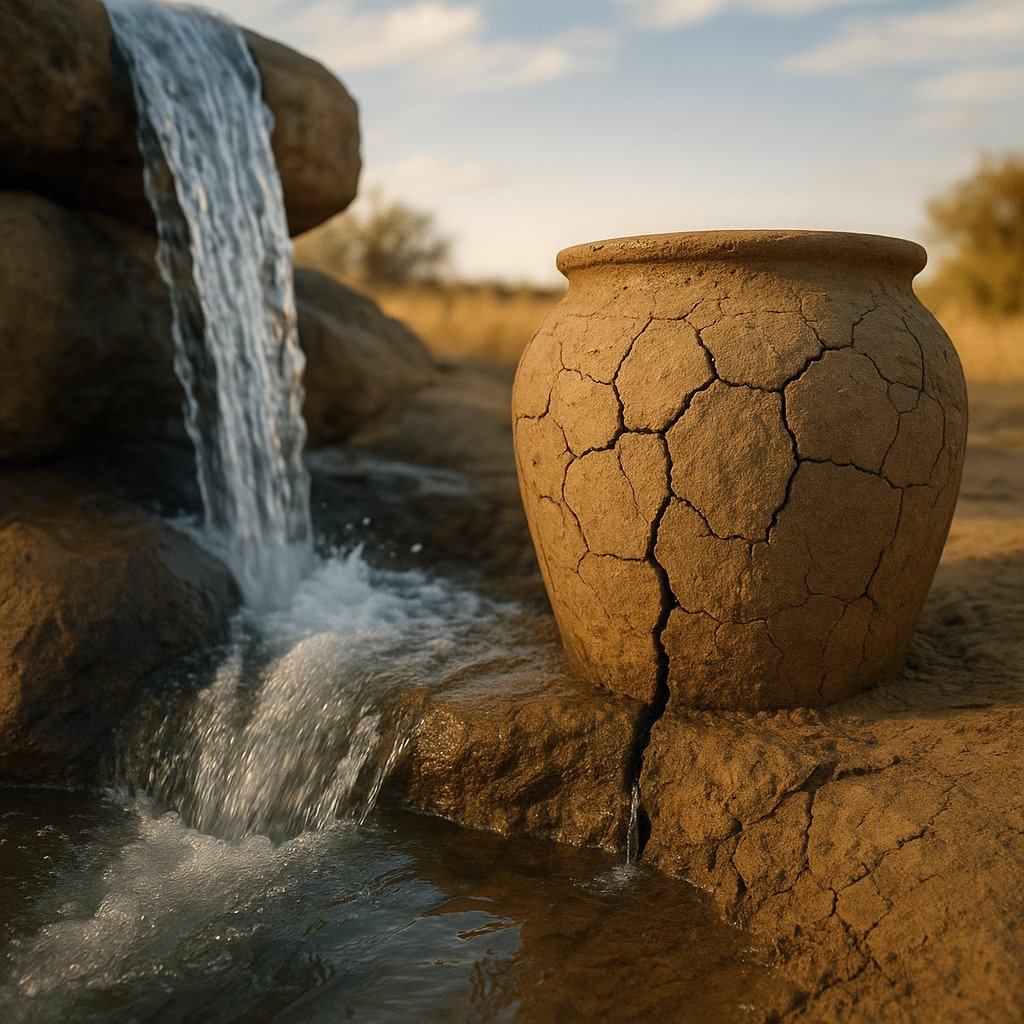
Jeremiah 2:10–13
10 Go west and look in the land of Cyprus; go east and search through the land of Kedar. Has anyone ever heard of anything as strange as this?
11 Has any nation ever traded its gods for new ones, even though they are not gods at all? Yet my people have exchanged their glorious God for worthless idols!
13 For my people have done two evil things: They have abandoned me—the fountain of living water. And they have dug for themselves cracked cisterns that can hold no water at all.
Introduction
Have you ever poured your hope into something—only to find it couldn’t hold you up?
That’s what Jeremiah calls a “cracked cistern.” It looks like it can hold water, but it always leaks. And if we’re honest, all of us have leaned on things that couldn’t sustain us.
I want to start by painting a picture of what a cistern is because they aren’t an everyday item here on the shore. I want to share how they were made and just how critical they were to survival in Jeremiah’s time. A cistern was carved deep into the limestone and lined with plaster to collect the precious rainwater during the short wet seasons. In a dry land like Israel, these cisterns weren’t optional—they were lifelines. Families, herds, even whole villages depended on them to make it through the long, scorching summer months when no rain would fall.
But a cistern was only as good as its integrity. If cracks formed in the limestone or the plaster gave way, the water slowly seeped out. You might not notice it until it was too late—until you lowered your bucket and found only a hollow echo. A cracked cistern wasn’t just a nuisance. It was devastating. Without water, crops failed, livestock died, and people perished.
Cisterns weren’t only used for storing water in ancient times—sometimes, when they dried up, they became prisons. An empty cistern was deep, dark, and impossible to escape without help. In fact, the prophet Jeremiah himself was imprisoned in one. Jeremiah 38:6 tells us that he was lowered by ropes into a cistern that had no water, only mud, and he sank down into it. Alone, trapped, and surrounded by darkness, Jeremiah experienced firsthand how a cistern that was meant to give life could instead become a place of despair.
And maybe that’s why the image in Jeremiah 2 carries such weight. The man who once sank in the mud of an empty cistern also spoke of a deeper spiritual reality: God’s people were trading the fountain of living water for cracked cisterns. What should have given them life had become the very thing that left them empty, thirsty, and bound. In Jeremiah 2:10–11, God makes a shocking comparison: other nations clung stubbornly to their false gods, but Israel abandoned the true and living God for idols of their own making. They exchanged their glorious God for worthless substitutes.
But before we shake our heads at them, don’t we do the same? We may not carve statues of stone or bow before golden images, but we build idols just as real—idols of success, idols of control, and idols of comfort. Many people don’t think of success, control or comfort as idols but they very well can be, especially in the world we live in here in the United States where even the most poor among us would be wealthy in most areas of the world. These are the cracked cisterns we keep running to, even though they can never hold the weight of our hope.
Today, I want us to look at each of these cisterns—success, control, and comfort—and see why they fail us, why we must not trust in them, and how God offers us something better: Himself, the fountain of living water.
Cistern 1: Success — The Leaking Bucket of Achievement
For some of us, our cracked cistern is success. We think, “If I just get the promotion, if I just achieve enough, then I’ll feel secure.” What’s worse is if we actually achieve these accomplishments as their acquisition can fuel the cistern. The challenge is that success often is fleeting and that causes this cistern to leak. One bad quarter, one pink slip, and it’s gone.
King Solomon is Exhibit A. He had more success than anyone could imagine. Ecclesiastes 2 records his pursuit: he built houses, planted vineyards, amassed silver and gold, surrounded himself with singers and concubines, and denied himself nothing his eyes desired.
4 I also tried to find meaning by building huge homes for myself and by planting beautiful vineyards. 5 I made gardens and parks, filling them with all kinds of fruit trees. 6 I built reservoirs to collect the water to irrigate my many flourishing groves. 7 I bought slaves, both men and women, and others were born into my household. I also owned large herds and flocks, more than any of the kings who had lived in Jerusalem before me. 8 I collected great sums of silver and gold, the treasure of many kings and provinces. I hired wonderful singers, both men and women, and had many beautiful concubines. I had everything a man could desire!
9 So I became greater than all who had lived in Jerusalem before me, and my wisdom never failed me. 10 Anything I wanted, I would take. I denied myself no pleasure. I even found great pleasure in hard work, a reward for all my labors. 11 But as I looked at everything I had worked so hard to accomplish, it was all so meaningless—like chasing the wind. There was nothing really worthwhile anywhere.
Success without God is just a cracked cistern. It can look impressive, but it cannot quench the thirst of the soul.
Look no further than Howard Hughes, the billionaire businessman and aviator. Many people know him and his legacy due to the movies made of his money, fame, and influence, but he died in misery—emaciated, addicted, and paranoid, locking himself away in hotel rooms. Success gave him wealth, but not peace. In fact, it robbed him of life. Born of meager means he worked hard and built empire after empire; from oil magnate to Hollywood studio star he had it all during the golden age of Hollywood and rubbed shoulders with the brightest lights of his time.
What Solomon saw thousands of years ago, Hughes proved in our modern age: success can fill your pockets, but it cannot fill your heart.
Success promises security but delivers anxiety. You’re only as good as your last quarter, your last deal, your last applause. You drink, but the bucket leaks.
Jesus asked in Mark 8:36, “What do you benefit if you gain the whole world but lose your own soul?”
So let me ask: are you pouring your life into the leaking bucket of success? Because without the fountain of living water, success will always run dry.
Cistern 2: Control — The Leaking Bucket of Self-Reliance
For others, the cracked cistern is control. We think, “If I can manage every detail—if I can keep my family, my health, my finances in line—then I’ll be safe.” But control leaks. One diagnosis, one accident, one market crash, and it’s gone.
Have you ever known someone you would call a “control freak.” These people feel the need to control every moment of every day of every situation. If they can control it then they know it will be a success but while they may experience success in one area, that doesn’t provide the solace they are looking for. As a result what do they do? They try to control the next thing, and the next thing, and the next thing; you get the idea.
Martha is one of the clearest New Testament examples of someone trying to find peace through control. In Luke 10:38–42, Jesus comes to her home, and while her sister Mary sits at His feet listening, Martha is consumed with the details. She’s preparing the meal, arranging the house, making sure everything is in order. From the outside, it looks admirable. She wants everything to be perfect for Jesus. But inside, she’s unraveling. Her attempts at control leave her frustrated, stressed, and even resentful of Mary.
Finally, Martha can’t hold it in any longer. She interrupts Jesus and says, “Lord, don’t you care that my sister has left me to do the work by myself? Tell her to help me!” It’s such a revealing moment. Martha isn’t just trying to manage her house—she’s trying to manage Jesus. She’s asking Him to get on board with her plan, to validate her control. But instead, Jesus speaks with love and correction: “Martha, Martha, you are worried and upset about many things, but few things are needed—or indeed only one. Mary has chosen what is better, and it will not be taken away from her.”
Martha’s story shows us what happens when we make control our cistern. It leaks. The more we grasp for it, the more anxious and resentful we become. Martha thought peace would come if everything was managed just right, but peace was sitting in her living room. The living water she needed wasn’t found in her efforts, but in His presence. And that’s the invitation for us too: to set down the cracked cistern of control and sit at the feet of the One who says, “I Am enough.”
History gives us another sobering picture. In 1912, the Titanic set out on her maiden voyage. She was called “unsinkable.” Engineers and investors boasted that not even God could sink her. But we know how that ended. One iceberg, one cold April night, and all the human confidence in technology and control was shattered.
It’s a chilling reminder: control is an illusion. We are not as strong as we think.
When control is our cistern, we live anxious lives. We grasp tighter, fearing that if we let go for one second, everything will collapse. But here’s the truth: it’s already too heavy for us to hold.
Proverbs 16:9 says, “We can make our plans but the Lord determines our steps.” You and I are not in control. But we know the One who is.
So what would it look like this week to surrender the illusion of control, and rest in the One who speaks peace to the storm?
Cistern 3: Comfort — The Leaking Bucket of Self-Indulgence
And still for others, the cracked cistern is comfort. We think, “If I can just buy enough, eat enough, scroll enough, then I’ll be happy.” But comfort leaks. It dulls us, but it doesn’t fill us.
Eli’s sons, Hophni and Phinehas, were born into privilege. As priests serving at the tabernacle in Shiloh, they had access to the things of God and the honor of spiritual leadership. But instead of stewarding that role with reverence, they twisted it for their own comfort. 1 Samuel 2:12 calls them “scoundrels who had no respect for the Lord.” When people came to sacrifice, they seized the choicest portions of meat for themselves, even before it was offered to God. They treated the holy offerings as their personal buffet line, indulging their appetites without shame.
Their self-indulgence didn’t stop at food. Verse 22 tells us they also slept with the women who served at the entrance of the tent of meeting. What should have been a place of holiness became, under their leadership, a place of corruption. They lived as if God’s tabernacle was designed to serve their cravings. Comfort and pleasure became their gods, and the cistern they dug for themselves leaked until judgment came.
In the end, Hophni and Phinehas fell in battle on the same day, and the ark of God was captured. Their indulgence cost them their lives, their father his legacy, and the nation its symbol of God’s presence. What looked like comfort and privilege turned out to be destruction. Their story is a sobering reminder that when we use God’s blessings to serve our appetites instead of His glory, those blessings become cracked cisterns that cannot hold. True life is never found in indulging ourselves—it’s found in honoring God.
Hophni and Phinehas show us what happens when leaders in God’s house trade holiness for indulgence. But God’s warning isn’t just for corrupt priests in the Old Testament—it’s for His people in every generation. Because the danger of comfort and self-indulgence doesn’t go away. It’s subtle, it creeps in, and before long, we’re using God’s blessings to serve ourselves instead of Him.
That’s why, centuries later, Jesus gave a stinging rebuke to the church in Laodicea. They weren’t stealing sacrifices like Eli’s sons, but their hearts had grown just as complacent. Their comfort had made them spiritually lukewarm. And just as God judged Hophni and Phinehas, He warned Laodicea that comfort without faithfulness is a cracked cistern that leaks every time.
Laodicea was a wealthy city. Located along major trade routes, it was famous for its banking, its black wool textiles, and its medical school that produced an eye ointment used throughout the empire. The people there didn’t just have resources—they had comfort. And that same spirit crept into the church. Jesus’ words in Revelation 3:17 reveal their heart: “You say, ‘I am rich. I have everything I want. I don’t need a thing!’ But you don’t realize that you are wretched and miserable and poor and blind and naked.” Comfort had dulled their dependence on God. They thought they were full when in truth they were empty.
And Jesus used an image they couldn’t miss. Laodicea had no reliable water source of its own. To the north, Hierapolis had hot mineral springs. To the south, Colossae had cold, refreshing streams. But by the time water was piped into Laodicea, it was lukewarm—tepid, stale, and often nauseating. That’s why Jesus said in Revelation 3:16, “Since you are like lukewarm water, neither hot nor cold, I will spit you out of my mouth.” Their spiritual state mirrored their water supply—neither healing like hot water nor refreshing like cold, just stagnant and useless.
Laodicea’s story is a direct warning to us: when we rely on comfort, when we become self-sufficient and spiritually complacent, we stop being effective for God’s kingdom. Comfort leaks. It can make us lukewarm—content with surface-level faith, dull to our need for God. And Jesus’ response is clear: He doesn’t coddle lukewarm faith, He confronts it. Yet even in His rebuke, He offers hope: “I stand at the door and knock. If you hear my voice and open the door, I will come in, and we will share a meal together as friends” (Revelation 3:20). The way back from the cracked cistern of comfort isn’t more indulgence—it’s opening the door again to the only One who could truly satisfy.
Historians often point to decadence and comfort as one of the contributing factors in the fall of Rome. As the empire grew wealthy, citizens grew complacent. Bread and circuses dulled their minds while enemies grew stronger. Rome collapsed, not just from outside attack, but from inner rot born of comfort.
The danger of comfort isn’t new. Rome shows us how a whole empire can rot from the inside out when people grow too content, but the same principle plays out in individual lives as well. In the film God’s Not Dead (2014), there’s a moment where a Dean Cain’s character Marc Shelley asks Mina’s mother why bad things happen to good people. And Mina’s mother, struggling with dementia, gives an answer that cuts right to the heart of comfort as a trap. She says that sometimes the devil allows people to live trouble-free because he doesn’t want them turning to God. Their sin is like a jail cell—comfortable, easy, with no reason to leave. But one day, time runs out, the door slams shut, and it’s too late.
- Marc Shelley: You prayed and believed your whole life. Never done anything wrong. And here you are. You’re the nicest person I know. I am the meanest. You have dementia. My life is perfect. Explain that to me!
- Mina’s Mother: Sometimes the devil allows people to live a life free of trouble because he doesn’t want them turning to God. Their sin is like a jail cell, except it is all nice and comfy and there doesn’t seem to be any reason to leave. The door’s wide open. Till one day, time runs out, and the cell door slams shut, and suddenly it’s too late.
Comfort lulls us into thinking we’re satisfied, but it never lasts. The dopamine hit fades. The distraction wears off. And we’re left thirsty again. Just like Jeremiah being thrown in the cistern as a prison, our comfort can be a prison we don’t realize.
Augustine said, “You have made us for yourself, O Lord, and our hearts are restless until they rest in you.” Restless—that’s the word. Comfort can quiet the noise for a moment, but only God can bring true rest.
Jesus told the Samaritan woman in John 4, “Whoever drinks this water will be thirsty again, but whoever drinks the water I give will never thirst.” True satisfaction isn’t found in comfort—it’s found in Him.
Conclusion
Success leaks. Control leaks. Comfort leaks. They are cracked cisterns that will never hold the weight of our hope.
But God’s name is different. In Exodus 3:14, He told Moses, “I Am Who I Am.” Not “I Was.” Not “I Will Be.” I Am—present, faithful, enough.
And through Jesus Christ, He offers us living water—a spring that doesn’t depend on circumstances, effort, or distraction. A well that never runs dry.
So here’s the question: which cistern have you been drinking from? What would it look like to set it down? And will you trust the name of the One who says, “I Am enough”?
Because if cracked cisterns leak, the fountain still flows. And His name is a name you can trust.
No responses yet