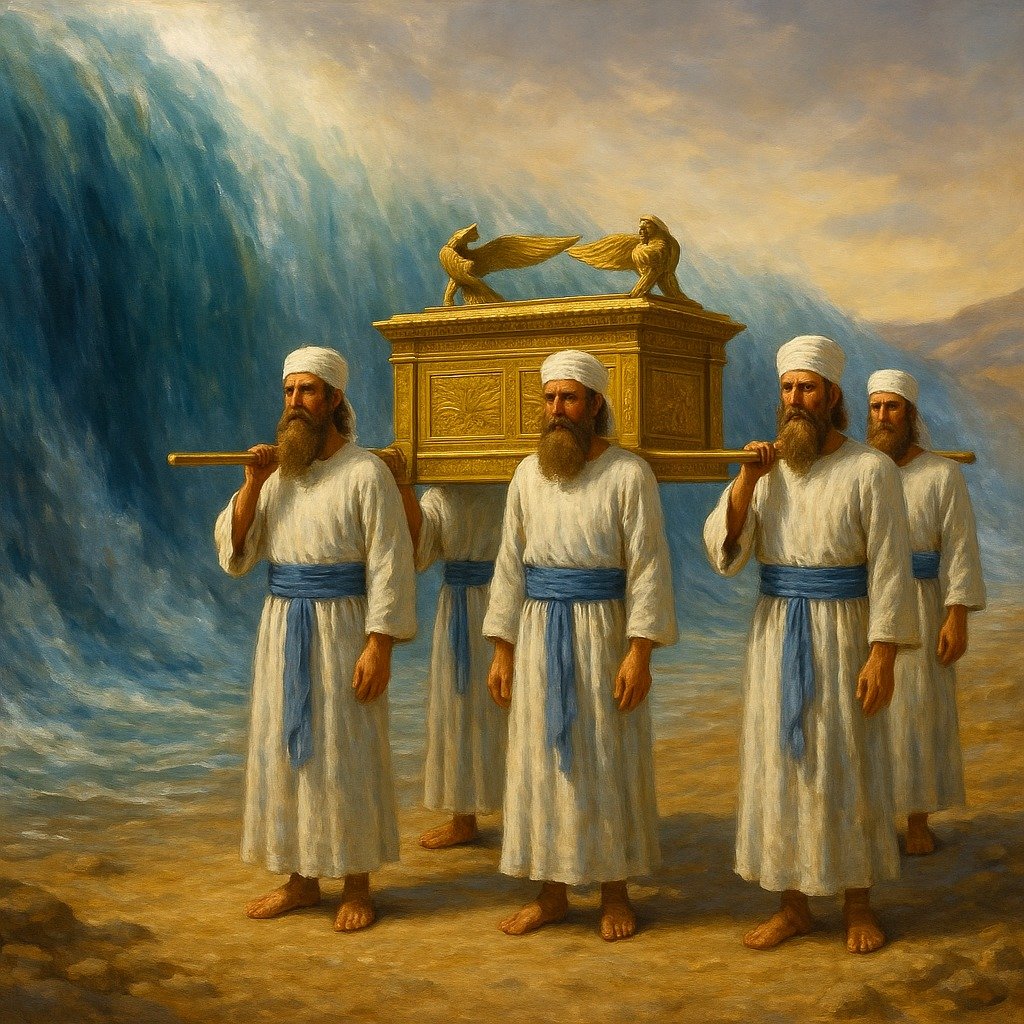
Joshua 3:1–17
Introduction
This morning marks the beginning of something new—not just for me, but for all of us. A new season of ministry. A new relationship, built not on what we already know, but on what we’re listening for: God’s voice.
And while new beginnings are exciting, they’re also a little unnerving. Whenever we step into something unfamiliar, there’s always a temptation to hesitate—to wait until everything is clear, everything is certain, everything feels safe. It seems like change always comes with questions about what lies ahead.
Some of you may be wondering:
- What will this new pastor be like?
- Will he understand us?
- Will we connect?
- What changes are coming?
- How do we even spell this guy’s name?
If you are my children sitting here you’re probably asking:
- Who thought giving dad a microphone was a good idea?
- How long will he talk?
And I’d be lying if I said I didn’t have my own questions.
- Will I serve you well?
- Will I honor the story God’s already telling in this place?
- Will we learn to walk together in grace and in love?
These are all normal human thoughts and concerns, but what if God is inviting us to move forward before we know all the details?
I’ll never forget Juliana’s first day of school, I still have the photo on my phone.
It was that mix of excitement and nerves—backpack a little too big, lunchbox clutched tight, looking up at me with those wide eyes excited and saying, “Today’s finally here!” And I was doing my best to smile, act calm, hold it together… but on the inside? I wasn’t as confident as I tried to portray on the outside.
There were questions I couldn’t answer that morning.
- Would she make friends?
- Would she know where to go?
- Would she feel safe, understood, and cared for?
And from their little heart, probably wondering the same about me:
“Will Dad still be right there when I need him?”
But here’s what I remember most: she walked on that bus anyway.
With all those questions, all that uncertainty… we both took a deep breath, turned, and stepped into something new.
And I think that’s where many of us are today.
This is a moment of stepping in. Of crossing into something unfamiliar. Of trusting God before all the answers are clear.
That’s exactly where God’s people find themselves in Joshua 3—standing on the banks of a flooded river, uncertain what comes next… and invited to trust that God is already leading.
Scripture Reading
Joshua 3:1–17
Point 1: God’s Voice Often Leads Before the Way Is Clear
Key Takeaway:
Don’t wait for the whole plan—start with listening for God’s voice and stepping out in faith.
“When you see the Ark… follow it. Then you will know which way to go, since you have never been this way before.” (Joshua 3:3–4)
This was a brand-new journey for Israel. After 40 years of wandering, they’re finally stepping toward the Promised Land. But there’s a problem: the river is in flood stage. There’s no bridge. No plan. Just the presence of God out ahead… and an invitation to follow before the water moves. The moment was so solemn that the traditional priests, the Kohathites who would have normally carried the Ark did not, the Levitical priests carried it.
That’s how God often leads. Not with a blueprint. But with a nudge and a peace that the world cannot understand.
The question for us as a church today isn’t “What’s the plan for the next five years?”
The better question is: “Are we listening for the presence of God?”
Hebrew Context: Nathak Mayim– “Waters Were Cut Off” (v. 13, v. 16)
Literal meaning: To be cut off, broken apart, snapped in two.
Contextual depth: This is Exodus language — the same verb is used when the Red Sea waters were “divided.” In ancient cosmology, water represented chaos; for God to “cut off” the waters is to assert His kingship over creation’s most untamable forces.
Isaiah 30:21 – “Whether you turn to the right or to the left, your ears will hear a voice behind you, saying, “This is the way; walk in it.’”
You may not know exactly what ministry will look like next. Neither do I. But if we keep our ears tuned to His voice—we will know where to step next.
We talk about following Him… but what does that mean in real life?
Here’s what Scripture teaches us about listening for God’s voice:
- God speaks through His Word
God will never contradict what He’s already said. If you want to know what His voice sounds like, start in Scripture. Let it shape your heart and train your ear.
“Your word is a lamp to guide my feet and a light for my path.” Psalm 119:105 (NLT)
- God speaks through peace in prayer
You may not get a detailed answer, but God often gives a deep peace when you’re heading in the direction of His will. Not comfort. Not convenience. But peace.
“And let the peace that comes from Christ rule in your hearts. For as members of one body you are called to live in peace. And always be thankful.” Colossians 3:15 (NLT)
- God speaks through godly community
Sometimes God confirms what He’s saying through the voices of trusted believers. He designed us to walk in community—not isolation.
“Plans go wrong for lack of advice; many advisers bring success.” Proverbs 15:22 (NLT)
- God speaks through the Spirit’s gentle nudge
Not always loud. Not always dramatic. But a whisper you can’t shake. A holy tug. A quiet burden. The sense that to delay would be to disobey.
“Your own ears will hear him. Right behind you a voice will say, ‘This is the way you should go,’ whether to the right or to the left.” Isaiah 30:21 (NLT)
Point 2: God’s Presence Goes Ahead of Us Into the Unknown
Key Takeaway:
God is already in the future we’re curious about.
The Ark of the Covenant of the Lord of all the earth will lead you across the Jordan. (Joshua 3:11)
In this story, the Ark—the physical sign of God’s presence—goes ahead of the people. Not behind. Not beside. Ahead.
God never sends us where He hasn’t already gone.
He doesn’t just call us into something—He walks ahead into it.
As we begin this journey together as pastor and churches, this is our foundation:
Not that we have all the answers, but that God is already leading.
This isn’t about my vision. Or your vision.
This is about God’s direction.
So how do we stay in step with His presence?
We ask together:
- Where do we sense God already at work in our community?
- What opportunities are opening—not because they’re easy, but because they’re holy?
- Where do we feel that deep spiritual peace—even amid questions?
Psalm 139:5 – “You go before me and follow me. You place your hand of blessing on my head.”
As a church, we don’t have to fear new ground.
We’re not forging our own path—we’re following the presence.
Point 3: When We Obey, We Open the Way for Others
Key Takeaway:
Our faith today builds the path for tomorrow’s breakthroughs.
The priests… stood firm on dry ground in the middle of the Jordan while all Israel passed by. (Joshua 3:17)
This might be my favorite part of the story. God doesn’t just part the waters for a single person to cross. He calls the priests to step in—and stand there. They don’t sprint through. They hold the space until the people pass.
That’s the kind of church I want us to be:
People who hold the ground of faith long enough for others to move forward.
When we choose to trust God together—when we serve, give, pray, show up, lead, listen, and love—we’re standing in the river. And that creates dry ground for others:
- for our youth
- for our neighbors
- for the person who isn’t even here yet
Galatians 6:9 – “So let’s not get tired of doing what is good. At just the right time we will reap a harvest of blessing if we don’t give up.”
1 Peter 2:9 – “But you are not like that, for you are a chosen people. You are royal priests,[a] a holy nation, God’s very own possession. As a result, you can show others the goodness of God, for he called you out of the darkness into his wonderful light.”
Your obedience today becomes someone else’s miracle tomorrow.
Let’s be the kind of church that stands in the middle—not with all the answers, but with open hands and faithful hearts, ready to help others move forward.
Conclusion: Beginning the Journey Together
The story doesn’t end with crossing the river.
It continues with remembering. In chapter 4, God tells Joshua to gather twelve stones—one for each tribe—so that future generations will remember what God did at that moment.
“When your children ask, ‘What do these stones mean?’ you will tell them…” (Joshua 4:6–7)
Church, we are stepping into a new chapter. Not just a new season as a pastor and congregation—but a new moment for us to listen carefully, follow faithfully, and move together in the direction God leads.
Let’s begin this journey as Joshua did; not with a map. Not with the perfect battle plan all built out and predetermined but with a shared faith that says:
“We have never been this way before.
But God is leading.
And we’re ready to follow.”
No responses yet