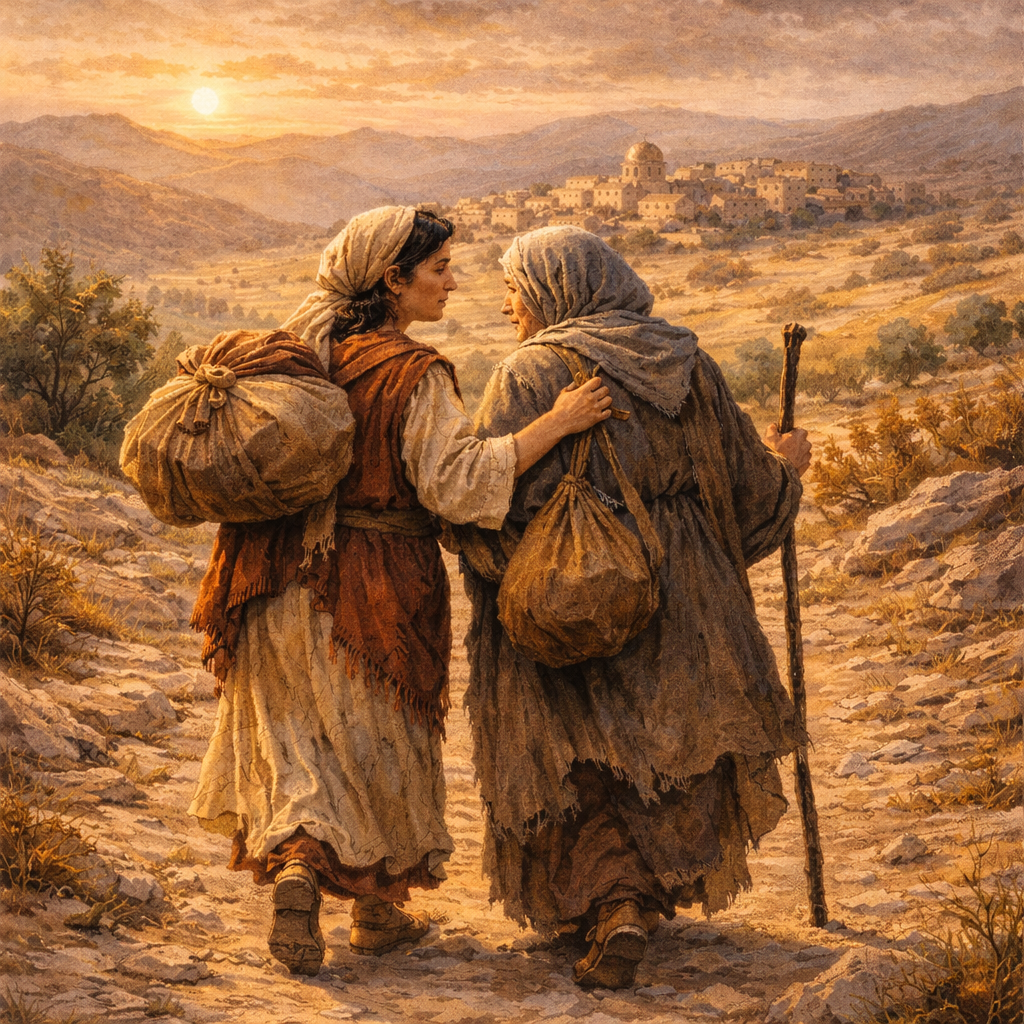
Ruth and Judges
- Before David was ever a king…
- Before Bethlehem was ever known for a manger…
- Before Israel ever had a throne…
There was a farmer named Boaz.
He was not a prophet. He did not part seas. He did not stand before Pharaoh. He did not call fire down from heaven. He owned fields in Bethlehem and lived during one of the most spiritually unstable periods in Israel’s history.
Ruth 1 tells us this story unfolds “in the days when the judges ruled.” And if you know the book of Judges, you know what that means. It means moral confusion. It means national instability. It means a people who had been delivered from Egypt, brought through the wilderness, planted in the Promised Land… and yet repeatedly drifting from their covenant with God. The book ends with the haunting line, “Everyone did what was right in his own eyes.”
That is the world Boaz lives in.
But Boaz does not stand outside the redemption story. He stands directly in the middle of it.
If you trace his lineage in Ruth chapter four, you find that Boaz is descended from Perez, the son of Judah. That means his line runs back to Jacob, back to Isaac, back to Abraham. The promises spoken in Genesis — “Through your offspring all nations of the earth shall be blessed” — are flowing through his bloodline.
He is only a handful of generations removed from the Exodus. Only a few generations removed from the walls of Jericho falling. He lives in Bethlehem — the “house of bread” — a town that has already seen famine and will one day cradle a king.
Boaz stands at a hinge point in history.
- Behind him is Abraham.
- Behind him is Egypt and deliverance.
- Behind him are the walls of Jericho collapsing in dust.
- Ahead of him is David.
- Ahead of him is a throne.
- Ahead of him is a manger.
- Ahead of him is Christ.
And yet when we meet him, he is simply a landowner walking into his field saying, “The Lord be with you.”
Because it reminds us that God does not only move through kings and prophets. He moves through farmers. Through ordinary faithfulness. Through men and women who show up with integrity in unstable times.
But here is what is even more fascinating. Boaz did not become Boaz in isolation.
He did not wake up one morning as a man of integrity, compassion, and covenant loyalty. Character is formed somewhere. Faith is shaped somewhere. Courage is learned somewhere.
And if you look closely at this story, you begin to see something hidden in plain sight. Three women stand behind Boaz’s story.
- Rahab: A woman from Jericho who once hung a scarlet cord from her window.
- Naomi: A bitter widow who returned to Bethlehem with empty hands.
- Ruth: A foreign daughter in law who chose covenant loyalty over comfort.
Three women who carried courage, grief, and faithfulness in very different ways — and through whom God shaped a bloodline that would lead to David… and ultimately to Jesus.
The story of Ruth is not just a romance. It is not just a harvest story. It is not just a tale of loyalty. It is a quiet chapter in the unfolding redemption of the world.
And what we are going to see this morning is this:
The way these women showed up in their moment shaped the type of believers their descendants would become.
And if we are willing to listen, we may discover that Christ is still revealing Himself in ordinary fields, through faithful women, and in stories that look small — but are anything but small in the hands of God.
Rahab — Courage That Rewrites a Future
Let’s start by first reading the Word of the Lord from Joshua chapter 2:
“I know that the Lord has given you the land, and that the fear of you has fallen upon us… For we have heard how the Lord dried up the water of the Red Sea before you when you came out of Egypt… And as soon as we heard it, our hearts melted… for the Lord your God, He is God in heaven above and on the earth beneath.”
Joshua 2:9–11
Those words are not spoken by an Israelite. They are not spoken by a priest. They are not spoken by one of the twelve tribes. They are spoken by Rahab — a Canaanite woman living inside the walls of Jericho.
Jericho is the first fortified city Israel encounters after crossing the Jordan. It represents opposition. It represents resistance to the promise. It represents everything that stands between Israel and fulfillment.
And inside those walls lives Rahab.
Scripture tells us she was a prostitute. The Bible does not sanitize her past. It does not soften her story. It simply tells the truth.
But it also tells us something else.
While the kings of Canaan trembled, and while Israel’s enemies plotted, Rahab listened.
She had heard about the Red Sea. She had heard about Egypt. She had heard about deliverance. And somewhere inside her, faith began to form.
“The Lord your God, He is God in heaven above and on the earth beneath.”
That confession is astonishing.
It is a declaration of sovereignty. It is a renunciation of Jericho’s gods. It is a woman inside a doomed city saying, I believe your God reigns.
And then she does something even more courageous.
She acts on it.
- She hides the spies.
- She risks execution.
- She ties the scarlet cord in her window.
She throws her future in with Israel.
When the walls fall in Joshua 6, everything collapses except one section of wall — the part where Rahab lives.
Do not miss that.
- Judgment falls.
- Dust rises.
- Stone crumbles.
- But mercy stands.
Rahab and her family are brought out and the text says she lived among Israel “to this day.”
Now here is where the hidden thread appears.
The book of Joshua does not tell us what happened next. It does not narrate her wedding. It does not describe her motherhood. It simply moves forward in history.
And then, generations later, in Matthew chapter 1, in the genealogy of Jesus, we read:
“Salmon the father of Boaz by Rahab.”
Boaz.
- The farmer in Bethlehem.
- The man of integrity.
- The kinsman redeemer.
His mother was Rahab.
That means Boaz was raised by a woman who knew what it meant to be rescued from judgment.
- Raised by a woman who knew what it meant to be an outsider brought inside.
- Raised by a woman whose life had been spared by grace.
And suddenly his character makes sense.
- His protection of Ruth.
- His kindness to a foreign widow.
- His refusal to exploit vulnerability.
- His instinct to redeem rather than reject.
Those things do not appear out of nowhere. They were shaped in a home where grace had already rewritten the family story. You see, Rahab’s courage did more than save her life, it redirected a bloodline.
And that is what we must see.
Rahab did not know she would become the mother of Boaz.
- She did not know her son would help produce the line of David.
- She did not know her name would appear in the genealogy of Christ.
She simply said yes to the God she believed was sovereign.
And here is the generational truth buried in plain sight:
The courage you show today may shape the character of someone you will never live to see.
Rahab hung a scarlet cord in her window. Years later, her son would spread his cloak over another outsider and say, I will redeem you. Why? Because, grace learned becomes grace given.
And in that quiet house in Israel, redemption began shaping redemption.
Naomi — From Mara to Restoration
There is a second mother figure in this story that we need to talk about, that is Naomi. In the very first chapter of Ruth we read:
“So the two of them went on until they came to Bethlehem. When they came to Bethlehem, the whole town was stirred because of them, and the women said, “Is this Naomi?” She said to them, “Call me no longer Naomi; call me Mara, for the Almighty has dealt bitterly with me. I went away full, but the LORD has brought me back empty; why call me Naomi when the LORD has dealt harshly with me and the Almighty has brought calamity upon me?” So Naomi returned together with Ruth the Moabite, her daughter-in-law, who came back with her from the country of Moab. They came to Bethlehem at the beginning of the barley harvest.”
Ruth 1:19-22 NRSVUE
And then at the end of the book, listen to what the women of Bethlehem say in Ruth 4:14–15:
“Then the women said to Naomi, “Blessed be the LORD, who has not left you this day without next-of-kin, and may his name be renowned in Israel! He shall be to you a restorer of life and a nourisher of your old age, for your daughter-in-law who loves you, who is more to you than seven sons, has borne him.””
Ruth 4:14-15 NRSVUE
Now hold those two moments together.
At the beginning, Naomi renames herself. Her name Naomi means “pleasant” and yet she says, “Call me Mara,” which means “bitter.”
In the Hebrew, the word for bitter, mar, carries the sense of sharpness, harshness, even poisoned grief. Naomi is not being dramatic. She is being theological. She believes God has dealt with her. She calls Him Shaddai, the Almighty. She has not abandoned belief. She is wrestling with it.
Notice something subtle: she does not deny God’s power. She questions His favor.
She says, “I went away full.”
- Full of a husband.
- Full of sons.
- Full of security.
“And the Lord has brought me back empty.” But she is not empty because what she is forgetting is that Ruth is standing beside her.
This is one of the quiet ironies of the book. Naomi’s grief has narrowed her vision. She can only see what she has lost. She cannot yet see what she has been given.
And here is where redemption begins to unfold.
The word “redeemer” in Ruth 4 is goel — the kinsman redeemer, the one who steps in to restore what has been lost, to preserve a family line, to protect inheritance. Naomi believes her line has ended. She believes her future is sealed.
But God is already working through Ruth and Boaz to secure her restoration.
And then comes that remarkable statement from the women of Bethlehem:
“She is more to you than seven sons.”
In the ancient world, seven symbolized completeness. Seven sons represented the ideal blessing of legacy, protection, and strength. To have seven sons was the picture of perfect fulfillment.
And the women say, Ruth — this foreign Moabite widow — is better than that.
Do not miss how radical that is. A Moabite woman is declared more valuable than the ideal Israelite inheritance. Naomi, who thought she was empty, is now told she is more blessed than completeness itself.
At the beginning of the story, Naomi tries to rename herself. At the end of the story, the community refuses to let bitterness define her.
- They bless the Lord.
- They recognize the redeemer.
- They declare restoration.
Naomi never formally changes her name back in the text.But she does not need to because her life has already been rewritten.
And here is the generational truth buried in this movement: Naomi did not see redemption when she renamed herself Mara.
- She could not see that Ruth would meet Boaz.
- She could not see that Obed would be born.
- She could not see that David would one day come from her household.
- She could not see that Bethlehem would hold a manger centuries later.
She only knew loss.
But she stayed true to her faith.
- She returned returned to the Lord even when it was hard.
- She instructed Ruth, her new daughter in the ways of the Lord.
- She recognized God’s hand and direction and gave Ruth the spiritual leadership she needed.
The text even tells us in Ruth 4:16 that Naomi took the child and laid him on her lap and became his nurse. The woman who thought her story had ended becomes the nurturer of the next generation.
The bitter woman becomes the bearer of blessing.
And this is what Naomi teaches us:
- Your grief does not disqualify you from redemption.
- Your disappointment does not cancel God’s covenant.
- And the name you try to give yourself in pain is not always the name heaven keeps.
Naomi thought she came back empty but heaven knew she came back positioned for restoration. And if Rahab shows us how courage can begin a bloodline, Naomi shows us how endurance can preserve it.
Sometimes redemption does not feel like fireworks.
Sometimes it feels like holding a baby in your lap and realizing God was at work when you could not see Him.
Ruth — Covenant Loyalty in Uncertain Fields
Now we come to the woman of the hour, Ruth herself. She’s quoted to this day for her words in Chapter 1, just before what we just read from Naomi:
“But Ruth said, “Do not press me to leave you, to turn back from following you! Where you go, I will go; where you lodge, I will lodge; your people shall be my people and your God my God. Where you die, I will die, and there will I be buried. May the LORD do thus to me, and more as well, if even death parts me from you!” When Naomi saw that she was determined to go with her, she said no more to her.”
Ruth 1:16-18 NRSVUE
Those words are often read at weddings.
But this is not romance like we like to think about it. This was a conversion and a covenant.
Ruth is not simply pledging loyalty to Naomi. She is binding herself to Israel’s God. She invokes the covenant name of the Lord. She is swearing allegiance in the language of Israel’s faith.
And that matters deeply because of who she is.
Ruth is a Moabite.
Moab was born from Lot’s compromise in Genesis 19. Throughout Israel’s history, Moab was not neutral. They opposed Israel in the wilderness. They hired Balaam to curse them. In Deuteronomy 23:3, the law says, “No Ammonite or Moabite may enter the assembly of the Lord, even to the tenth generation.”
That is not a small detail.
Ruth belongs to a people historically excluded from covenant participation.
And yet here she stands, saying, “Your God will be my God.”
She is stepping into something she does not fully understand.
- She is leaving her homeland.
- Leaving her security.
- Leaving her future prospects.
Walking into Bethlehem as a foreign widow with no guarantee of provision.
And once she arrives, she does something extraordinary in its simplicity.
Ruth 2:3 says, “So she set out and went and gleaned in the field after the reapers, and she happened to come to the part of the field belonging to Boaz…”
“She happened.”
The Hebrew carries almost a playful irony. It reads like coincidence. But the reader knows better.
What looks accidental is providential.
Ruth is living obediently before she sees outcome.
- She does not know about Boaz.
- She does not know about redemption.
She just works the field in front of her.
And when Naomi instructs her to go to the threshing floor in chapter three, Ruth obeys again. That moment is risky. It is culturally delicate. It requires trust.
Naomi says, “Do all that he tells you.” And Ruth responds, “All that you say I will do.”
Notice the pattern.
- Where you go, I will go.
- Your God will be my God.
- All that you say, I will do.
Ruth’s life is marked by surrendered direction.
- She does not demand clarity.
- She does not require guarantees.
- She steps forward in faith.
And this is where her Moabite identity becomes even more powerful. The law in Deuteronomy said no Moabite to the tenth generation. The genealogy in Ruth 4 ends with ten names from Perez to David.
It is as if the book itself is whispering something. What exclusion declared permanent, grace quietly overturns.
Ruth becomes not only accepted — she becomes essential. So much so that the women of Bethlehem later say she is better than seven sons.
What they don’t know yet is that this Moabite widow will become the grandmother of King David.
And here is what that tells us, faithfulness is often clearer in hindsight than in the moment. Ruth did not know she was part of what would be a God ordained kingship.
All Ruth knows at this point is that she is actively chosing:
- Covenant over comfort.
- Obedience over familiarity.
- Trust over fear.
And in doing so, she becomes the bridge between Naomi’s bitterness and Boaz’s redemption.
- She walked into a field she did not own.
- She followed instructions she did not fully understand.
- She trusted a God she had only recently confessed.
And heaven was weaving history through her ordinary steps.
That is Ruth.
- Not dramatic.
- Not loud.
- Just faithful.
And because she was faithful, David would one day sit on a throne.
And because David would sit on a throne, Christ would come.
Conclusion — The Redeemer Behind the Redeemer
When we began this morning, we started with a farmer named Boaz. A man standing in a field in Bethlehem saying to his workers, “The Lord be with you.”
He was:
- A man of integrity in unstable times.
- A man of protection in a predatory world.
- A man who chose redemption over convenience.
But now that we have walked through the story, we understand something deeper. Boaz did not rise in isolation, he was shaped.
Through Rahab he was shaped by a mother who once lived inside collapsing walls and chose courage over fear because Rahab knew what it meant to be spared.
She knew what it meant to hang a scarlet cord and trust that mercy would stand when judgment fell. And somewhere in his upbringing, Boaz learned that outsiders are not to be discarded but covered.
Through Naomi he was shaped to understand what it meant to live in a community that included:
- Women who stayed in covenant even when it hurt.
- Women who returned home when grief told them to run.
- Women who could not see redemption yet still positioned themselves where redemption might find them.
And finally through the woman who would become his wife, Ruth
- A foreign woman who stepped into fields she did not own and lived by God’s direction even when she did not understand it.
- A woman who embodied covenant loyalty with her whole life.
- A woman who trusted that obedience would lead somewhere, even if she could not see where.
Three critical things:
- Rahab’s courage.
- Naomi’s endurance.
- Ruth’s obedience.
Boaz became the kind of man who redeems because he was raised by redemption, surrounded by endurance, and married to faithfulness.
And that is not accidental. Because the story of Ruth is not just about Boaz being a redeemer. It is about preparing us for a greater Redeemer.
- Boaz redeems one widow.
- Christ redeems the world.
Boaz pays a cost to secure Ruth’s future but Christ pays the ultimate cost to secure ours.
Boaz brings a foreigner into covenant belonging and Christ tears down the dividing wall and brings the nations in.
Boaz redeems in Bethlehem and centuries later, in that same town, another child is born.
A Son of David, a greater Redeemer. One who does not merely restore land or lineage but restores life itself.
And here is where this story presses into us.
- Rahab did not know her courage would shape a redeemer.
- Naomi did not know her return would preserve a throne.
- Ruth did not know her obedience would lead to a king.
They simply listened, responded and said yes.
And Christ still reveals Himself that way.
Not always in spectacle. Not always in clarity. Often in fields. Often in grief. Often in small decisions that feel ordinary.
- If we will listen.
- If we will step forward.
- If we will stay in the covenant when it hurts.
- If we will trust when we do not understand.
The Redeemer behind the redeeming is still at work.
- Maybe you feel like Naomi — bitter but still believing.
- Maybe you feel like Ruth — stepping forward without full clarity.
- Maybe you feel like Rahab — carrying a past that feels too heavy to redeem.
That’s okay because:
- God does not waste courage.
- He does not ignore endurance.
- He does not overlook obedience.
He weaves them into redemption.
And the same Christ who stood behind Boaz stands before you now.
The question is not whether He is at work. The question is whether we are willing to see Him in the ordinary places — and say yes when He reveals Himself.
Comments are closed