John 18:1–27, John 21:1–17
The night began with good intentions.
Jesus had just finished praying in the Upper Room—words so tender and holy that John devotes an entire chapter to them. The disciples were filled with emotion. They had eaten together, sung a hymn together, and heard Jesus speak of love, unity, and the coming of the Spirit. But what none of them fully grasped was how quickly everything was about to unravel.
John 18 opens with a walk across the Kidron Valley—a dark, stony ravine just east of Jerusalem. On the other side lies a familiar garden, a place Jesus often went to pray. This is no accident; it’s deliberate. Just as the story of humanity’s fall began in a garden, so too will redemption’s journey begin in one. In the garden of Eden, Adam hid from God. In the garden of Gethsemane, God does not hide from us—He walks straight into the hands of sinners.
And standing beside Him, sword at his side and loyalty in his eyes, is Peter.
We know Peter well. He’s the disciple who speaks first and thinks later, the one who blurts out what everyone else is afraid to say. He’s bold, passionate, and deeply human. And on this night, Peter is ready to fight for Jesus—or so he thinks. Within a few hours, his confidence will collapse into denial. He’ll go from swinging a sword to swearing he never even knew Christ.
It’s a story of
Zeal that outruns faith -> fear that silences faith -> and grace that restores faith.
And in Peter’s story, we find our own.
- Because if we’re honest, all of us have stood in those shadows.
- We’ve made promises we didn’t keep.
- We’ve fought battles God didn’t call us to fight.
- We’ve failed when we most wanted to stand firm.
But the good news of the Gospel is this: failure isn’t final in God’s hands.
If you place your failure in His hands, it can become the soil of restoration and the spark of new beginnings. Peter’s story doesn’t end in the courtyard; it moves forward to a different shoreline, and a different fire where Jesus is waiting.
When Zeal Outruns Faith
(John 18:10–11)
The soldiers arrive with torches and weapons, led by Judas Iscariot. It’s one of the most haunting contrasts in Scripture: the light of the world surrounded by men carrying false light. They think they’ve come to arrest Him, but Jesus is the only one truly in control.
When the soldiers ask for “Jesus of Nazareth,” He steps forward and says, “I am.”
Not, “I’m the one,” or “That’s me.” Just — “I am.”
In Greek: egō eimi (ἐγώ εἰμι). It’s the same phrase God spoke to Moses at the burning bush: “I AM WHO I AM.”
And John tells us that when Jesus spoke those words, the soldiers “drew back and fell to the ground.”
Think about that — the arresting party falls before the arrested man.
- They come with torches, but He is the light.
- They come with weapons, but He speaks a word and they collapse.
Scholars have long seen this as a glimpse of divine power breaking through human darkness.
It’s as if heaven itself testifies: this is not a victim being overpowered; this is a Savior choosing surrender.
The “I AM” from the burning bush now stands in the garden, willingly handing Himself over.
But Peter can’t stand it.
John 18:10 says, “Then Simon Peter, who had a sword, drew it and struck the high priest’s servant, cutting off his right ear.” The servant’s name was Malchus.
When scripture speaks of Peter’s sword, it was a machaira (μάχαιρα), a short dagger used for close combat—more like a concealed knife than a weapon of war. It wasn’t an act of strategy; it was an act of panic. Peter is trying to prove his loyalty, to make good on his promise: “Lord, I’ll die for You!”
But Jesus immediately rebukes him: “Put your sword into its sheath; shall I not drink the cup the Father has given Me?”
That phrase—the “cup” (potērion, ποτήριον)—is deeply theological. In the Old Testament, when the Psalmist or the Prophet Isaiah referred to the “cup” they were referring to God’s judgment and wrath poured out on sin (Psalm 75:8, Isaiah 51:17). Jesus is saying, “Peter, you can’t save Me from the very mission I came to fulfill.”
“For not from the east or from the west and not from the wilderness comes lifting up, but it is God who executes judgment, putting down one and lifting up another. For in the hand of the Lord there is a cup with foaming wine, well mixed; he will pour a draught from it, and all the wicked of the earth shall drain it down to the dregs.”
Psalms 75:6-8 NRSVUE
“Rouse yourself, rouse yourself! Stand up, O Jerusalem, you who have drunk at the hand of the Lord the cup of his wrath, who have drunk to the dregs the cup of staggering.”
Isaiah 51:17 NRSVUE
Peter’s mistake was not his lack of love but his lack of understanding. He wanted to fight for Jesus but not to suffer with Him. He tried to serve the kingdom of God by the weapons of the world.
How often do we do the same? We swing our own little swords—words, posts, opinions, agendas—thinking we’re defending the faith, when in reality, we’re just avoiding the cross. We wound when we should heal; we react when we should pray.
Peter’s zeal outpaced his faith. His heart was in the right place, but his method was not.
And Jesus, in grace, cleans up his mess—healing the very man Peter wounded.
That’s the thing we must be careful of; those moments when our zeal outruns our faith. When we move ahead of God instead of walking with Him.
Peter tried to fight with steel what Jesus meant to conquer with surrender.
True discipleship doesn’t look like winning arguments—it looks like carrying crosses.
It’s not about proving our strength; it’s about trusting His plan.
So Jesus allows Himself to be arrested, and the disciples scatter.
But Peter—ever loyal, ever conflicted—follows “at a distance.”
When Fear Silences Faith
(John 18:15–27)
John 18:15 begins softly: “Simon Peter followed Jesus.”
The scripture says that Peter followed “at a distance.” He’s near enough to see, but far enough to stay safe.
Many people today do the same. They live a life with the tension of half-hearted discipleship, close enough to look religious, distant enough to avoid risk.
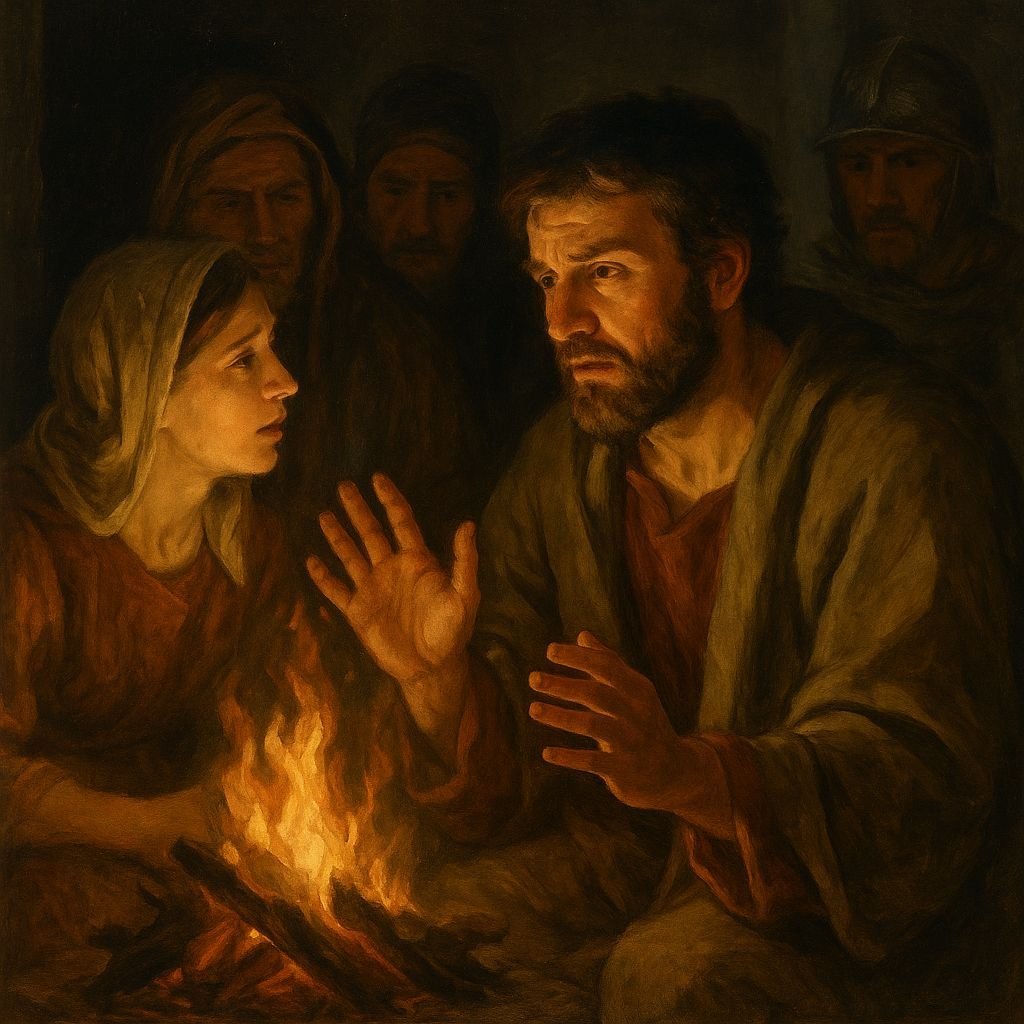
He and John enter the high priest’s courtyard. It’s cold. The guards are standing around a fire of burning charcoal—anthrakia (ἀνθρακία). That word appears only twice in all of Scripture: here, and later in John 21, when Jesus restores Peter beside another fire. John wants us to see that God’s grace is already preparing the sequel.
Peter warms his hands by the fire. You can picture it: orange light flickering across his face, the smell of smoke rising into the night. Inside, Jesus stands on trial for truth; outside, Peter stands trial for fear.
A servant girl recognizes him.
“You’re not one of this man’s disciples, are you?”
Matthew 26:69–73 (NRSVUE)
Now Peter was sitting outside in the courtyard. A servant-girl came to him and said, “You also were with Jesus the Galilean.” But he denied it before all of them, saying, “I do not know what you are talking about.” … Later another bystander came up and said to Peter, “Certainly you are also one of them, for your accent betrays you.”
And Peter replies with words that must have stunned even his own ears: “I am not.”
In Greek: ouk eimi (οὐκ εἰμί).
Those two words directly oppose the divine egō eimi (ἐγώ εἰμι) of Jesus moments earlier. Jesus says, “I AM.” Peter says, “I am not.”
The contrast couldn’t be sharper. The faithful witness and the fearful follower.
The second denial comes when others press him again: “You’re not one of them, are you?” He denies it.
And the third comes with emphasis: “Didn’t I see you in the garden with Him?”—and John tells us, “Peter denied it again, and immediately a rooster crowed.”
In Luke’s account, at that very moment, Jesus turns and looks at Peter.
Imagine that—Jesus, beaten and bound, still searching for His friend’s face.
That look isn’t condemnation; it’s compassion. It’s not “How could you?” but “I told you, and I still love you.”
Leon Morris calls that look “the beginning of repentance.” Peter goes out and weeps bitterly—not because he’s ruined, but because grace has begun its work.
And we can learn from this. Sometimes it’s hard for us to speak up because so many times fear silences our faith. It whispers that belonging to Jesus will cost too much. But every time we shrink back from our witness, every time we say “I am not” when Jesus says “You are mine,” the rooster crows again.
And yet… the crowing isn’t the sound of final judgment—it’s the sound of awakening.
The dawn is near. Grace is already on the move.
Peter’s denials didn’t surprise Jesus.
He predicted them.
And He also planned Peter’s restoration.
When Grace Restores Faith
(John 21:1–17)
Fast forward a few chapters.
The crucifixion has happened. The resurrection has stunned the disciples. But Peter still carries the weight of failure. He’s gone back to fishing—back to what he knows, perhaps trying to outrun what he’s done.
And once again, it’s early morning. Once again, he’s by the sea. And once again, there’s a fire of burning charcoal—anthrakia.
This is no coincidence. John is showing us that God’s grace doesn’t ignore our failures; it revisits them.
Jesus recreates the scene of Peter’s denial—not to shame him, but to heal him.
When Peter realizes it’s the Lord, he jumps into the water and swims to shore. There, soaked and breathless, he sees Jesus cooking breakfast. The last time he saw Jesus across a fire, he was denying Him. Now Jesus is inviting him to eat.
Three times, Jesus asks, “Do you love Me?”
It’s a mirror image of the three denials.
The first two times, Jesus uses the word agapaō (ἀγαπάω)—divine, self-giving love. Peter answers with phileō (φιλέω)—affectionate, brotherly love. He can’t bring himself to claim more. He’s too aware of his weakness.
The third time, Jesus meets him there: “Do you phileō Me?”—in other words, “Peter, do you even love Me as a friend?” And Peter replies, “Lord, You know everything. You know that I love You.”
In that moment, Jesus restores what was broken—not by lecture, but by love.
Three denials, three affirmations.
Three wounds, three healings.
Three failures, three commissions: “Feed My lambs. Tend My sheep. Feed My sheep.”
Jesus isn’t just forgiving Peter; He’s calling him.
He’s saying, “You may have denied Me at the fire, but now you’ll lead My flock.”
This is the heart of grace—it takes the place of our greatest failure and turns it into the platform of our greatest calling.
Maybe that’s what someone here needs to hear today:
You haven’t gone too far.
You haven’t failed too deeply.
If you bring your shame to Jesus, He’ll light a fire of restoration right where you thought your story ended.
Peter’s journey gives us a gospel-shaped pattern for our own.
In the garden, he failed by force—trying to control what only God could accomplish.
In the courtyard, he failed by fear—protecting himself instead of confessing Christ.
But on the shoreline, he found faith—restored by the very One he denied.
His story could have ended with a rooster’s crow, but God’s story ended with a resurrection call.
When Peter finally preached at Pentecost, he stood before another crowd—not to deny Jesus this time, but to proclaim Him boldly. Three thousand souls were saved that day. The one who said “I am not” now declared “Let all Israel know that God has made this Jesus both Lord and Christ.”
What changed? Grace.
Peter discovered that in God’s hands, failure isn’t the opposite of faith—it’s the classroom of faith.
It’s where we learn who Jesus really is: the Savior who doesn’t just forgive sinners, but restores disciples.
So maybe you’re here today carrying the weight of your own courtyard moment.
Maybe you’ve said or done something that still echoes in your mind when the night is quiet.
Maybe you think you’ve gone too far or that God could never use you again.
Friend, the rooster’s crow is not your ending—it’s your wake-up call.
Jesus is already on the shore, already lighting a new fire, already calling your name.
Bring Him your failure. Bring Him your regret. Bring Him your “I am not.”
And let Him remind you that because of the cross, He will always be “I AM.”
Your failure isn’t final in God’s hands.
In His hands, it becomes forgiveness.
In His hands, it becomes purpose.
In His hands, it becomes testimony.
Comments are closed