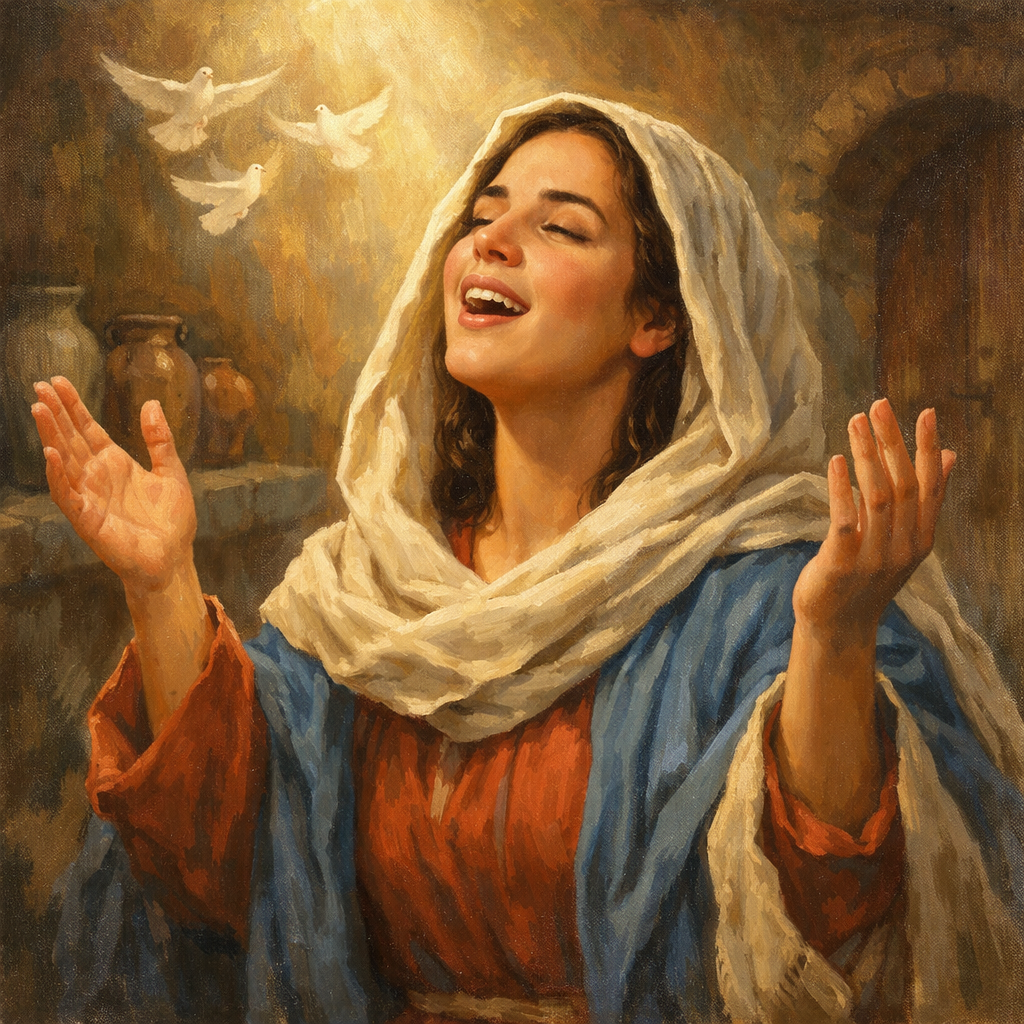
Text: Luke 1:46 to 55
Every great story has a moment when everything begins to turn.
For centuries the people of Israel had been waiting. The prophets had spoken about a coming Messiah. They had promised that God would one day restore His people, that a king from David’s line would come, and that through him the world would be blessed.
But then the prophetic voices grew quiet.
Four hundred years passed without a new prophet. Empires rose and fell. Rome came to power. The temple still stood in Jerusalem, but heaven seemed silent.
And then, suddenly, the silence breaks.
An angel appears.
His name is Gabriel.
That name may sound familiar, because Gabriel had appeared once before in Scripture in the Book of Daniel. In Daniel’s time he explained visions about kingdoms and about the coming of God’s redemption. Now centuries later the same messenger appears again, announcing that the moment those prophecies pointed toward has finally arrived.
Gabriel first appears to a priest named Zechariah in the temple. Then he travels north to a small village called Nazareth and speaks to a young woman named Mary.
He tells her that she will conceive by the Holy Spirit and give birth to a son who will be called the Son of the Most High.
It is an announcement that will change the world.
Mary responds with remarkable faith. She says, “Let it be to me according to your word.”
Not long after that, Mary travels south into the hill country of Judea to visit her relative Elizabeth.
And it is there, in that home, in the presence of Elizabeth, that Mary begins to sing.
This is not a song performed on a stage. It is a conversation between two women who are witnessing the beginning of something extraordinary.
Elizabeth has just recognized that Mary is carrying the promised Messiah. And Mary responds with words that have been echoing through the church ever since.
“My soul magnifies the Lord.”
What we call the Magnificat.
But here is what makes Mary’s song so remarkable.
It is not just beautiful poetry. It is deeply rooted in Scripture. It carries the language of the Psalms and the prophets. It reflects the promises God had been making to His people for generations.
Mary is not inventing new theology in that moment.
She is stepping into a story she already knows.
And as we walk through her song today, we will discover three things that shaped her faith and can shape ours as well.
- Mary knew the Word.
- Mary understood the character of God’s kingdom.
- And Mary’s song was bigger than her situation.
She Knew the Word
Text: Luke 1:46-49
What we just heard from Mary may sound spontaneous, but it actually reveals something remarkable about her life.
Mary did not invent this song.
Nearly every line of the Magnificat echoes the Scriptures of Israel. Her words sound like the prayer of Hannah in 1 Samuel when God answered her cry for a child. Her praise carries the same rhythm as the psalms the people of God had been singing for generations. You can even hear the voice of the prophets in it, especially the promises of Isaiah that God would lift the humble and overturn the pride of the powerful.
In other words, when Mary sings, she is stepping into a story that had already been unfolding for centuries.
And that tells us something important about her.
Mary knew the Scriptures.
Nazareth was not a theological center. It was a small Galilean village. Mary was not trained in the rabbinical schools of Jerusalem. She held no religious title. She was simply a young woman who had grown up listening to the Word of God.
She had heard the stories of Abraham and God’s covenant faithfulness. She had heard the songs of the psalms. She had heard how the Lord lifts the lowly and keeps His promises from generation to generation.
And somewhere along the way those words settled deep into her heart.
So when heaven interrupts her life, Scripture comes pouring out.
This is one of the most beautiful things about the Magnificat. Mary is not searching for words in that moment. The language of faith is already inside her.
And there is a lesson for all of us in that.
When life surprises us, we do not suddenly invent faith. What comes out of us in those moments is usually what has already been planted in us.
Mary’s song shows us what had been planted in her heart for years. The promises of God had become the language of her soul.
That is why she can speak so confidently about God remembering His mercy and helping His people. In Scripture, when it says God remembers, it does not mean He had forgotten something. It means He is now acting on the promises He made long ago. Mary understands that the child she carries is the fulfillment of the covenant God made with Abraham generations earlier.
She understands the story she is standing inside.
Dietrich Bonhoeffer once said that Mary’s song is ‘the most passionate and revolutionary Advent hymn ever sung.’ It is not a quiet lullaby. It is a declaration that God is about to overturn the world’s expectations. And the reason Mary can sing like that is because she already knows the story of God’s faithfulness. Her song is filled with the language of Scripture. Which leads to one of the most important lessons of this message.
You cannot sing what you have never stored.
Mary knew the Word before she knew the miracle.
- Before the angel came.
- Before the pregnancy.
- Before Bethlehem.
- Before the cross.
She already had Scripture in her bones.
And that matters, because when heaven interrupts your life, you do not suddenly develop theology. You reveal the faith that has already been forming inside you.
God’s Kingdom Turns the World Upside Down
Text: Luke 1:50-53
What we just heard in Mary’s song would not have sounded unfamiliar to the people of Israel.
The language she uses had been shaping the worship of God’s people for centuries.
There was actually a group of songs in Israel known as the Hallel Psalms, Psalms 113 through 118. The word Hallel simply means praise. These psalms were sung during the great festivals of Israel, especially during Passover when families gathered to remember how God had delivered them from slavery in Egypt.
Year after year, generation after generation, the people of God sang these songs together. Parents taught them to their children. Communities lifted them together in worship. These words became part of the spiritual vocabulary of Israel.
Which means Mary almost certainly grew up hearing them.
She would have heard them at the festivals. She would have heard them in worship. The rhythm of these psalms would have been familiar long before the angel ever appeared to her.
And here is the moment that really takes your breath away.
Mary is singing the language of these psalms as Christ is entering the world.
Then decades later, Matthew 26:30 tells us that on the night before the cross, Jesus gathers with His disciples for the Passover meal. After the meal the Gospels tell us that they sang a hymn together before going out to the Mount of Olives.
“When they had sung the hymn, they went out to the Mount of Olives.”
Matthew 26:30 NRSVUE
That hymn would have been these same Hallel Psalms.
So Mary is singing these songs as the Messiah comes into the world.
And Jesus sings these songs as He walks toward the cross.
The story of redemption is surrounded by the same worship.
Listen to how one of those psalms describes the character of God.
“Who is like the LORD our God, who is seated on high, who looks far down on the heavens and the earth? He raises the poor from the dust and lifts the needy from the ash heap, to make them sit with princes, with the princes of his people.”
Psalms 113:5-8 NRSVUE
That is the song Mary grew up hearing.
The God of Israel is the God who lifts the lowly, who notices the forgotten, who raises the humble and unsettles the proud.
So when Mary sings about the proud being scattered, the mighty being brought down, and the humble being lifted up, she is not inventing something new.
She is recognizing that the God who has always worked this way is about to act again.
And this time, the turning point of history is growing inside her.
Mary is describing what many theologians call the great reversal of God’s kingdom.
The values of heaven are not the same as the values of the world.
In the kingdoms of this world, power rises to the top. Status determines importance. Wealth often determines who is heard and who is ignored.
But when God begins to move, the entire system flips.
- The proud are scattered.
- The mighty are brought down.
- The humble are lifted up.
- The hungry are filled with good things.
This theme appears all throughout Scripture. It was there in Hannah’s song when she declared that the bows of the mighty are broken while those who stumble are strengthened. The prophets spoke about it again and again, promising that one day God would establish a kingdom where justice and mercy would prevail.
Mary understands that this long promised kingdom is now beginning to arrive.
And what is remarkable is how confidently she says it.
She speaks as if these things have already happened.
- The proud have been scattered.
- The mighty have been brought down.
- The hungry have been filled.
But if you look around Mary’s world at that moment, nothing visible has changed yet.
- Rome is still in power.
- The rich are still comfortable.
- The poor are still struggling.
- And Mary herself is about to walk into a life filled with uncertainty.
Yet she sings as though the victory is already secure.
That is what faith does.
Faith sees the world through the promises of God rather than the circumstances of the moment.
Mary understands that when God begins His work, the outcome is never in doubt.
The kingdom of God may begin quietly, but it always moves toward justice, mercy, and restoration.
And Mary is standing at the very beginning of that story.
Her Song Was Bigger Than Her Situation
Text: Luke 1:54-55
The final lines of Mary’s song step back even further.
She moves beyond her personal story, beyond the great reversal of God’s kingdom, and she anchors everything in the promises God made long before she was born.
Mary declares that God has helped His servant Israel and remembered His mercy just as He promised to Abraham and to his descendants forever.
In other words, Mary understands something extraordinary.
What is happening in her life is not a random moment.
It is the continuation of a promise that began centuries earlier.
From the very beginning of Israel’s story, God had promised that through Abraham’s family the world would be blessed. Generation after generation held onto that promise. Prophets spoke about it. Psalms celebrated it. The people of God waited for it.
And now Mary realizes something breathtaking.
The promise is unfolding in her lifetime.
The child she carries is the fulfillment of that ancient covenant.
But here is the remarkable part of Mary’s song.
She sings all of this before anything in her life has actually changed.
The angel has spoken, yes.
But the road ahead is still uncertain.
She will soon have to explain a miraculous pregnancy to Joseph. Her reputation in Nazareth will likely be questioned. The journey to Bethlehem will be difficult. Not long after Jesus is born, she and Joseph will flee to Egypt to escape a violent king.
Even later, Simeon will look at her in the temple and say that a sword will pierce her own soul.
Mary does not know all of those details yet, but she certainly knows that following God’s call rarely leads to an easy path.
And yet she sings.
- She sings about the proud being scattered.
- She sings about the mighty being brought down.
- She sings about the hungry being filled.
- She sings about God remembering His promises.
Nothing visible has changed yet, but Mary speaks as though the victory is already secure.
That is what faith looks like. Faith is not pretending that life is easy. Faith is trusting that God’s promises are larger than our circumstances.
Mary’s song was bigger than her situation.
She understood that the God who had been faithful to Abraham, faithful to Israel, and faithful through every generation would also be faithful now.
And that truth has not changed.
There are moments in our lives when the promises of God feel larger than the reality we are facing. We pray for healing but still live with illness. We ask for direction but still feel uncertain. We hold onto hope even when the road ahead is unclear.
In those moments we stand in the same place Mary stood.
And the question becomes the same one she answered.
Will we trust the promise before we see the outcome?
Mary’s faith reminds us that the story of God is always larger than the moment we are standing in.
She could sing because she knew the character of the God who had made the promise.
And that same God is still faithful today
Conclusion
When you step back and look at Mary’s song, something beautiful begins to emerge.
This is not just a young woman reacting to surprising news. This is a life that has been shaped by the story of God.
Mary knew the Word.
The songs of Israel had been living in her heart long before the angel appeared. The promises of God had already become the language of her soul.
And when heaven interrupted her life, those promises came pouring out.
She knew the character of God.
She knew that the God of Israel lifts the humble, fills the hungry, and overturns the pride of the powerful. The kingdom she sang about may begin quietly, but it always moves toward justice, mercy, and restoration.
And most remarkably of all, her song was bigger than her situation.
- She sang before the journey to Bethlehem.
- She sang before the uncertainty of Nazareth.
- She sang before the long road that would eventually lead her to stand at the foot of a cross.
Mary did not wait until everything made sense before she praised God.
She trusted the promise before she saw the outcome.
And that may be the greatest lesson of the Magnificat.
Faith does not wait for perfect circumstances before it begins to sing. Faith sings because it knows the character of the One who has made the promise.
The God Mary trusted is the same God we worship today.
The God who kept His covenant with Abraham, who fulfilled His promises through Christ, and who raised Jesus from the grave is still faithful to His people.
Which means the song Mary sang is still our song.
- We can magnify the Lord even when the road ahead is uncertain.
- We can rejoice in God our Savior even when the world feels unsettled.
- We can trust that the God who has been faithful for generations will be faithful again.
Because the story Mary stepped into did not end in Bethlehem.
- It moved to the cross.
- It moved to the empty tomb.
- And it continues even now.
So may we become people who know the Word deeply, who trust the character of God fully, and who learn to sing a song that is bigger than our situation.
“My soul magnifies the Lord, and my spirit rejoices in God my Savior.”
Comments are closed