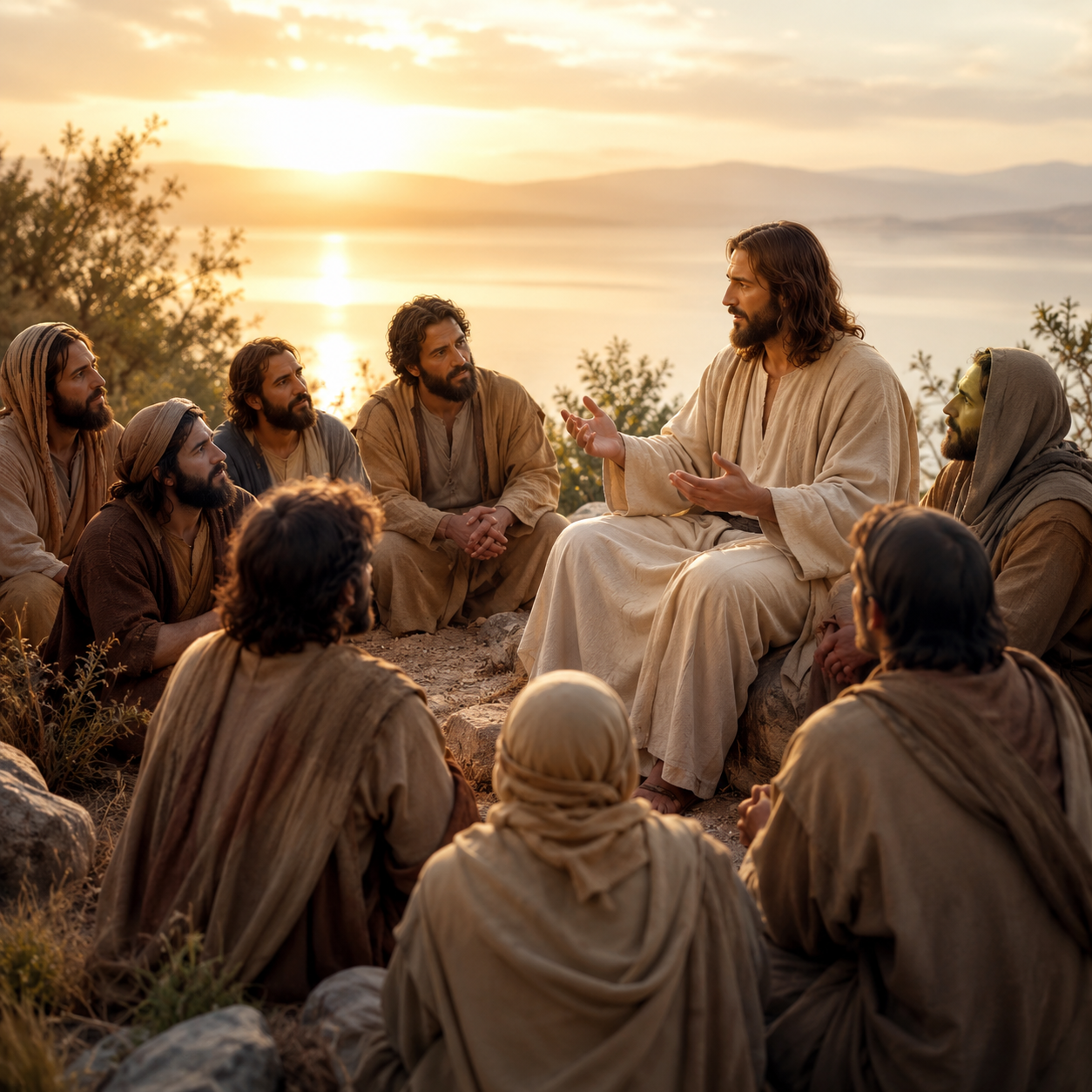
Matthew 6:5-15
There are moments in the Gospels when the disciples ask Jesus questions that reveal what is happening beneath the surface of their hearts. Sometimes they ask Him to explain a parable they have not understood. At other times they ask about the future or wrestle with the meaning of something He has said. Yet among all of those conversations, there is one request that stands apart because it is not simply a question seeking information, but a humble admission that they lacked something they deeply desired.
“Lord, teach us to pray.”
The more I have reflected on those simple words, the more remarkable they have become. By the time the disciples made that request, they had already witnessed things that most of us can scarcely imagine. They had watched Jesus speak with an authority that silenced His critics and captivated ordinary people. They had seen diseases disappear at His touch, demons flee at His command, and lives transformed simply because He had spoken a word. Before long they would witness storms obeying Him, thousands being fed from a few loaves of bread, and even the dead raised to life. Yet nowhere do we find them saying, “Lord, teach us to perform miracles.” They never ask Him to teach them how to preach with His authority or how to heal as He healed. Instead, after quietly observing the rhythm of His life, they ask Him to teach them to pray.
I have often wondered what they saw that led them to make that request. Perhaps it was because they noticed that every significant moment in Jesus’ ministry seemed to be preceded by time alone with His Father. Before important decisions He prayed. After demanding days of ministry He withdrew to pray. In moments of joy He prayed, and in moments of sorrow He prayed. Prayer was never an interruption to His ministry; it was the place from which His ministry flowed. Long before the disciples understood everything Jesus was teaching them, they understood that there was something profoundly different about His relationship with the Father, and they longed to know that same intimacy for themselves.
I suspect their request is closer to our own hearts than we sometimes admit. Prayer is one of the most familiar practices of the Christian life, and yet it is also one of the most intimidating. Many believers quietly wonder whether they are saying the right words, whether they are praying long enough, or whether someone else simply knows how to pray better than they do. Some are perfectly comfortable praying silently but become anxious the moment they are asked to pray aloud, while others have slowly convinced themselves that prayer belongs to pastors, Bible study leaders, or Christians who have somehow mastered a spiritual language they never learned.
If that has ever described you, then you have far more in common with the disciples than you may have realized.
Every Sunday, we join together and pray the Lord’s Prayer. Many of us learned those words as children, and they have become so familiar that we can often pray them from memory without stopping to consider why Jesus arranged them exactly as He did. We know the words, but perhaps we have not always noticed the wisdom that lies within their order.
Jesus was doing far more than giving His disciples a prayer to memorize.
He was teaching them how to pray.
My hope this morning is not simply that we leave with a deeper appreciation for the Lord’s Prayer, but that we leave with greater confidence in our own prayer lives. I hope that the next time we stand together and pray these familiar words, they will no longer feel like a cherished tradition we faithfully recite, but like the gentle voice of our Savior once again teaching ordinary disciples how to draw near to their Father. And perhaps, over time, these words will become more than a prayer we offer together each Sunday; they will become the pattern that quietly shapes every conversation we have with God throughout the week.
Look Up
When Jesus’ disciples asked Him to teach them to pray, they were not asking for a collection of impressive words that would make them sound more spiritual. They had listened to the religious leaders pray in the synagogues. They had heard long, carefully constructed prayers offered in public places. If eloquence had been the goal, they already had plenty of examples to imitate. Yet there was something different about the way Jesus prayed, something that drew them to ask not for better words, but for a better way. They had begun to realize that prayer was more than speaking to God. It was living in relationship with Him.
That relationship is the very first thing Jesus places before them.
“Our Father in heaven…”
Those words have become so familiar that it is easy to miss how breathtaking they must have sounded to those first disciples. The God of Abraham, Isaac, and Jacob, the One who spoke creation into existence, who thundered from Mount Sinai, whose glory filled the temple so completely that no one could stand in His presence, was now being introduced with the warmth and intimacy of a family relationship.
Jesus was not diminishing God’s majesty. He was revealing the privilege that would become ours through Him.
Every parent understands something of this. A child never wonders whether they are welcome to come to their father. They do not rehearse every sentence before asking a question or sharing what is on their heart. They come because they know they belong. Their confidence is not rooted in how well they speak but in the relationship they already possess.
That is the invitation Jesus extends to every believer.
How many people never pray because they are convinced someone else knows how to do it better? They listen to a pastor or a Sunday school teacher and quietly conclude that their own prayers are too simple, too awkward, or too ordinary. Yet Jesus never says that prayer begins with carefully chosen words. He teaches that it begins by remembering whose presence we have entered.
We come as children.
We come because Christ has made a way.
We come because the Father delights to hear the voices of His children.
Yet before we become too comfortable, Jesus adds another phrase that holds this beautiful invitation in perfect balance.
“Our Father in heaven.”
The same God who welcomes us as His children is still the sovereign King of heaven and earth. His nearness never diminishes His holiness, just as His greatness never lessens His love. Those two truths belong together, and whenever we separate them our understanding of prayer begins to drift. If we remember only His greatness, we may become afraid to approach Him. If we remember only His closeness, we may begin to treat Him too casually. Jesus will allow us to do neither, because the Father who welcomes us with open arms is still the Lord before whom angels bow in worship.
That is why the prayer continues, “Hallowed be Your name.”
Before Jesus teaches us to bring our requests before the Father, He teaches us to linger for a moment in worship, because worship has a remarkable way of restoring our perspective. Left to ourselves, we naturally carry our burdens into prayer and allow them to become the largest thing we see. A difficult diagnosis, an uncertain future, a strained relationship, or a burden we have carried for years can quietly occupy every corner of our minds until we can scarcely think of anything else. Yet as our attention settles upon the holiness, goodness, and faithfulness of God, those burdens begin to find their proper place. They have not disappeared, nor have they suddenly become unimportant, but they are no longer the greatest reality before us. The God to whom we pray is.
Perhaps that is why Jesus continues by teaching us to pray, “Your kingdom come. Your will be done, on earth as it is in heaven.”
Those words are familiar enough that we sometimes speak them without noticing what we are actually asking. Before we ever mention our own plans, our own hopes, or our own needs, Jesus teaches us to desire that God’s purposes would be accomplished first. He invites us to picture heaven itself, where God’s will is embraced without hesitation because those who dwell in His presence know that His ways are always good. Then, with remarkable simplicity, Jesus teaches us to pray that the same willing obedience would begin to shape our own lives.
That is not always an easy prayer to offer. There are moments when God’s will seems to align perfectly with our own desires, and surrender comes easily. There are other moments when following Christ requires forgiving someone we would rather avoid, trusting Him when the future remains uncertain, or waiting patiently when every instinct tells us to take matters into our own hands. It is precisely because those moments come that Jesus teaches us to begin here. Long before we ask God to change our circumstances, He teaches us to allow Him to shape our hearts.
Only after we have walked through these opening words do we begin to notice the pattern Jesus has been establishing all along. Before He teaches us to think about ourselves, He teaches us to lift our eyes toward our Father. Before our attention settles upon our needs, it rests upon His character. Before we ask Him to act on our behalf, we remember who He has always been.
In other words, every healthy prayer begins the same way.
It begins by looking up.
Look In
Once Jesus has taught His disciples to lift their eyes toward the Father, something beautiful begins to happen. The prayer that started with God’s character and God’s kingdom now gently turns toward the lives of those who are praying it, although even here Jesus refuses to let us become the center of the conversation. Instead, He teaches us that the confidence we found in our Father’s presence becomes the very reason we can now bring every part of our lives before Him with honesty and trust.
“Give us this day our daily bread.”
At first glance, those words seem almost too ordinary.
After speaking of God’s holy name, His kingdom, and His will, we might expect Jesus to continue with something equally grand, yet He deliberately turns our attention toward something as simple as bread. In doing so, He reminds us that our heavenly Father is not only concerned with the great moments of history, but also with the ordinary moments that make up our daily lives. The God who rules over heaven also cares whether His children have what they need today.
There is something wonderfully freeing about the word daily.
Jesus does not teach us to pray for next year’s bread or even next month’s bread. He teaches us to trust the Father for today. His first listeners would have immediately remembered the wilderness, where God provided manna one day at a time so that Israel would learn to depend upon Him rather than themselves. Every sunrise became another opportunity to discover that God’s faithfulness had not run out overnight.
How quickly we forget that lesson.
Our minds naturally race toward tomorrow. We worry about next week’s appointment, next month’s bills, or the uncertainty that lies somewhere beyond the horizon. Long before those things ever arrive, they have already stolen today’s peace. Yet Jesus gently draws us back to the present because faith has always been lived one day at a time. The Father who proved Himself faithful yesterday has not suddenly become less faithful today.
As those words settle into our hearts, we begin to realize that Jesus is teaching us something much deeper than how to ask for food. He is teaching us to acknowledge that every good gift ultimately comes from the Father and that dependence upon Him is not a sign of weakness but the very posture of every faithful disciple.
Then, almost without pause, Jesus turns from our physical needs to something even deeper.
“And forgive us our debts, as we also have forgiven our debtors.”
Just as we cannot provide everything our bodies need, neither can we repair what sin has broken within us. Every one of us stands before God in need of mercy. Whether we have walked with Christ for fifty years or only recently begun following Him, we never outgrow our need for His grace. Prayer becomes the place where we stop pretending we have everything together and instead bring our hearts honestly before the One who already knows them completely.
It is no accident that forgiveness immediately turns our attention toward other people.
The mercy we ask God to extend toward us begins to reshape the mercy we extend toward others. Hearts that have been overwhelmed by God’s forgiveness gradually become hearts that find it more difficult to cling to resentment, because it is impossible to linger at the foot of the cross without remembering how much we ourselves have been forgiven.
There is another detail in this portion of the prayer that is easy to overlook until someone points it out, and once you notice it, it becomes almost impossible to unsee.
Jesus never says my.
He teaches us to pray, our Father… give us… forgive us.
Every request is offered in the company of God’s family.
When I pray for our daily bread, I cannot help but remember those who are struggling to put food on the table. When I ask God to forgive us, I remember that I stand beside every other believer as someone who lives entirely by grace. Prayer quietly pulls us out of ourselves and reminds us that we belong to one another just as surely as we belong to Christ.
Perhaps that is the discovery Jesus has been leading us toward all along. After teaching us to lift our eyes toward our Father, He now invites us to examine our own hearts with honesty, bringing before Him our needs, our failures, and even our relationships with others, all the while reminding us that we never make this journey of faith alone.
Only then do we recognize the pattern that has been quietly taking shape.
Healthy prayer not only teaches us to look up.
It also teaches us to look in.
Look Ahead
As Jesus brings the Lord’s Prayer to its final petition, something remarkable begins to emerge. He has already taught His disciples to lift their eyes toward the Father before they think about themselves. He has taught them to bring their daily needs, their deepest failures, and even their relationships honestly before God. Yet He does not conclude the prayer by leaving them in that quiet place of communion. Instead, He gently turns their attention toward the world that awaits them beyond the prayer itself, because the purpose of prayer has never been to remain in God’s presence for a few peaceful moments before returning unchanged to ordinary life. Prayer is meant to prepare us for whatever lies beyond the moment we say, “Amen.”
“And lead us not into temptation, but deliver us from evil.”
Those words have sometimes caused confusion because James later reminds us that God does not tempt anyone to sin. Temptation does not originate in the Father’s heart, nor does He delight in placing stumbling blocks before His children. Jesus is not suggesting otherwise. Rather, He is teaching His disciples to acknowledge something that every follower of Christ eventually discovers, namely that we are far less capable of navigating this life faithfully than we often imagine.
There is a quiet humility in praying these words because they require us to admit something our pride would rather deny. Left to ourselves, we are not nearly as strong as we think we are. We are not as discerning as we imagine, nor are we as prepared for tomorrow as we often convince ourselves. Every new day places before us conversations we have not anticipated, decisions we have not yet considered, disappointments we cannot foresee, and temptations that frequently arrive wearing the disguise of ordinary moments. Rarely do they announce themselves with dramatic warnings. More often they come quietly through impatience with someone we love, pride that seeks recognition, resentment that refuses to let go of an old wound, fear that slowly replaces trust, or the subtle temptation to rely upon our own wisdom instead of the Father’s.
Jesus knows those moments are coming.
That is perhaps the most striking feature of this final petition. He does not teach His disciples how to pray if temptation comes into their lives. He teaches them how to pray because temptation will come. The question is not whether we will face moments that test our faithfulness, but whether we will enter those moments having already placed ourselves under the Father’s care.
How often do we reverse that pattern?
We pray after the harsh words have already been spoken. We seek wisdom after the decision has already been made. We ask for strength after we have exhausted our own. We cry out for forgiveness after we have wandered farther than we ever intended to go. There is immeasurable grace when we do, for our Father never turns away the repentant heart. Yet Jesus invites us into something even deeper. He teaches us to seek the Father’s guidance before our feet ever begin walking the path before us, because prayer is not merely God’s provision for recovering from yesterday’s failures. It is His gracious gift for preparing us to walk faithfully through today.
There is also something profoundly comforting about what Jesus chooses to ask for—and what He does not.
He does not teach us to pray that every hardship will disappear or that every difficult circumstance will be removed from our lives. He never promises that following Him will shield us from disappointment, suffering, or seasons of uncertainty. Instead, He teaches us to pray that as we encounter those realities, the Father will faithfully guide us through them without allowing temptation or evil to draw our hearts away from Him. The prayer shifts our attention away from comfort and toward faithfulness. Rather than asking for an easier road, Jesus teaches us to seek the Father’s presence along whatever road lies ahead.
Then He adds one final request.
“Deliver us from evil.”
By the time Jesus speaks those words, His disciples have already witnessed enough of His ministry to know that the kingdom of God does not advance without opposition. Evil is not merely the collection of unfortunate circumstances that make life difficult. Throughout Jesus’ ministry it represents everything that stands opposed to God’s good purposes, everything that seeks to distort His truth, weaken our trust, or lure our hearts away from faithful obedience. Long before we step into a meeting, answer a telephone call, begin a conversation with a family member, or face an unexpected disappointment, there is already a spiritual reality unfolding around us that we cannot fully see. Jesus teaches us to acknowledge that reality not because He wants us to live in fear of it, but because He wants us to live in daily dependence upon the One who has authority over it.
As those final words settle into our hearts, we begin to realize that Jesus has quietly been preparing us for far more than a few moments of prayer. He has been preparing us for life itself. The Father whose name we have just honored, whose kingdom we have just sought, whose provision we have just trusted, and whose forgiveness we have just received is the very Father who now walks beside us into whatever this day may hold. Tomorrow remains unknown to us, but it has never been unknown to Him.
Only after following Jesus through this final petition do we begin to recognize the beautiful pattern that has been unfolding from the very first words of the prayer. Before He taught us to speak about our needs, He taught us to remember our Father. Before He sent us into the uncertainties of tomorrow, He invited us to bring our hearts honestly before Him. Now, as the prayer comes to its close, He teaches us to step confidently into the future, not because we know what tomorrow holds, but because we know the Father who already holds tomorrow.
Perhaps that is the final discovery Jesus intended His disciples to make.
Healthy prayer does not end when we rise from our knees.
It quietly prepares us to walk into the day with the confidence that our Father is already there.
In other words, every healthy prayer eventually learns to do one more thing.
It learns to look ahead.
Conclusion
As we come to the end of the Lord’s Prayer, we also return to the request that first brought us here.
“Lord, teach us to pray.”
When the disciples spoke those words, they could not have imagined how many generations would one day treasure the answer Jesus was about to give them. They were not asking for a prayer to recite during worship or a set of carefully chosen words that would make them sound more spiritual. They were asking their Rabbi to teach them how to enjoy the same communion with the Father that they had watched Him experience day after day. Jesus answered that request by giving them something far greater than a formula. He gave them a pattern that would shape every conversation they would ever have with God.
That is why the Lord’s Prayer is a gift from Christ Himself that has endured for two thousand years.
Every time we pray these familiar words, Jesus gently teaches us once again where prayer begins, what it accomplishes within us, and how it prepares us for the life that lies beyond it. He reminds us to lift our eyes before we lift our requests, because worship restores our perspective and our Father is always greater than the burdens we carry. He invites us to bring our hearts honestly before Him, trusting that the One who provides our daily bread is also the One who delights to forgive His children and reshape our hearts toward one another. Then, before we leave His presence, He prepares us to step into an uncertain world with the quiet confidence that the Father who has heard our prayers will also guide our steps.
Perhaps that is why Christians have continued praying these words through every generation and in every corner of the world. They have been whispered beside hospital beds, spoken around family tables, prayed in prison cells, recited in crowded sanctuaries, and offered quietly by believers whose voices could barely be heard. Through every century, the circumstances have changed, but the Father has not. The same Savior who first taught these words to a handful of disciples still teaches them to His Church today.
So next Sunday, when we stand together and pray the Lord’s Prayer as we always do, I hope those familiar words will sound a little different. I hope you will hear them not simply as a treasured tradition of the Church, but as the loving voice of Jesus once again teaching His disciples how to pray. And when Monday morning arrives, long before you begin your work, check your messages, or turn your attention to everything the day demands of you, remember the simple pattern He has given us.
Look up: Remember your Father.
Look in: Bring Him your whole heart.
Look ahead: Entrust the day into His faithful hands.
Prayer has never been about finding the perfect words. It has always been about walking each day with the perfect Father, and there is no greater teacher of that truth than the One who first looked upon His disciples with compassion and simply said, “When you pray…”
Comments are closed