Text: John 11–12, Zechariah 9:9
There are moments in life that change everything.
Not always in the moment. Sometimes they feel ordinary at first. A conversation. A gathering. A meal shared around a table. But later, when you look back, you realize that what happened there set everything else in motion.
Palm Sunday is one of those moments.
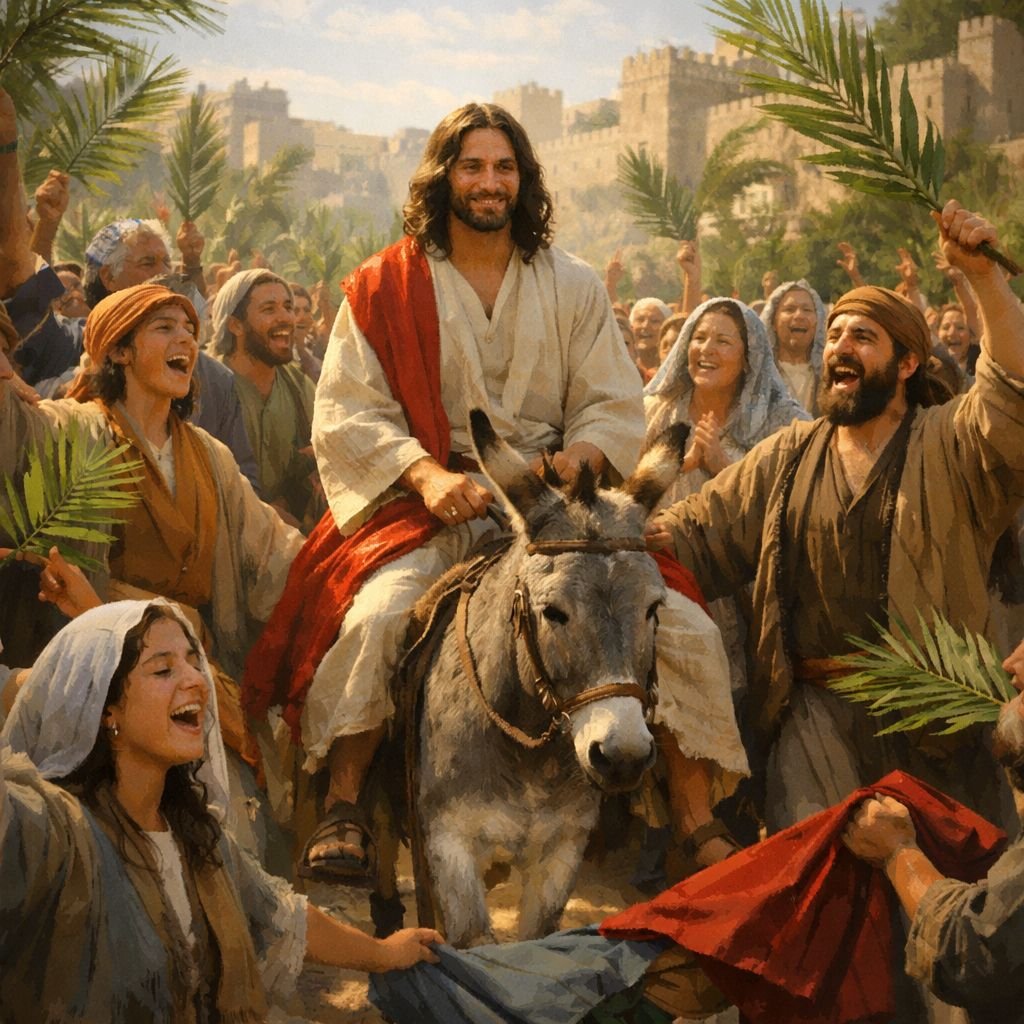
We tend to picture it as a beginning. The start of Holy Week. The moment Jesus enters Jerusalem as the crowd waves palm branches and shouts, “Hosanna.”
But Palm Sunday does not begin on the road into Jerusalem.
It begins in a home.
It begins in Bethany, with a family that Jesus loved. Martha, Mary, and their brother Lazarus. And just before this moment, something happens that changes everything.
Lazarus dies.
And not just for a moment. Not just long enough to create concern. He has been in the tomb for four days. Long enough that hope is gone. Long enough that the people around him have already begun to move on with grief.
And then Jesus arrives.
Martha meets Him with a mixture of faith and heartbreak. Mary falls at His feet in tears. And Jesus stands at the edge of a tomb and calls a dead man by name.
“Lazarus, come out.”
And Lazarus walks out.
There’s an old line from Augustine of Hippo that has always stayed with me when I read this story. He said that it was a good thing Jesus called Lazarus by name, because if He had simply said “come out,” every tomb in Jerusalem might have opened. And when you really sit with that, you begin to realize just how powerful the voice of Jesus truly is and it is impossible to overstate what that moment does.
This is not a quiet miracle. This is not something that can be explained away. This is public. This is undeniable. A man who was dead is now standing in front of them. And word spreads.
People begin to talk. Crowds begin to gather. And from that moment on, everything begins moving toward Jerusalem.
Because when Jesus raises Lazarus, He does not just change a family.
He sets into motion the week that will change the world.
And it is in the days immediately following that miracle that we meet three groups of women, each responding to Jesus in a different way.
- One serves Him.
- One worships Him.
- And one celebrates Him.
And in their responses, we begin to see something that speaks directly to us.
Because not all responses to Jesus are the same.
- Some come from devotion.
- Some come from understanding.
- And some come from expectation.
And as we step into Holy Week, the question is not just what happened then.
Martha — True service is not distraction when it flows from devotion (John 12:2)
When we return to Bethany after the raising of Lazarus, the atmosphere has changed.
This is no longer a house filled with grief. It is a house filled with life. Lazarus is at the table, no longer wrapped in burial cloths but seated as a living testimony to what Jesus has done. You can almost imagine the conversations, the glances across the room, the quiet awareness that something extraordinary has taken place. This is not just dinner. This is a moment shaped by resurrection.
And in the middle of that moment, Martha is exactly where we would expect her to be, Serving.
John tells us simply, “Martha served,” and the word he uses is διακονέω, diakoneō. It means to minister, to attend to, to care for the needs of others. It is not a casual word. It is where the early church would later draw the language for deacons, those who are set apart for service within the body of Christ. What Martha is doing is not peripheral to the moment. It is central to it.
But if we are not careful, we will misunderstand her.
Because for many of us, the first thing we think of when we hear Martha’s name is another story. We remember her in Luke’s Gospel, busy and distracted, frustrated that Mary is not helping, overwhelmed by everything that needs to be done. And Jesus gently corrects her there, reminding her that she is worried about many things.
And because of that, Martha has been remembered as the one who got it wrong.
But this is not that moment, you see, something has changed.
This is not Martha serving out of anxiety. This is Martha serving out of understanding.
She has stood in front of Jesus and wrestled with loss. She has spoken words of faith even in grief. She has heard Him say, “I am the resurrection and the life,” and then she has seen those words come to life as her brother walks out of a tomb.
And now, she serves again.
But this time, there is no complaint. No comparison. No frustration that someone else is not doing their part. There is simply faithfulness.
There is a quiet confidence in what she is doing.
Because Martha no longer needs to prove anything. She is not trying to manage the moment. She is responding to it.
And that is the difference.
Because service, when it flows from the wrong place, becomes burden.
But service, when it flows from the right heart, becomes worship.
Martha is not distracted anymore.
She is devoted.
She is preparing the table, but she is also preparing the space. She is creating an environment where people can sit in the presence of Jesus, where conversation can happen, where lives can be changed. And while her hands are moving, her heart is settled.
And I think this matters, because there are many people who love Jesus deeply, but their love does not look like stillness.
- It looks like responsibility.
- It looks like showing up early and staying late.
- It looks like setting things up and cleaning things up.
- It looks like making sure there is a place for someone else at the table.
And sometimes, those acts can feel invisible.
But not to Jesus.
Because what Martha shows us is that not every act of devotion happens at His feet.
- Some of it happens in the background.
- Some of it happens in the quiet faithfulness of doing what needs to be done.
And when it is rooted in love, it is no less sacred.
Martha teaches us that true service is not about being busy.
It is about being devoted.
It is about allowing what we have seen Jesus do in our lives to shape how we respond to Him.
And when that happens, even the simplest acts become something more.
- They become an offering.
- They become worship.
- They become a way of saying, without words, “Because of who You are, this is what I give.”
Mary — True worship recognizes who Jesus is and responds with everything (John 12:3)
If Martha shows us movement, Mary shows us stillness.
If Martha’s devotion is expressed through service, Mary’s devotion is expressed through surrender.
And what makes this moment so powerful is not just what Mary does, but what she understands.
Because while the room is still processing the miracle, while people are still talking about Lazarus and everything that has happened, Mary does something that shifts the entire atmosphere.
John tells us that she takes a pound of pure nard, a costly perfume, and anoints the feet of Jesus. The word used is μύρον, myron, a fragrant oil often associated with burial. This is not something you use casually. This is not something you bring out for an ordinary moment. This is something you save. Something you protect. Something you hold onto because of its value.
And Mary pours it out.
Not a portion of it. Not a measured amount. She breaks it open and gives it fully.
And then she does something even more striking.
She lets down her hair and wipes His feet with it.
It is hard for us to fully feel how personal that is. In that culture, a woman’s hair was not something she would let down in public. This is an act of vulnerability. Of humility. Of complete disregard for how this might be perceived by others in the room.
But Mary is not focused on the room, she is focused on Jesus.
- She is not calculating the cost.
- She is not managing appearances.
- She is not waiting for the right moment.
She sees Him for who He is, and her response is to give everything.
And John tells us that the house was filled with the fragrance of the perfume.
Not just around her. Not just around Jesus. The whole house.
Everyone in that space is now aware of what she has done.
And that is what true worship does.
- It cannot be contained.
- It cannot be hidden.
- It fills the room.
- It affects others.
But not everyone understands it.
Judas speaks up. He questions it. He calls it wasteful. He frames it as something that could have been used more wisely, more efficiently, more practically. And if we are honest, his words can sound reasonable at first.
Until you realize that worship is not about efficiency, it is about response. And Jesus defends her.
“Leave her alone. She bought it so that she might keep it for the day of my burial.”
In that moment, Jesus reveals what Mary already seems to understand.
This is not just a celebration. This is preparation.
While others are still focused on the miracle behind them, Mary is responding to what lies ahead.
She sees something they do not yet see.
She recognizes that the path Jesus is walking does not lead to a throne the way they expect, but to a cross. And her response is not to pull back, not to question, not to hold onto what she has.
Her response is to pour it out and that is what makes her worship different.
- Martha serves faithfully.
- Mary worships sacrificially.
- Martha creates space for the presence of Jesus.
- Mary responds to the presence of Jesus.
Both are beautiful and necessary; but Mary shows us something that prepares us for what comes next.
Because true worship is not just about what Jesus has done for us.
It is about recognizing who He is, even when we do not fully understand what He is about to do.
And when we begin to see Him that way, the question is no longer what is reasonable to give.
The question becomes, what could we possibly hold back?
It is possible to celebrate Jesus for what we want Him to be, and still miss who He truly is. (John 12:12-13)
The next day, everything changes.
The quiet, intimate setting of Bethany gives way to the noise and movement of Jerusalem. The table is left behind, and the road comes into view. The fragrance that filled the house is replaced by the sound of a crowd gathering, voices rising, anticipation building.
And among that crowd are women.
Women who have heard the stories. Women who have likely heard about Lazarus. Women who have come with everyone else to see Jesus as He enters the city. They are not on the outside of this moment. They are part of it. They are participating, engaged, caught up in what feels like the beginning of something extraordinary.
John tells us that they take palm branches and go out to meet Him.
Palm branches were not just something people grabbed because they were nearby. They carried meaning. They were symbols of victory, of deliverance, of national hope. When people waved palm branches, they were making a statement about what they believed was happening.
And then they begin to shout.
“Hosanna! Blessed is the one who comes in the name of the Lord, the King of Israel!”
That word “Hosanna” comes from the Hebrew הוֹשִׁיעָה נָּא, hoshi‘ah na, which means “save us now.” It is a cry pulled straight from Psalm 118, a song they would have known, a prayer they would have sung. It is both praise and plea at the same time.
“Save us, we beseech you, O LORD! O LORD, we beseech you, give us success! Blessed is the one who comes in the name of the LORD. We bless you from the house of the LORD.”
Psalms 118:25-26 NRSVUE
Save us now.
“So they took branches of palm trees and went out to meet him, shouting, “Hosanna! Blessed is the one who comes in the name of the Lord— the King of Israel!””
John 12:13 NRSVUE
And in their minds, they know exactly what that means.
- Save us from Rome.
- Save us from oppression.
- Save us from the weight of the world we are living in.
They are not wrong to call Him King.
They are just expecting the wrong kind of victory.
Because while they are waving branches that symbolize triumph, Jesus is entering the city in a way that speaks of humility. He comes riding on a donkey, fulfilling the words of the prophet Zechariah, a King who comes not in power as the world defines it, but in gentleness, in lowliness, in peace.
“Rejoice greatly, O daughter Zion! Shout aloud, O daughter Jerusalem! See, your king comes to you; triumphant and victorious is he, humble and riding on a donkey, on a colt, the foal of a donkey.”
Zechariah 9:9 NRSVUE
And in that moment, two realities exist side by side.
- The crowd sees a conqueror.
- Jesus comes as a Savior.
- The crowd celebrates what they hope He will do.
- Jesus is committed to what He has come to do.
And this is where the contrast with Martha and Mary becomes unmistakable.
- Martha serves with a heart shaped by what she has seen Jesus do. Her service flows from trust.
- Mary worships with a heart that recognizes who Jesus is, even when others do not. Her worship flows from understanding.
- But the crowd, including the women of Jerusalem, responds with expectation.
They are not responding to who Jesus is, they are responding to who they want Him to be.
And that is where the tension of Palm Sunday lives.
Because it is possible to be close to Jesus…
- To be part of the crowd…
- To raise your voice in praise…
- To participate in the moment…
And still miss the meaning.
It is possible to celebrate Him as King, and still resist the kind of King He actually is.
Because the King they wanted would take power. The King who came would give His life.
The King they expected would overthrow Rome. The King who came would conquer sin, death, and the human heart.
And that is a different kind of victory. One that is not won with force, but with sacrifice.
Not established through domination, but through love. And as we stand at the beginning of Holy Week, that same question comes to us. Not just what are we shouting.
But what are we expecting?
Are we coming to Jesus asking Him to fix the circumstances around us or are we willing to let Him transform what is within us? Because Martha shows us what it looks like to serve with the right heart. Mary shows us what it looks like to worship with the right heart. And the crowd reminds us how easy it is to praise with the wrong expectations.
They were not wrong to cry out, “Hosanna.”
They were just not ready for the answer to that prayer because the answer would not come through a throne. It would come through a cross.
Conclusion
As we come to the end of this moment, we find ourselves back where we began.
In Bethany.
In a home that, at first glance, could have felt like just another gathering. A meal shared. A table set. Conversations happening in the background. But now we know better.
Because just days before, that home had been filled with grief.
- A brother lost.
- A tomb sealed.
- Hope buried.
And then Jesus stood in front of that tomb and called Lazarus by name.
And everything changed.
That moment did not stay in Bethany, it moved, spread and carried people from a home into the streets of Jerusalem. It stirred a crowd. It created anticipation. It set into motion the week that would change the world.
And in the middle of all of it, we see three responses.
Martha serves.
Not out of pressure. Not out of comparison. But out of a heart that has seen what Jesus can do and simply wants to create space for others to encounter Him. Her worship looks like movement. It looks like responsibility. It looks like faithfulness in the background, where not everyone sees, but where everything matters.
Mary worships.
Not with caution. Not with restraint. But with a heart that recognizes something deeper. She pours out what is costly. She steps into vulnerability. She fills the room with a fragrance that no one can ignore. Her worship is personal. It is sacrificial. It is shaped not just by what Jesus has done, but by who He is.
And then the crowd gathers.
Voices raised. Branches waving. Energy building. They shout the right words. They call Him King. They cry out, “Hosanna, save us now.”
And yet, they do not fully see Him. They are in His presence but they do not yet recognize His purpose and that is the tension that carries into this week. Because worship is not one size fits all. It is not confined to one posture, one expression, one way of responding.
For some, it looks like Martha for some, it looks like Mary. Both are beautiful and are needed. Because worship is as unique as we are. and there is something that must be true for all of us.
- It is not enough to simply be near Jesus.
- It is not enough to be in the room.
- It is not enough to be part of the crowd.
- It is not enough to say the right words or sing the right songs.
We must recognize Him for who He truly is.
Because the same Jesus who sat at the table in Bethany is the one who entered Jerusalem. And the same Jesus who entered Jerusalem is the one who walked toward the cross. And if we only see Him as a King who comes to take power, we will miss the Savior who came to give His life.
So as you leave this place today, standing at the beginning of Holy Week, the invitation is not just to remember what happened.
- It is to see Him clearly.
- To follow Him intentionally.
- To respond to Him honestly.
- And to worship Him for who He truly is.
Because when we do, everything changes.
- Just like it did in Bethany.
- Just like it did on that road into Jerusalem.
- And just like it still can today.
Comments are closed