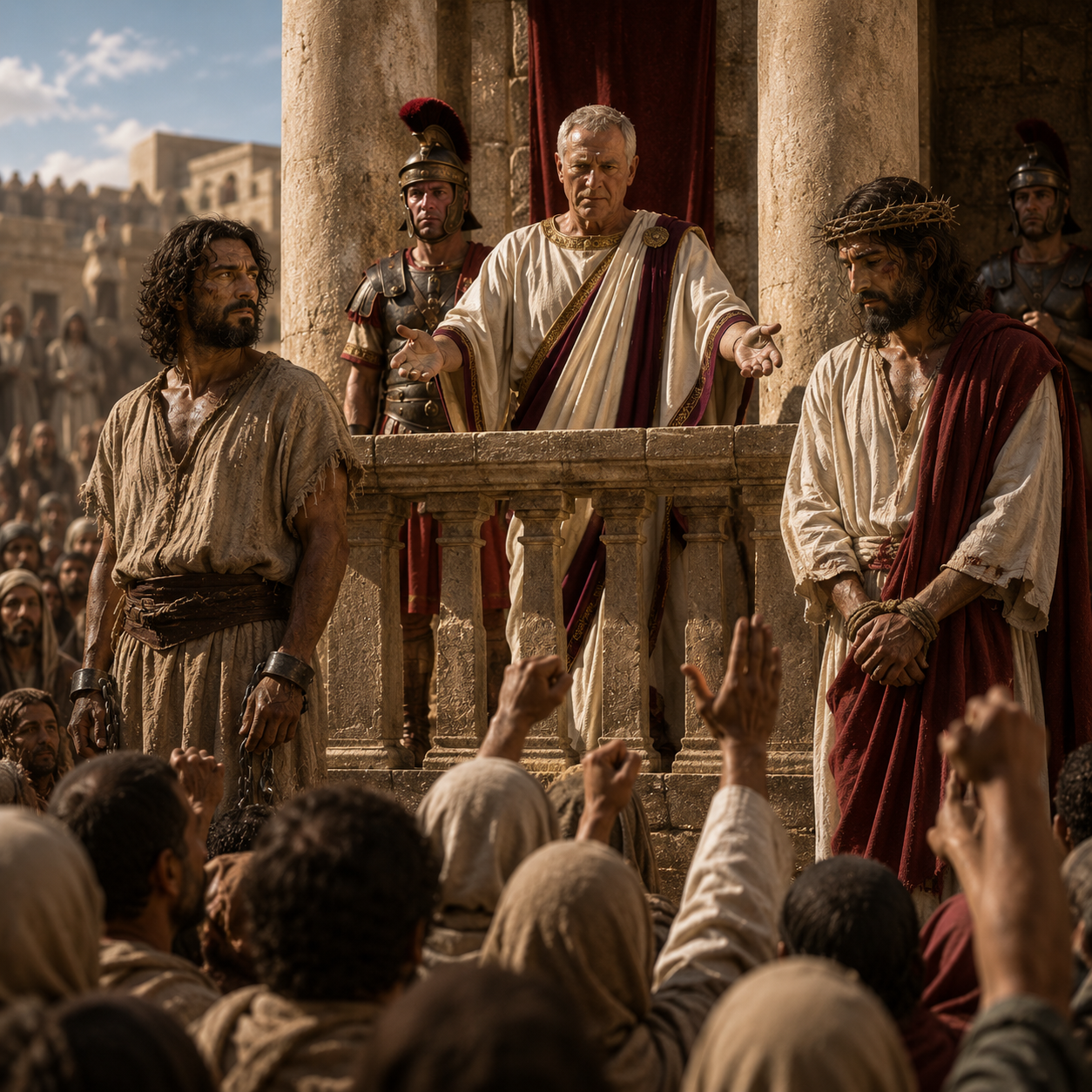
Matthew 27:15-21
I’m sure most of you expected me to step away from our Matthew study this week. After all, this is our Service of Hope, and the passage scheduled for today is the story of Barabbas being set free while Jesus is sent toward his execution. There are certainly easier passages to preach on a morning when we are surrounded by lights representing people we love. Yet hidden within this enormous moment in the Passion is one easily overlooked detail that I think may be exactly where we need to spend some time today.
There are a lot of names represented by the lights at our alter rail, and every one of those names carries a story much larger than anything that could ever be written on the side of a luminary. Some belong to survivors, some to people whose journey is still unfolding, and some to people we desperately wish were sitting beside us today. Some of these lights belong to my story too, so I don’t approach what we are doing today as though suffering, caregiving, grief, and hope are things that only happen in somebody else’s family.
Yet the name written on the light rarely tells the whole story. Behind that name are other people whose lives were changed too: the spouse sitting beside the hospital bed, the child driving a parent to treatment, the sibling waiting for the phone call, the friend who keeps showing up, or the caregiver who somehow learns to carry responsibilities they never expected to have. Their suffering is different from the suffering of the person they love, but different does not mean insignificant.
Perhaps that is why Matthew’s easily overlooked detail matters so much today. Right in the middle of a story dominated by Jesus, Barabbas, Pilate, and the crowd, Matthew pauses long enough to notice someone standing outside the spotlight. Someone whose suffering could easily have been lost within a much bigger story. And perhaps before we talk about hope today, Matthew is inviting us to notice her too.
Your Suffering Is Real
Now at the festival the governor was accustomed to release a prisoner for the crowd, anyone whom they wanted. At that time they had a notorious prisoner called Jesus Barabbas. So after they had gathered, Pilate said to them, “Whom do you want me to release for you, Jesus Barabbas or Jesus who is called the Messiah?” For he realized that it was out of jealousy that they had handed him over. While he was sitting on the judgment seat, his wife sent word to him, “Have nothing to do with that innocent man, for today I have suffered a great deal because of a dream about him.” Now the chief priests and the elders persuaded the crowds to ask for Barabbas and to have Jesus killed. The governor again said to them, “Which of the two do you want me to release for you?” And they said, “Barabbas.”
Matthew 27:15-21
Matthew brings us into a scene where almost everything demands our attention. Pilate is sitting on the judgment seat, the chief priests and elders are stirring the crowd, and two prisoners stand before them. One is Barabbas, a notorious prisoner whose freedom now hangs in the balance. The other is Jesus, the one Matthew has spent his entire Gospel helping us understand. Pilate asks the crowd which man they want released, and as the pressure begins to build, the story seems to be moving so quickly toward the decision that will send Jesus to the cross that it would be easy to miss the interruption Matthew places right in the middle of it.
While Pilate is sitting there, a message arrives from his wife: “Have nothing to do with that innocent man, for today I have suffered a great deal because of a dream about him.” Matthew is the only Gospel writer who tells us this happened, and those words are remarkable because Pilate’s wife is not the person on trial. She will not be beaten, mocked, or crucified, and whatever suffering she experienced that day cannot be compared with what Jesus was about to endure. Yet Matthew does not use the magnitude of Jesus’ suffering to dismiss hers. He simply allows her to tell the truth: “I have suffered a great deal.”
There is something deeply important in that for anyone who has ever stood beside someone they love while that person suffered. We sometimes minimize what is happening inside of us because we know someone else has it worse. The caregiver says, “I’m fine, I’m not the one who’s sick.” The spouse says, “This isn’t about me.” The parent tries to remain strong because their child already has enough to carry, while the child does the same thing because they do not want their parent worrying about them. Love has a way of making us willing to carry enormous burdens quietly, and sometimes we become so accustomed to carrying them that we convince ourselves they should not feel heavy.
But suffering is not a competition, and acknowledging your own pain does not diminish the pain of the person you love. Pilate’s wife suffered differently from Jesus, but differently did not mean insignificantly. The same is true for the person who sits through the appointments, waits through the procedures, learns the medications, lies awake listening for movement in the next room, or spends months trying to be the strong one for everybody else. It is also true for the person whose caregiving has ended, but whose love has not, and who now carries grief where responsibility used to be.
Matthew gives Pilate’s wife only one verse, but one verse is enough to remind us that the people standing beside suffering are part of the story too. Their names may not be written on the luminaries at our altar rail, and their experiences may never receive the same attention as the person they love, but God does not overlook suffering simply because it happens outside the spotlight. Before hope asks us to believe anything about tomorrow, perhaps it begins by allowing us to tell the truth about today: this is hard, this hurts, and God sees me here too.
There Is Another Voice
At that place he came to a cave and spent the night there. Then the word of the LORD came to him, saying, “What are you doing here, Elijah?” He answered, “I have been very zealous for the LORD, the God of hosts, for the Israelites have forsaken your covenant, thrown down your altars, and killed your prophets with the sword. I alone am left, and they are seeking my life, to take it away.” He said, “Go out and stand on the mountain before the LORD, for the LORD is about to pass by.” Now there was a great wind, so strong that it was splitting mountains and breaking rocks in pieces before the LORD, but the LORD was not in the wind, and after the wind an earthquake, but the LORD was not in the earthquake, and after the earthquake a fire, but the LORD was not in the fire, and after the fire a sound of sheer silence. When Elijah heard it, he wrapped his face in his mantle and went out and stood at the entrance of the cave. Then there came a voice to him that said, “What are you doing here, Elijah?”
1 Kings 19:9-13
Pilate’s wife does more than acknowledge that she is suffering. She sends a message into the middle of everything happening around her. She cannot stop the trial, control the crowd, or determine what Pilate will do, but she can speak what she has been given to speak: “Have nothing to do with that innocent man.” Matthew has already taught us to pay attention when dreams appear in his Gospel because God repeatedly uses them to reveal something that people otherwise could not see, and here, once again, an unexpected person recognizes something true about Jesus while so many others are missing it.
The tragedy is that her voice is surrounded by louder ones. The chief priests and elders persuade the crowds, the people demand Barabbas, and the pressure around Pilate continues to build. Pilate’s wife speaks only once, and then her voice disappears from Matthew’s Gospel altogether. Yet the fact that the crowd is louder does not make the crowd right. Sometimes the loudest voice is not the truest voice, and sometimes the voice carrying truth is the one we have to become quiet enough to hear.
Elijah discovered something similar centuries earlier when his own life had become overwhelmed by fear and exhaustion. He had reached the point where he simply wanted to give up, and when God met him at Horeb, Elijah experienced a powerful wind, an earthquake, and then a fire. Yet 1 Kings tells us that the Lord was not in any of them. After all that noise came what our translation describes as “a sound of sheer silence,” and there Elijah encountered the presence of God. God did not have to become louder than everything surrounding Elijah in order to be present with him.
Anyone who has walked beside someone through illness knows how loud that world can become. There are diagnoses and prognoses, test results and treatment plans, fears about what happens next and questions nobody seems able to answer. Grief can become just as loud, especially when the person you spent so much time caring for is suddenly gone and the silence they leave behind feels louder than anything you remember. Those realities are not imaginary, and faith does not ask us to pretend they are. But neither do they get to tell us the whole truth about God.
Sometimes caregivers become the quiet voice for someone else. They are the ones saying, “I’m here,” when someone is afraid, reminding them that they are loved when illness begins to define their days, praying when nobody knows what else to say, or simply remaining beside them when there are no words left. Yet the people who spend so much time speaking hope to everyone else need to hear hope spoken to them too. Somewhere beneath all the noise, God continues to speak the same truth his people have needed in every generation: You are seen. You are loved. You are not alone. The noise may be louder, but it does not get the final word.
Hope Has Somewhere to Stand
“Therefore, since we are justified by faith, we have peace with God through our Lord Jesus Christ, through whom we have obtained access to this grace in which we stand, and we boast in our hope of sharing the glory of God. And not only that, but we also boast in our afflictions, knowing that affliction produces endurance, and endurance produces character, and character produces hope, and hope does not put us to shame, because God’s love has been poured into our hearts through the Holy Spirit that has been given to us.”
Romans 5:1-5
That brings us to the difficult question beneath everything we have been talking about: what exactly are we hoping for? When someone we love is sick, we know what we want. We pray for healing, for the treatment to work, for the next scan to be clear, for more time, and we should pray for those things with confidence that God hears us. Yet some of the lights at our altar rail remind us that not every prayer ends the way we wanted it to end, which means Christian hope has to be strong enough to survive even when the outcome we desperately hoped for does not come.
Paul writes to the Romans about a hope that can do exactly that. He speaks of suffering producing endurance, endurance producing character, and character producing hope, but he is not suggesting that suffering itself is good or that we should somehow be grateful for everything that hurts us. Paul is describing what God can bring forth even in circumstances we would never have chosen. Suffering does not have to be good for God to remain good within it, and our inability to change what is happening does not mean God has abandoned us there.
Then Paul tells us why this hope can bear so much weight: “hope does not put us to shame, because God’s love has been poured into our hearts through the Holy Spirit that has been given to us.” Our hope ultimately rests not in our ability to predict what tomorrow will bring, but in the love of God that remains ours whatever tomorrow brings. That matters for the caregiver who cannot fix the illness of someone they love, because faithfulness was never measured by whether you could make them well. It matters for the child or sibling carrying grief, because the death of someone you love does not mean that hope failed. And it matters for the person who has spent so long being strong for everybody else that they are no longer sure how much strength they have left.
Maybe that is one of the quiet voices we need to hear today. Hope does not say, “I know how this is going to turn out.” Hope says, “I know who will be with me however it turns out.” It gives us somewhere to stand when circumstances keep changing, because the love beneath our feet does not change with them. We can pray boldly for healing, celebrate joyfully when healing comes, grieve honestly when someone we love dies, and still discover that the God who was present in the praying and the celebrating is also present in the grieving.
For those who spend their lives standing beside someone else’s suffering, and for those who are learning how to live after someone they loved is gone, that may be the hope we need most. You do not have to know what comes next in order to trust the One who will meet you there. The God who sees you when your own suffering is hidden, and whose voice still speaks beneath all the noise, is the same God whose love will remain when tomorrow arrives. That is why hope has somewhere to stand.
Conclusion
When we look at the lights along our altar rail today, our eyes naturally go to the names written on them, and they should. Those names represent people we love, people whose lives have shaped ours, people whose victories we celebrate, and people whose absence we still feel. Yet perhaps Matthew has taught us to notice something else today. Around every one of those names is a much larger story, filled with people who stood beside them, cared for them, prayed for them, encouraged them, and sometimes eventually had to learn how to live without them.
Some of you are still living that story. You are caring for someone you love, carrying responsibilities other people rarely see, and trying to speak encouragement while sometimes needing encouragement yourself. Others have already walked that road and now carry memories where appointments and responsibilities once filled your days. Wherever you find yourself, I hope you hear what Matthew allows us to hear through one easily overlooked woman standing outside the center of the Passion: your suffering matters too. God sees you too.
Pilate’s wife reminds us that the quiet voices still matter. Elijah reminds us that God does not need to compete with the noise in order to be present. And Paul reminds us that our hope does not rest upon our ability to control tomorrow, but upon the love of God that will meet us there. The diagnosis may be loud. Fear may be loud. Grief may be loud. Even the empty chair beside us can sometimes feel unbearably loud. But the loudest voice is not necessarily the truest voice.
So when these lights shine today, may we remember not only the names written upon them, but all the lives gathered around those names. May those who are still caring know that they do not have to carry everything alone, and may those who are grieving know that love does not disappear simply because someone we love is no longer within our reach. We do not know what every tomorrow will bring, and Christian hope has never required us to pretend that we do. Our hope is that whatever tomorrow brings, the God who sees us today will already be there to meet us.
Comments are closed