Introduction: Changes Everything
Most people think the people who change the world are the ones in the spotlight. The ones with the loudest voices, the biggest platforms, the most visible impact.
But in the kingdom of God, it often works the other way around.
Some of the most important lives are lived just off to the side… quietly, faithfully, consistently doing what others overlook.
Andrew was one of those people. If you asked most Christians to name the twelve apostles, Peter, James, and John would come quickly. Judas would come too, though for a sad reason. But Andrew is often overlooked. He is not the loudest voice, not the boldest personality, not the one who writes a major book of the New Testament. And yet, if you trace Andrew’s life carefully, you discover something beautiful: Andrew is one of the most useful men in the Bible because he had a simple habit — he kept bringing people to Jesus.
That may not sound dramatic at first. It may not sound like the kind of life that would fill a sermon. But in the kingdom of God, that kind of life is never small. There is one man who brought his brother, then the same man brought a boy and the same man helped some Greeks get an audience with Christ. His name was Andrew and he kept doing the same humble thing again and again, the impact of his life reached far beyond what any crowd could measure.
There is a lesson there for every believer. Very few of us will preach to thousands, lead a ministry that becomes widely known or be remembered for public achievements. But every Christian can do what Andrew did: hear Jesus, follow Jesus, and bring others to Jesus.
So let us begin where Scripture begins.
John 1:35–42:
35 The next day John again was standing with two of his disciples, 36 and as he watched Jesus walk by he exclaimed, “Look, here is the Lamb of God!” 37 The two disciples heard him say this, and they followed Jesus. 38 When Jesus turned and saw them following, he said to them, “What are you looking for?” They said to him, “Rabbi” (which translated means Teacher), “where are you staying?” 39 He said to them, “Come and see.” They came and saw where he was staying, and they remained with him that day. It was about four o’clock in the afternoon. 40 One of the two who heard John speak and followed him was Andrew, Simon Peter’s brother. 41 He first found his brother Simon and said to him, “We have found the Messiah” (which is translated Anointed]). 42 He brought Simon to Jesus, who looked at him and said, “You are Simon son of John. You are to be called Cephas” which is translated Peter).
That passage gives us the whole shape of Andrew’s life. He comes to Jesus, he stays with Jesus, and he brings someone else to Jesus.
And if we follow Andrew from beginning to end, we learn that true greatness in the kingdom of God is not found in being famous, but in being faithful. It is not found in getting credit, but in helping others come to Christ.
So let us walk through Andrew’s life and discover three lessons from this quiet apostle.
Andrew Teaches Us to Seek Jesus Personally
Andrew first appears in Scripture not as a famous apostle, but as a seeker. He is not introduced to us as a man already at the center of everything. He begins as a disciple of John the Baptist. That is actually a very important detail because John the Baptist lived to point people away from himself and toward the Lamb of God.
So when Andrew hears John say, “Behold, the Lamb of God,” he does not argue, delay or demand a full explanation first. He follows Jesus. That is where every genuine Christian life begins; not with our plans for God, but with our response to Christ’s call.
It’s also important to recognize that when Andrew and the others say, “Rabbi,” John tells us that means “Teacher.” That small detail matters, because it shows reverence, humility, and willingness to learn. Andrew is not coming to Jesus as an evaluator, he is coming as a disciple.
Then Andrew says, “We have found the Messiah,” and John again gives the meaning: “which means Christ.” “Messiah” is the Hebrew and Aramaic form, and “Christ” is the Greek equivalent.
Both mean “Anointed One.”
Andrew is not merely saying, “We found someone interesting.” He is saying, “We have found the One promised by God.”
There is something refreshing about that kind of hunger. So many people are content with a form of faith that never really seeks Christ. They are near religious things, hear sermons, read Bible verses, and watch faith based influencers online but remain far from personal pursuit. Andrew reminds us that the first duty of a disciple is not to be impressive, but to be hungry.
And notice what happens when Andrew follows Jesus. Jesus does not merely give him a lecture, Jesus invites him in. “Come and you will see.” Andrew comes and sees where Jesus dwells, and he stays with Him. That is how discipleship deepens. It begins with curiosity, then becomes communion.
This is important because many people want the benefits of Christianity without the relationship at the center of Christianity. They want:
- Comfort without Christ
- Blessing without surrender
- Heaven without holiness.
Andrew shows us a better way. He sought Jesus personally, and because he sought Jesus personally, he became the kind of man who could help others find Him too.
This is the first great lesson from Andrew: before he ever brought anyone else to Christ, he had to come to Christ himself. That is still the order today. A witness is not made by technique first, but by encounter first.
You cannot give what you have never received. You cannot point people to a Savior you have never truly met. Andrew’s life begins with personal seeking, and that is where every lasting Christian life must begin as well.
So here is the question: are you merely around Jesus, or are you truly seeking Jesus? Are you content with secondhand religion, or are you pursuing the Lord with a heart that says, “I want to know where You dwell, and I want to stay with You?”
Andrew teaches us that the path to fruitful service always begins with a personal pursuit of Christ.
Andrew Teaches Us to Bring Others to Jesus
If Andrew’s life had ended right after his first meeting with Christ, it would still be a beautiful testimony. But Scripture does not leave him there. The next thing we see is the first defining mark of his character: Andrew found his brother Simon and brought him to Jesus.
That is one of the simplest sentences in the Gospels, and one of the most powerful.
Andrew did not organize a campaign. He did not write a strategy plan. He did not build a platform. He did not wait until he felt qualified. He simply went and found his brother.
And that is where Andrew becomes unforgettable.
Imagine the weight of that moment. Andrew went to Simon and said, “I have found the Messiah.” That is what every Christian witness is at heart; not a salesperson pushing a product, but a believer saying, “I have found the One your soul has been looking for.”
And there is another part of this encounter that is easy to read and skip past. Jesus immediately says to Simon, “You shall be called Cephas,” and John tells us that means Peter. “Cephas” is Aramaic, while “Peter” is the Greek form. Both point to the idea of a rock or stone. Andrew brought Simon to Jesus, but it was Jesus who named him, defined him, and transformed him.
That is a sermon all by itself. Andrew did not have to change Peter. Andrew only had to bring Peter. Jesus did the deeper work.
There are people in Scripture who preach to crowds, and there are people who quietly change history by bringing one person to Christ. Andrew is the second kind of person.
And Peter mattered. Peter would become the bold spokesman among the disciples. Peter would preach at Pentecost. Peter would help shape the early church. But before Peter became Peter, Andrew brought him to Jesus. That is not a small thing. In the hands of God, the most ordinary act of obedience can become the beginning of an extraordinary life.
We should not miss the tenderness of that. Andrew did not compete with Peter. He did not resent Peter. He did not try to be more important than Peter. Some people are eager to bring others to themselves, but Andrew was eager to bring others to Christ. That is a very different spirit. One seeks personal recognition. The other seeks the salvation of souls.
And Andrew keeps doing it.
John 12:20–22:
“Now among those who went up to worship at the feast were some Greeks. So these came to Philip, who was from Bethsaida in Galilee, and asked him, ‘Sir, we wish to see Jesus.’ Philip went and told Andrew; Andrew and Philip went and told Jesus.”
There he is again. Quietly. Faithfully. Bringing people to Jesus.
Those Greeks say, “Sir, we wish to see Jesus.” And that phrase is still the cry of the world. Some say it clearly. Some say it through sorrow. Some say it through confusion. Some say it through emptiness. But beneath so much of human need is that same longing: “We wish to see Jesus.”
And Andrew is again a bridge.
He is approachable enough that people can come near. He is trustworthy enough that he can help them move closer to Christ. He is not the center of the scene, but he helps people reach the Center.
How much of church life becomes healthier when we remember Andrew’s example? Parents bring children to Jesus. Friends bring friends to Jesus. Brothers bring brothers. Sisters bring sisters. Neighbors bring neighbors. In homes, in workplaces, in schools, in daily conversations, the ministry of Andrew still matters.
This is one of the great tragedies of Christian life: people sit in church for years and never think to bring anybody with them. They enjoy the blessing, they receive the teaching, they take comfort from the gospel, and yet they keep the door closed behind them. Andrew would not let that happen.
When he found Jesus, he went looking for somebody else.
And that should confront us. Who have you brought to Jesus? Who have you invited? Who have you prayed for? Who have you spoken to? Who knows that your faith is not merely private sentiment, but a living conviction that Christ saves?
Andrew teaches us that the natural response to meeting Jesus is to introduce others to Him. A real encounter with Christ creates a missionary impulse. You do not merely say, “I have been blessed.” You say, “Come and see.”
That is point two: Andrew teaches us to bring others to Jesus.
Andrew Teaches Us to Offer What Little We Have
The third scene where Andrew stands out comes during one of the greatest miracles in the Gospels: the feeding of the five thousand.
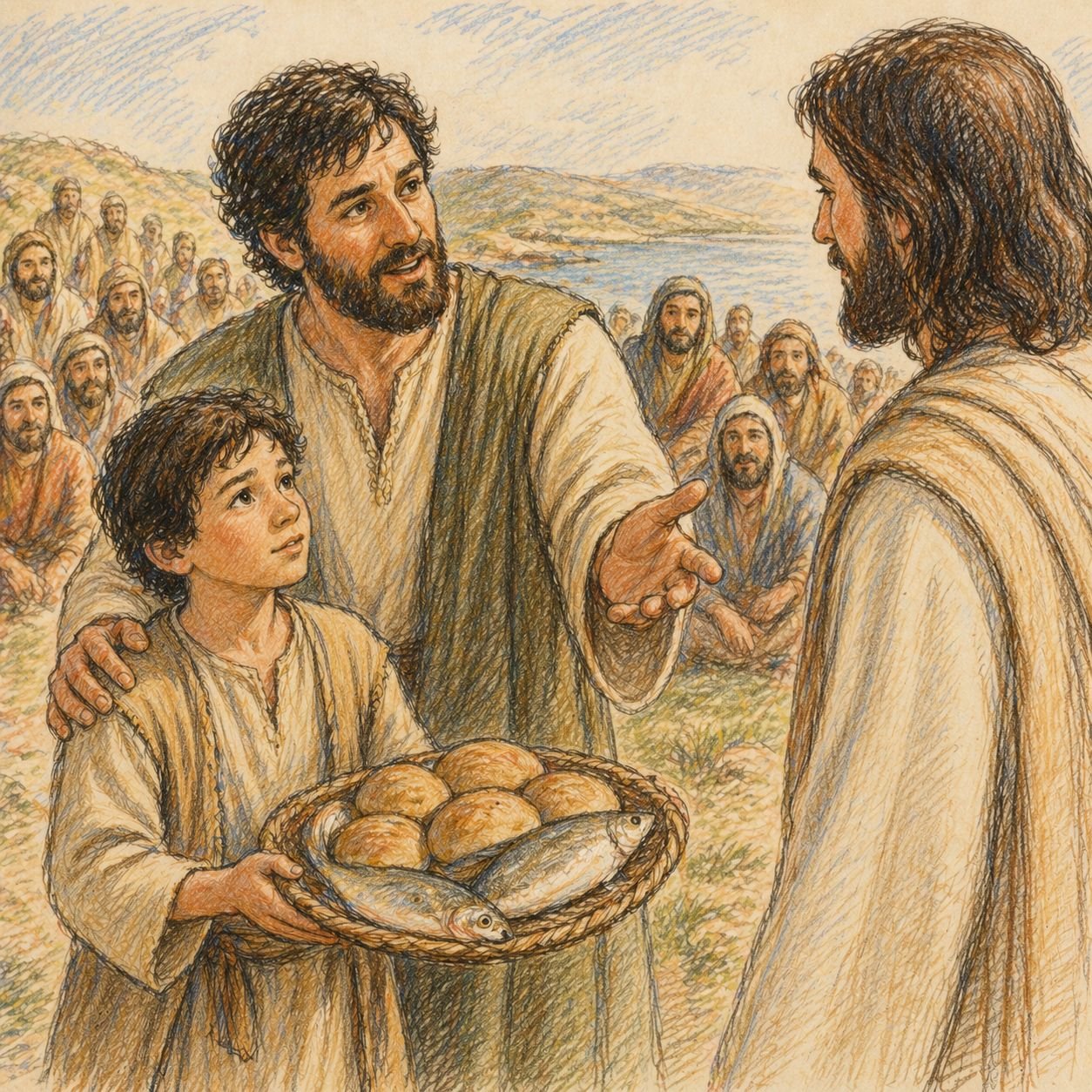
A huge crowd is gathered. The people are hungry. The need is overwhelming. The disciples look at the situation and see impossibility. Then Andrew notices a small boy with five barley loaves and two fish.
John 6:8–9:
“One of his disciples, Andrew, Simon Peter’s brother, said to him, ‘There is a boy here who has five barley loaves and two fish, but what are they for so many?’”
That is one of the most interesting moments in the Gospels, because Andrew does something both hopeful and hesitant at the same time. He brings the boy to Jesus, but he also recognizes how small the offering is. In effect, Andrew says, “Here is a lad with five barley loaves and two fish, but what are they among so many?”
That statement is so human. It sounds like the voice of every believer who has ever looked at a massive need and felt inadequate. The need is large, the resources are small, and we wonder whether anything we have could possibly make a difference.
But again, Andrew does the right thing. He takes the little he has and brings it to Jesus.
That is the heart of faith.
Andrew did not perform the miracle. He did not multiply the bread. He did not feed the crowd. But he did know where to take the small thing. And that matters.
Some people never serve because they think what they have is too small. They say, “I do not have enough talent.” “I do not have enough money.” “I do not have enough education.” “I do not have enough influence.” “I do not have enough time.” So they keep their little offering in their hands and never put it into the hands of Christ.
Andrew teaches us a better way. Do not despise the little you have. Bring it to Jesus.
A child’s lunch became a miracle because it was surrendered. A small gift in the hands of Christ became enough for thousands. That is how the kingdom works. God often begins with what looks insufficient to us, because He wants it to be clear that the power belongs to Him.
That means your small act of obedience is not pointless. Your prayer is not pointless. Your invitation is not pointless. Your testimony is not pointless. Your service is not pointless. Your generosity is not pointless. Your kindness is not pointless. Your witness is not pointless.
The boy had a lunch. Andrew had enough faith to bring the boy to Jesus. The disciples saw a problem. Andrew saw a possibility. He did not fully understand how Jesus would solve it, but he knew enough to place the need in the right hands.
That is what mature faith does. It may not understand the process, but it knows the Person. It may not know how the miracle will happen, but it knows who can do it.
And this point is vital for the sermon because it corrects two errors at once. On one side is pride, which says, “What I have is enough on its own.” On the other side is despair, which says, “What I have is too small to matter.” Andrew shows us a third way: humble surrender. Bring the small thing to Christ and let Him do what only He can do.
That is why Andrew matters so much. He is a man who keeps bringing things and people to Jesus. He brings a brother. He brings a boy. He brings a need. He brings what is available, and he trusts Christ with the result.
That is the third lesson: Andrew teaches us to offer what little we have to Jesus, because in His hands small things become sufficient.
Conclusion: The Greatness of a Quiet Life
When we gather Andrew’s life together, a clear picture emerges.
- He began by seeking Jesus.
- He continued by bringing others to Jesus.
- He matured by offering what little he had to Jesus.
That is a beautiful arc for any life.
Andrew was not the flashiest disciple. He was not the one most people would choose if they were trying to build a human resume. But heaven measures greatness differently than earth does. Heaven does not ask first, “How many people know your name?” Heaven asks, “Did you know My Son? Did you point others to Him? Did you trust Him with what you had?”
Andrew answers those questions well.
His life tells us that the kingdom of God advances by people who are willing to be quiet, faithful, relational, and useful. The world loves celebrity, but the church needs Andrews. The world rewards visibility, but God honors faithfulness. The world applauds those who make much of themselves, but God uses those who make much of Christ.
And that is where Andrew’s life becomes deeply comforting. Not everyone can be a Peter. Not everyone can preach at Pentecost. Not everyone can stand before crowds. But every believer can do Andrew’s work. Every believer can seek Jesus. Every believer can tell someone else, “Come and see.” Every believer can place small gifts into the Savior’s hands.
That means Andrew is not just an ancient apostle to admire. He is a pattern to follow.
Maybe you have felt that your life is too ordinary to matter. Maybe you think your witness is too small, your gifts too limited, your influence too narrow. Andrew stands before you and says that none of that disqualifies you. In fact, that may be exactly the kind of life God loves to use.
A quiet Christian life can still change the world if it keeps bringing people to Jesus.
So let the sermon end where Andrew’s life points us: not to Andrew himself, but to Christ. Because Andrew would never have wanted us to stop with him. He would have taken us by the hand and said, “Come with me. I know someone you need to meet.”
And that is the final call of this message: come to Jesus yourself, bring others to Jesus faithfully, and offer all that you are and have to Jesus completely.
For in the end, that is what a fruitful life really is.
A life that brings people to Jesus.
Comments are closed