Matthew 9:9–13; Matthew 28:16–20
Most of us spend our lives climbing towards something. From the time we are young, we are taught to work hard, build stability, create security, and make something of ourselves. There is nothing inherently wrong with any of those things. Scripture praises diligence, wisdom, and responsibility. The problem is not climbing itself. The danger is never stopping long enough to ask where the ladder is leaning.
I think that is one of the deepest struggles in modern life because many people today are exhausted from climbing. Some are climbing financial ladders. Others are climbing career ladders, achievement ladders, social ladders, and even religious ladders. We spend years trying to build lives that feel meaningful, secure, and successful, only to sometimes discover this quiet restlessness underneath everything. Even after reaching the goals we once thought would satisfy us, there can still remain this lingering sense that something deeper is missing.
That is part of why Matthew’s story feels so personal.
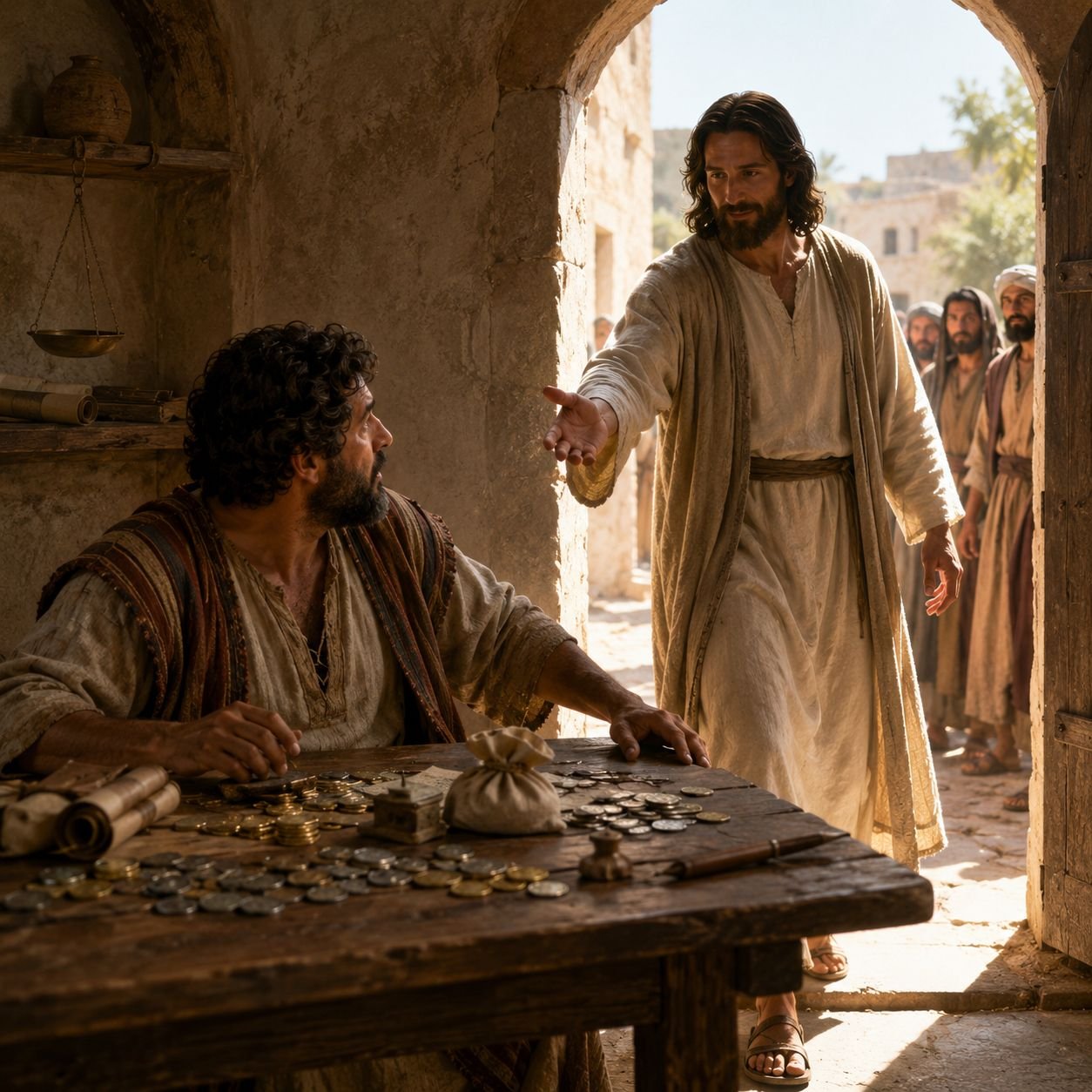
When we first meet Matthew in Scripture, he does not look like a man whose life is falling apart. He is not visibly broken or desperate. He is sitting at work. He has structure, stability, income, and direction. From the outside, Matthew probably looked successful.
But spiritually, something deeper was missing.
To fully understand the tension in this story, we have to understand what tax collectors represented in the first century. Matthew was not simply disliked because people hated paying taxes. Tax collectors worked for Rome, the occupying empire, and many became wealthy by charging more than Rome required and keeping the extra for themselves. Matthew likely had money and security, but very few people truly respected him. He had gained financial stability while slowly losing connection to his own community.
And into that ordinary moment, Jesus walks by and speaks two simple words: “Follow me.”
That invitation changes everything because Jesus does not simply come to improve Matthew’s existing life. He comes to redirect it. Matthew’s story reminds us that it is entirely possible to spend your whole life climbing successfully while still moving spiritually in the wrong direction. Sometimes the most gracious thing Jesus can do is interrupt the life we were building before we spend decades climbing toward something that can never truly satisfy the soul.
Matthew Looked Successful
Matthew 9:9 begins with what appears to be a very ordinary moment: “As Jesus was walking along, he saw a man named Matthew sitting at his tax collector’s booth.” Yet one of the most important details in the entire story is where Matthew is sitting when Jesus calls him.
Matthew is at work.
He is not wandering through life looking lost. He is not publicly falling apart. In many ways, he probably looked like someone who had life figured out. The Greek word used for tax booth is τελώνιον, telōnion, referring to a customs or toll collection station. Capernaum sat along a major trade route, meaning Matthew likely collected taxes connected to fishing commerce, transportation, and goods moving throughout the region. This was not a small side job. Matthew probably made very good money.
And honestly, that matters because sometimes we oversimplify these stories and forget that Matthew had reasons to stay exactly where he was. Security feels safe. Predictability feels safe. Success feels validating. Many people around Matthew probably envied his financial stability. It would have been very easy for him to justify staying at that table.
That is part of why this story still feels so relevant today because many people are not trapped in obviously destructive lives. They are trapped in comfortable ones. Lives that make sense externally. Lives that appear stable and successful. Yet underneath everything there remains this quiet sense that something deeper is still missing.
Success can hide spiritual drift for a very long time. When life is working, when the paycheck is steady, and when everybody around you believes you are doing well, it becomes very easy to ignore the quiet restlessness underneath the surface.
That is why Jesus later asks, “What do you benefit if you gain the whole world but lose your own soul?” I do not think Jesus is only warning about greed there. He is warning about the danger of building your entire life around temporary things and then wondering why your soul still feels empty once you finally reach them.
Ecclesiastes wrestles with this same tension. Solomon describes accomplishments, wealth, pleasure, influence, and achievement, only to finally conclude that apart from God it all becomes “a chasing after the wind.” Perhaps that is exactly where Matthew was spiritually when Jesus walked by that booth. Successful. Stable. Financially secure. Yet still restless.
Then Jesus speaks the words that completely disrupt the direction of Matthew’s life: “Follow me.”
The Greek word Jesus uses is ἀκολούθει, akolouthei, and it means far more than simply “walk behind me.” It carries the idea of attaching yourself to someone else’s entire way of life. Jesus is not inviting Matthew to make religion part of his existing life. He is inviting him into an entirely new direction, identity, and purpose.
What happens next is astonishing. Matthew gets up immediately. There is no negotiation, no delay, and no recorded excuse. Luke’s Gospel even tells us that Matthew “left everything.” That detail matters because fishermen could always return to their boats if things did not work out. Tax collecting did not really work that way. Matthew is walking away from security, status, and the life he spent years building.
Somewhere in that moment, Matthew realizes something many people spend their entire lives avoiding: you can be successful in the eyes of the world and still be spiritually empty.
John Wesley understood that tension deeply. Wesley never condemned hard work or responsible living, but he constantly warned people not to build their identity around wealth, comfort, or achievement. He taught believers to “gain all you can” and “save all you can,” but always under the Lordship of Christ and always for the love of neighbor. Success itself was never the problem. The problem was trusting success to give life meaning.
And maybe that brings us to the real question underneath Matthew’s story: What wall is your life leaning against?
Because the greatest tragedy is not failing to climb. The greatest tragedy is spending your whole life climbing faithfully toward something that can never truly satisfy the soul.
Jesus Redirected Matthew Toward What Actually Matters
What happens next in Matthew’s story is incredibly important because the first visible sign of transformation is not a sermon, a public testimony, or even a dramatic spiritual moment. It is a table.
Matthew 9:10 says, “Later, Matthew invited Jesus and his disciples to his home as dinner guests, along with many tax collectors and other disreputable sinners.”
That detail is easy to move past too quickly, but it reveals something profound about what happens when Jesus truly begins redirecting a life. Matthew has barely started following Christ, and already his priorities are changing. Before Jesus, Matthew built his life around gathering wealth. After Jesus, he begins gathering people. That is a completely different kind of life.
Honestly, I think this is one of the clearest signs that grace is genuinely transforming someone. It is not simply that they think differently about God or become more religious. It is that they begin seeing people differently.
Before Christ, people often become tools. They become competitors, obstacles, transactions, or opportunities. We begin evaluating people according to what they can contribute to our lives, our success, or our comfort. But when Jesus changes a heart, people stop being objects orbiting our lives and start becoming souls deeply loved by God.
And that is exactly what begins happening in Matthew.
The man who once spent his days collecting money from people now immediately begins bringing people into the presence of Jesus. Matthew may not fully understand theology yet. He may not fully grasp everything Jesus is teaching. But he knows enough to recognize this: “I met someone who changed my life, and I want other people to meet Him too.”
There is something beautiful about the simplicity of that kind of faith because new believers sometimes assume they are not useful until they know enough Scripture, have enough answers, or become spiritually mature enough to help others. Yet Matthew reminds us that transformed people naturally begin creating spaces where others can encounter Jesus, even before they have everything figured out themselves.
And then the Pharisees arrive.
Of course they do.
Because religious systems built around performance often become uncomfortable when grace starts reaching the wrong people.
Matthew 9:11 says, “But when the Pharisees saw this, they asked his disciples, ‘Why does your teacher eat with such scum?’”
That question reveals far more about the Pharisees than it does about the people sitting at Matthew’s table. They had developed categories for people. Clean people and unclean people. Acceptable people and unacceptable people. Holy people and sinful people. In their minds, holiness was maintained by separation.
But Jesus consistently reveals something very different about the heart of God.
When Jesus hears their question, He responds, “Healthy people don’t need a doctor. Sick people do.”
I love that imagery because Jesus compares Himself to a physician. In other words, He is saying, “The presence of brokenness is not a reason for me to withdraw. It is the very reason I came.”
Then Jesus quotes Hosea 6:6: “I want you to show mercy, not offer sacrifices.”
The Hebrew word in Hosea is חֶסֶד, chesed, one of the richest words in the entire Old Testament. It speaks of steadfast love, covenant faithfulness, loyal mercy, and compassionate love that actively moves toward people. It is not abstract kindness or distant politeness. It is mercy that draws near.
And in Matthew’s Gospel, that same idea becomes visible in the person of Jesus Himself. While others created distance from broken people, Jesus moved toward them.
That does not mean Jesus ignored sin or excused destructive behavior. Matthew’s life clearly changes after meeting Christ. Grace is never permission to remain unchanged. But Jesus understood that transformation begins not with condemnation shouted from a distance, but with mercy that comes close enough to heal.
Honestly, I think that is still one of the greatest tensions facing the Church today because it is entirely possible to know Scripture, attend worship faithfully, believe correct doctrine, and still quietly lose the heart of mercy.
The Pharisees had become experts at maintaining separation. Jesus came to redeem people.
John Wesley understood this deeply. Wesley spoke constantly about what he called “works of mercy” alongside “works of piety.” Prayer matters. Worship matters. Scripture matters deeply. But all of those things are meant to produce hearts that increasingly reflect the compassion of Christ in the world. In Wesley’s understanding, there is no genuine holiness that does not eventually overflow into love of neighbor.
And that is exactly what we see beginning in Matthew.
The man who once used people to build his own security is now using his home, his relationships, and his resources to bring people into the presence of Jesus. His life is no longer leaning inward toward himself. Now it is beginning to lean outward toward others.
And maybe that is one of the clearest questions discipleship asks us to wrestle with today: Has following Jesus simply made us more religious, or has it actually made us more merciful?
Because one of the clearest signs that Jesus is redirecting your life is that you begin caring about the people He cares about. You begin noticing the lonely, the overlooked, the doubting, the struggling, the outsider, and the person everybody else quietly gave up on. Not because you are trying to feel morally superior, but because somewhere along the way you realized that Jesus moved toward you when you needed mercy too.
Matthew Finally Found Something Worth Building
By the time we reach Matthew 28, something extraordinary has happened in Matthew’s life. The man who once sat behind a tax booth collecting temporary wealth is now standing on a mountain listening to the risen Christ commission the Church to reach the world. That contrast is really the heart of this entire sermon because Matthew’s life began centered on building something for himself, yet over time Jesus redirected his life into something eternal.
And honestly, I think it is important for us to pause long enough to really feel the weight of that transformation.
Matthew once built his life around financial security, social status, and personal advancement. Like many people, he spent years climbing toward what looked stable and successful. Yet now, by the end of the Gospel, the things that once defined him no longer hold the center of his life. Matthew has discovered something greater than success. He has discovered purpose.
Matthew 28:16–17 says, “Now the eleven disciples went to Galilee, to the mountain to which Jesus had directed them. When they saw him, they worshiped
him, but some doubted.”
I have always loved the honesty of that verse because Matthew could have easily left that detail out. After all, this is the risen Christ standing before them. This is the moment of victory after the resurrection. Yet Matthew still tells us that even here, some doubted.
Not rejected Jesus.
Not abandoned Him.
But wrestled internally trying to fully comprehend what they were seeing and what it all meant.
And honestly, I think that detail matters deeply because it reminds us that the Kingdom of God has never moved forward through perfect people with perfect faith. The Gospel has always moved forward through ordinary disciples still learning to trust Him.
Peter still carried the memory of his denial.
Thomas had wrestled openly with doubt.
The others had fled when fear overwhelmed them during the crucifixion.
And Matthew himself had once spent years building his life in service to the wrong kingdom entirely.
Yet Jesus gathers them together anyway.
Not because they are flawless, but because grace has redirected their lives toward something eternal.
Matthew tells us that this moment happens on a mountain, and throughout his Gospel mountains consistently become places where heaven and earth seem to draw close together. It was on a mountain that Jesus delivered the Sermon on the Mount and revealed what life in the Kingdom of God truly looks like. It was on a mountain that Peter, James, and John witnessed the Transfiguration and saw Christ’s glory revealed before them. And now, after the resurrection, Matthew once again brings us to a mountain where the risen Christ gathers His disciples before sending them into the world.
Matthew wants us to see that revelation, authority, and mission all converge together in this final moment.
Then Jesus speaks words that would have landed with enormous weight for Matthew:
“All authority in heaven and on earth has been given to me.”
For Matthew, those words were not abstract theology. Matthew had spent years living underneath Rome’s authority. Rome controlled the roads, commerce, taxation, military power, and the economy itself. Caesar appeared untouchable. Rome looked permanent. And Matthew had once built his life around serving that empire because earthly kingdoms always appear powerful in the moment.
But now Matthew stands before the risen Christ and hears something that changes everything: ultimate authority does not belong to Caesar. It belongs to Jesus.
History has a way of exposing how temporary earthly power really is. Rome once looked unstoppable, yet today people name their children Matthew, Peter, and John far more often than Caesar. Empires rise and fall. Economies shift. Nations change. But the Kingdom of God continues moving through generations because Christ’s authority does not fade with time.
Then Jesus gives what we now call the Great Commission:
“Go therefore and make disciples of all nations.”
The central Greek verb is μαθητεύσατε, mathēteusate, meaning “make disciples.” Not merely converts. Not shallow belief. Not casual admiration. Disciples. People whose entire lives are being reshaped around Jesus Christ.
And honestly, I think this is where Matthew’s transformation becomes deeply personal for us because somewhere along the way, Matthew stopped building his life only around himself.
The man who once used people to increase his own wealth became the kind of person who opened his table so others could encounter Jesus.
And maybe that is what discipleship ultimately does inside us.
It slowly changes the direction of our lives outward.
- Outward toward mercy.
- Outward toward people.
- Outward toward invitation.
- Outward toward grace.
The Great Commission is not merely about programs, strategies, or institutions. At its heart, it is about ordinary people whose lives have been changed by Jesus creating spaces where other people can encounter Him too.
And honestly, most of us are probably not called to stand on stages, write books, or travel across continents. But every one of us is called to make room at the table.
- Room for the lonely.
- Room for the struggling.
- Room for the doubting.
- Room for the person quietly carrying shame.
- Room for the neighbor who feels disconnected.
- Room for the family member who has drifted away.
- Room for the person everybody else has already labeled or written off.
Because Matthew never forgot what it felt like to be the person nobody wanted to sit beside.
And maybe that is why grace changed him so deeply.
He knew exactly what it felt like for Jesus to move toward him when everyone else kept their distance.
And honestly, I wonder if that is part of the question this Gospel leaves sitting in front of all of us today:
Who is God asking you to make room for?
- Who needs an invitation instead of judgment?
- Who needs mercy instead of distance?
- Who needs someone willing to open the table wide enough for grace to enter in?
Because when Jesus redirects a life, He does not simply make us more religious.
He makes us more open.
More compassionate.
More aware of the people around us who are still searching for hope.
And maybe one of the clearest signs that our ladder is finally leaning against the right wall is that our lives begin making more room for other people to encounter Jesus too.
Conclusion
When you step back and look at Matthew’s story as a whole, what makes it so powerful is not simply that Jesus forgave him. It is that Jesus redirected him.
Because Matthew was not standing at rock bottom when Jesus called him. He was not visibly broken or obviously desperate. He was sitting at a tax booth. Working. Earning. Building. Climbing. From the outside, his life probably looked stable, successful, and secure. He had direction. He had income. He had a future that made sense according to the world around him.
But underneath all of it, his ladder was leaning against the wrong wall.
And honestly, I think that is why this story resonates so deeply today because many people are not spiritually exhausted from obvious failure. They are exhausted from spending years climbing toward things they hoped would finally satisfy them. More success. More money. More recognition. More security. More achievement.
Yet even after reaching those things, there often remains this quiet ache underneath the surface that whispers, “There has to be more than this.”
Matthew discovered there was.
Not because Jesus simply gave him a slightly improved version of the life he already had, but because Jesus offered him an entirely different direction. Everything changes the moment Matthew stands up from that table because from that point forward, his life is no longer centered on building himself upward.
The man who once built his life around collecting wealth begins spending his life gathering people toward Christ.
The man who once sat at a table taking from others begins opening tables where others can encounter mercy.
The man who once served Rome’s empire becomes part of a Kingdom that outlives every earthly empire.
And maybe that is the invitation sitting in front of all of us this morning.
Not simply whether we believe in Jesus.
But whether we are willing to let Jesus redirect the direction of our lives.
Because discipleship is about far more than attending church or becoming slightly more religious. It is about allowing Christ to reshape what matters most to us. It is about slowly becoming people whose lives lean outward toward mercy, invitation, compassion, and grace.
Because Matthew never forgot what it felt like for Jesus to move toward him when everyone else stayed away and perhaps one of the clearest signs that our lives are finally leaning against the right wall is that we begin making room for other people to encounter the same mercy that changed us.
The beautiful truth of the Gospel is that it is never too late for Jesus to redirect a life. Never too late to step away from what cannot satisfy the soul. Never too late to discover purpose bigger than yourself. Never too late to become part of the eternal work God is already doing in the world.
Matthew’s story reminds us that disciples transform the world not because they are extraordinary people, but because ordinary people surrendered to Christ become part of an extraordinary Kingdom.
And it all began with two simple words:
“Follow me.”
Comments are closed