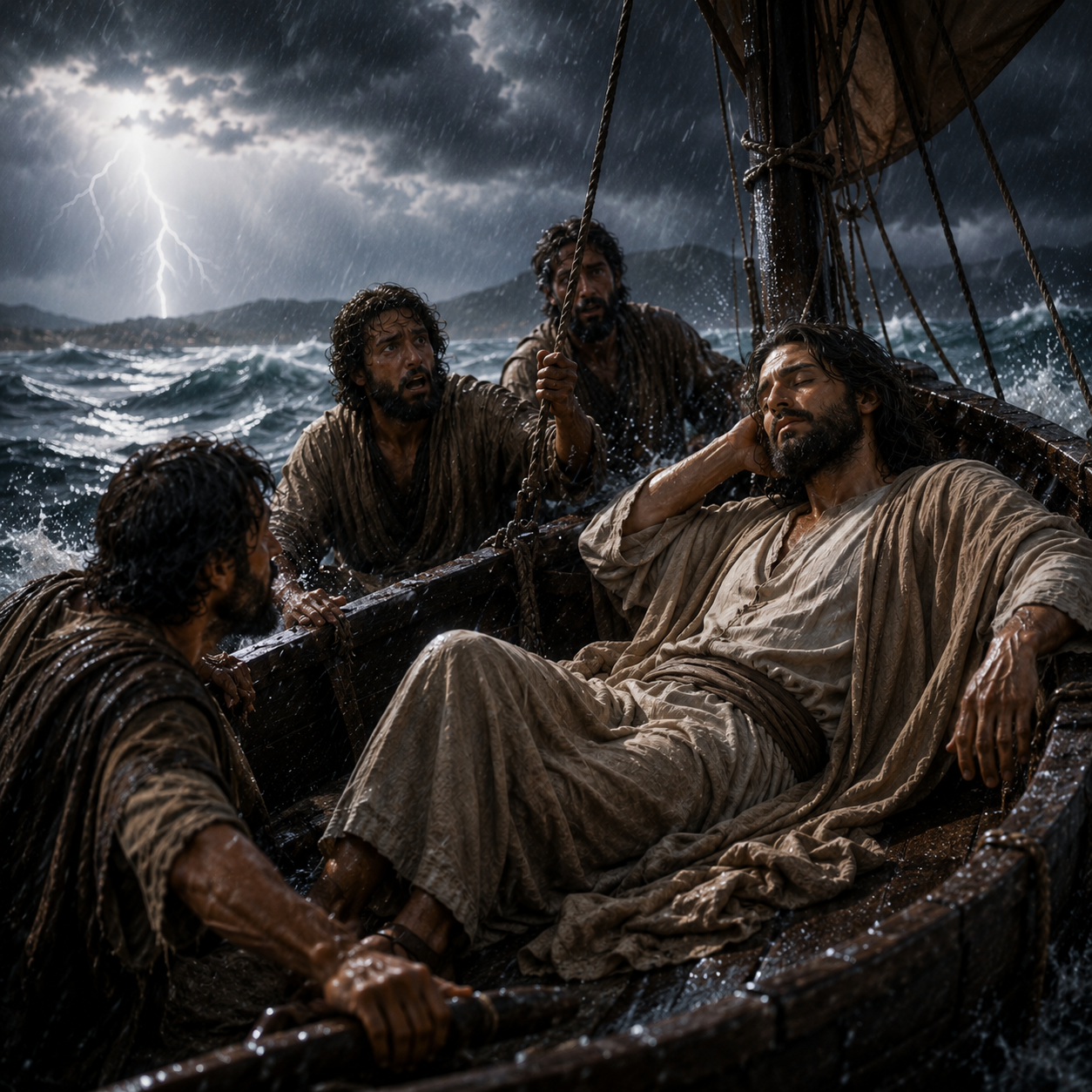
Matthew 8:23-27
There are moments in life when we suddenly realize that someone we thought we knew is far greater than we had ever imagined.
Nothing about them has changed. They are the same person they have always been, yet something happens that allows us to see them with new eyes. What we once appreciated only in part suddenly comes into much sharper focus, and from that moment forward our understanding of them is never quite the same.
I believe every follower of Christ experiences moments like that.
When we first come to know Jesus, our faith is genuine, but our understanding is still growing. The Christian life is not simply learning more information about Him. It is a lifelong journey of discovering more fully who He is. As we walk with Him through the ordinary moments of life, and sometimes through the extraordinary ones, our vision of Christ continues to deepen.
That is why I find today’s Gospel so compelling.
Most of us know this story well. We remember the storm on the Sea of Galilee, the frightened disciples, and Jesus speaking until the wind and the waves become perfectly still. It is one of those passages that has brought comfort to Christians for generations because we naturally recognize something of ourselves in those disciples.
Yet as I spent time praying over this passage this week, I found myself drawn to the way Matthew ends the story. He does not end with the calm or with the miracle. He ends with a question.
After everything is over, the disciples look at one another and ask, “What kind of man is this, that even the winds and the sea obey him?”
That question is not asked by strangers, it is asked by disciples.
These are men who have already left everything to follow Jesus. They have heard His teaching, witnessed His miracles, and entrusted their lives to His care. Their faith is real, yet they are about to discover that there is still more of Christ to know than they have yet imagined.
Perhaps that is where this story meets us today.
The Christian life is not merely about learning to endure the storms that come our way. It is about allowing every season of life to deepen our understanding of the One we have chosen to follow. As we walk through this familiar passage together, I would invite you to resist the temptation to rush ahead to the miracle. Instead, let us stay with the disciples for a while, because before Matthew teaches us anything about faith, he first invites us to consider the One who is in the boat.
The Storm Reveals the Disciples
Then he got into the boat, and his disciples followed him. Suddenly a furious storm came up on the lake, so that the waves swept over the boat. But Jesus was sleeping. The disciples went and woke him, saying, “Lord, save us! We’re going to drown!”
—Matthew 8:23–25
Matthew begins this account with a detail that seems almost ordinary. Jesus gets into the boat, and the disciples follow Him. It is such a simple statement that we could easily pass over it, yet it reminds us that these men find themselves in the middle of the storm for one reason alone. They are following Christ.
That observation quietly reshapes the way we read the rest of the story because it reminds us that faithful obedience does not always lead us into calm waters. We sometimes imagine that if we are sincerely seeking God’s will, life should become increasingly predictable, yet the Scriptures consistently tell a different story. Abraham followed God into an unknown land. Moses followed God into Pharaoh’s court. Elijah followed God into the wilderness. The disciples now follow Jesus onto a lake where a storm is already waiting for them.
There is a comforting honesty in that reality because it reminds us that difficulty is not always evidence that we have wandered from the path of discipleship. There are seasons when the very place Christ calls us to be is also the place where our faith will be stretched beyond what we believed it could bear. The storm is not proof that Jesus has abandoned His disciples. It is simply the next classroom in which He intends to teach them.
Matthew tells us that a great storm suddenly arose on the sea. The word he chooses is seismos, the same word often used to describe an earthquake, suggesting something so violent that the very world around them seems to be coming apart. For fishermen who had spent much of their lives on this sea, this was not a normal storm to be managed but a force that threatened everything they knew. Their experience could not calm the wind, their strength could not steady the waves, and all the confidence they had developed through years on the water suddenly proved incapable of carrying them through this moment.
There is a quiet mercy in that realization, although it would not have felt merciful at the time. We rarely discover the limits of our own strength while everything is going well. It is only when the familiar resources we have always depended upon begin to fail that we become ready to discover the sufficiency of Christ. Before Jesus ever speaks to the storm, the storm has already begun exposing the places where His disciples have been relying upon themselves more than they realized.
Then Matthew gives us perhaps the most unexpected detail in the entire account.
Jesus is asleep.
His sleep certainly reminds us of His humanity. The One who had spent His days teaching crowds, healing the sick, and pouring Himself into the lives of others experienced genuine exhaustion. The Son of God did not merely appear to share our humanity; He embraced it fully, even to the point of falling asleep in the stern of a fishing boat.
Yet His sleep also creates a striking contrast with the disciples. They look at the same storm and conclude that everything is slipping beyond control, while Jesus rests with the quiet confidence of One who has never doubted His Father’s sovereign care. The circumstances surrounding them are identical, but their understanding of those circumstances is profoundly different because their understanding of the Father is profoundly different.
Perhaps that is where the first work of grace begins in this passage.
The disciples do not yet realize how much their fears are revealing about their understanding of Christ. They have seen Him cleanse the leper and heal the centurion’s servant, yet there remain hidden corners of their hearts where His authority has not yet reached. Those places have remained comfortably concealed while the skies were clear, but now the storm is bringing them into the light.
John Wesley often spoke of grace as God’s continual work within us, drawing us ever closer to Christ and gradually conforming us to His likeness. That work is seldom accomplished by information alone. More often, it unfolds through the ordinary experiences of life as God gently reveals those places where our trust has not yet fully matured. The disciples did not need another lecture on faith nearly as much as they needed to discover the places where their faith was still unfinished.
By the time they awaken Jesus, their cry reveals both how far grace has already brought them and how much farther it still intends to lead them.
“Lord, save us! We are perishing!”
Those words are not the cry of unbelief. They do not abandon Jesus in the storm, nor do they attempt to face it alone. When every other resource has failed them, they instinctively turn to Christ because somewhere deep within their hearts they already know that He alone can save them.
Yet their plea also reveals that they still do not fully know the One to whom they are praying.
That is the tension Matthew invites us to notice.
Their faith is real.
Their love for Christ is genuine.
Their decision to follow Him has already cost them much.
Yet grace is not finished with them because they still have more to discover about the One who has called them into the boat.
Long before Jesus calms the sea, He is already at work within His disciples. The storm has become an instrument of His grace, uncovering what calm waters had quietly concealed and preparing their hearts for a revelation that will forever change the way they see the One they have chosen to follow.
Grace in the Question
He replied, “You of little faith, why are you so afraid?”
—Matthew 8:26a
At first glance, Jesus’ response almost surprises us.
The storm is still raging around them. The boat is still being tossed by the waves, and the disciples have just cried out for help. We expect His first concern to be the wind and the sea, yet before He ever speaks to the storm, He speaks to His disciples.
That order is anything but accidental.
Had Jesus calmed the sea first, the disciples would certainly have arrived safely on the opposite shore, but they might also have arrived unchanged. Instead, Christ pauses long enough to draw their attention toward something deeper than the danger surrounding them because His greatest concern has never been merely to rescue His people from difficult circumstances. His desire is to transform His people through every circumstance they encounter.
That has always been the work of grace.
Grace is not simply God’s willingness to forgive us when we fail. It is His patient and persistent work of restoring His image within us, gently shaping us into the people He created us to become. Sometimes that work brings comfort and encouragement. At other times it comes through questions that lovingly expose what we have not yet seen in ourselves.
“Why are you so afraid?”
Jesus is not asking because He lacks compassion. He knows the wind is fierce, the waves are real, and the danger is genuine. Neither is He suggesting that faithful people never experience fear. The Scriptures are filled with men and women who loved God deeply and yet found themselves overwhelmed by circumstances beyond their control.
His question reaches beneath the surface because He is not simply interested in the fear they are experiencing. He is interested in what that fear is revealing.
That is often how Christ works in our own lives.
There are moments when we ask God to remove a difficult circumstance as quickly as possible, while He lovingly uses that very circumstance to reveal something within us that calm days never could. We naturally pray for immediate relief, but Christ is equally concerned with our spiritual formation because He sees not only the burden we are carrying today but also the disciple we are becoming for tomorrow.
The Christian life is a continual journey of grace in which Christ steadily enlarges our hearts and deepens our trust. That journey is rarely accomplished all at once. More often, it unfolds one faithful step at a time as the Holy Spirit gently uncovers those places where we still struggle to surrender every part of our lives to the lordship of Christ.
That is precisely what Jesus is doing here.
He addresses them as those of “little faith.”
Those words have often been heard as a harsh criticism, but they sound very different when we remember who is receiving them. Jesus is not speaking to His opponents. He is not speaking to the religious leaders who have rejected Him. He is speaking to the very disciples He has called, loved, and patiently taught from the beginning of His ministry.
Their faith is not absent.
It is growing.
They have already left their homes to follow Him. They have already witnessed His authority and entrusted their futures to His care. Even now, in the middle of the storm, they run to Jesus rather than away from Him. Their cry, “Lord, save us,” is itself an expression of genuine faith because they instinctively know that apart from Him there is no hope.
Yet genuine faith is not the same as mature faith.
The disciples know that Jesus can save them, but they do not yet understand the fullness of who He is. They still see Him through categories that are too small. He is a teacher unlike any they have known. He is a healer unlike any they have witnessed. He is even the promised Messiah they have begun to follow. All of those things are true, but they have not yet come to see Him as the Lord before whom all creation bows.
That is why Jesus asks His question before He stills the sea.
He is preparing them for what they are about to witness.
His words begin the lesson, and the miracle will complete it.
Looking back, we can see that the storm itself was never Christ’s greatest concern. The wind would soon fall silent, and the waves would settle into calm. Left to themselves, however, the disciples would continue carrying an understanding of Jesus that was too small for the calling that lay ahead of them.
Christ loved them too much to leave them there.
His question was not intended to shame them but to invite them further. It was another gracious step in the lifelong work of discipleship, drawing them beyond the faith that had first led them into the boat and toward the deeper faith that would one day carry the Gospel to the ends of the earth.
Before Jesus transformed the sea, He was already transforming His disciples. The storm had revealed what still needed to grow, and now the patient work of grace was preparing them to see Christ more clearly than they ever had before.
The One in the Boat
“Then he got up and rebuked the winds and the sea, and there was a dead calm. They were amazed, saying, “What sort of man is this, that even the winds and the sea obey him?””
Matthew 8:26b-27
Having prepared the hearts of His disciples through His question, Jesus now turns His attention to the storm itself.
Matthew tells us that He rebuked the winds and the sea, and there was a great calm. The simplicity of those words almost invites us to read past them, yet they describe something that no human being had ever witnessed before. Men had learned to navigate the sea, to respect its power, and to endure its storms, but no one had ever stood before the wind and commanded it to obey.
Jesus does.
The same voice that only moments before had spoken to the hearts of His disciples now speaks to creation itself, and both respond to His authority. The disciples had been invited to examine what was happening within them, while the wind and the waves simply obeyed the One who called them into being. In only a few moments they have witnessed Christ exercise authority over both the visible storm surrounding them and the invisible work He is accomplishing within them.
As remarkable as the miracle is, Matthew does not linger over it because the miracle itself is not the destination of the story. Instead, our attention is immediately drawn back to the disciples as they look upon Jesus with a sense of wonder unlike anything they have yet experienced. Their fear of the storm gives way to amazement at the One who has calmed it, and they find themselves asking, “What kind of man is this, that even the winds and the sea obey him?”
That question marks a significant turning point in their journey of discipleship because they are beginning to realize that every category they have used to understand Jesus is no longer sufficient. They have called Him Rabbi, and rightly so, for no one has ever taught as He teaches. They have witnessed Him heal the sick and cleanse the leper, revealing a compassion and authority unlike anything they had ever seen. They have watched Him respond to the faith of a Roman centurion whose understanding of authority astonished even Jesus Himself. Yet none of those experiences had fully prepared them for this moment because this miracle reaches beyond disease and suffering into creation itself.
The Scriptures had long taught that the sea belonged to the Lord alone. From the opening chapters of Genesis, where God brought order out of the waters of chaos, to the songs of the psalmists who proclaimed that He stills the roaring of the seas, Israel confessed that creation itself responds to the voice of its Creator. Psalm 107 is probably the clearest place of connection that the disciples would have made. It’s a psalm that celebrates those who cried to the Lord in their trouble, and He saves them and they declare descriptions of God’s power and of His identity.
“Some went down to the sea in ships, doing business on the mighty waters; they saw the deeds of the LORD, his wondrous works in the deep. For he commanded and raised the stormy wind, which lifted up the waves of the sea. They mounted up to heaven; they went down to the depths; their courage melted away in their calamity; they reeled and staggered like drunkards and were at their wits’ end. Then they cried to the LORD in their trouble, and he brought them out from their distress; he made the storm be still, and the waves of the sea were hushed.”
Psalms 107:23-29
Now those same disciples have watched Jesus do exactly what they had always confessed the Lord alone could do.
Matthew offers no explanation because none is needed.
The answer to the disciples’ question has been unfolding since the opening chapter of the Gospel. Before a single miracle had been performed, Matthew introduced Jesus as Immanuel, “God with us.” The disciples are only beginning to discover what Matthew’s readers have known from the very beginning. The One who has been teaching them, walking beside them, and even sleeping in the stern of their boat is none other than the Lord who rules over all creation.
Perhaps this is why Matthew leaves us with the disciples’ question rather than a triumphant confession of faith. Discipleship is not completed in a single afternoon, and sanctifying grace doesn’t accomplish its work all at once. Christ reveals Himself patiently, enlarging our understanding of Him one encounter at a time until every area of our lives gradually comes under His loving authority. The disciples leave this storm with a deeper vision of Jesus than they possessed when they entered the boat, and that deeper vision will continue to shape them long after the waters of Galilee have become a distant memory.
That same gracious work continues in the lives of Christ’s disciples today. We often think of spiritual growth as learning new truths about God, yet the deeper work of grace is allowing those truths to reshape the way we see Christ Himself. Every season of discipleship, whether marked by joy or by struggle, becomes another opportunity for the Holy Spirit to enlarge our vision of the Savior until we trust Him not simply because He can calm the storms we face, but because we know the One who stands sovereign over them.
When the disciples first stepped into the boat, they believed they were following a remarkable teacher who possessed extraordinary authority. By the time they reached the opposite shore, they had begun to glimpse a far greater reality. The greatest miracle they witnessed that day was not simply that the wind and the waves obeyed Jesus. It was that the One they had welcomed into their boat was the Lord of heaven and earth, and that growing realization would forever transform the way they followed Him.
Conclusion
As we come to the end of this passage, I find myself returning once more to the title of today’s message: The One in the Boat.
When the disciples stepped into that boat, they believed they knew who Jesus was. They had heard His teaching, witnessed His miracles, and willingly left their old lives behind in order to follow Him. Their faith was genuine, yet it was still growing because there was more of Christ to know than they had yet imagined. It was not until the wind began to howl and the waves threatened to overwhelm them that they discovered how much their understanding of Him still had room to grow.
Perhaps that is why this story continues to speak so powerfully to every generation of believers.
The Christian life is not simply learning to trust Jesus more. It is first learning who Jesus truly is. Every step of discipleship is an invitation to see Him more clearly than we did before, and as our vision of Christ grows, our trust quietly grows with it. We believe that the grace of God is always drawing us forward, continually forming us into the likeness of Christ until every part of our lives is yielded to His loving authority. The disciples’ journey across the Sea of Galilee was not merely a lesson in courage. It was another step in the gracious work of Christ revealing Himself to those He had called.
That is the question this passage leaves with us today.
Who is the One in your boat?
It is possible to admire Jesus as a wise teacher and still underestimate His authority. It is possible to believe He can forgive our sins and yet quietly carry parts of our lives as though they remain outside His care. It is even possible to follow Him faithfully for many years while still discovering places where our understanding of Him has been too small. The disciples remind us that spiritual maturity is not pretending we have arrived. It is allowing Christ, through the patient work of His grace, to continually enlarge our vision of who He is.
The beautiful promise of this story is that Jesus does not wait until His disciples possess perfect faith before He continues His work within them. He meets them in the middle of the storm. He patiently exposes what still needs to grow, lovingly reveals more of Himself, and then invites them to keep following. That same grace continues to meet us today. Christ has not finished revealing Himself to us, nor has He finished the work He began within us.
The disciples climbed into the boat believing they understood the One they were following. They stepped onto the shore knowing that the One who had called them was greater than they had ever imagined. That is the invitation before us as well. May we continue to follow Christ with humble hearts, allowing His grace to deepen our faith, enlarge our vision, and bring every corner of our lives under the loving authority of the One who is still in the boat with His people.
Comments are closed