Matthew 26:6-13
We put a value on things all the time, usually without giving much thought to what we are doing. We decide whether the meal is worth the price on the menu, whether the repair is worth putting more money into the car, whether the house is worth what someone is asking for it, or whether something we have held onto for years is finally worth selling. Sometimes the answer is relatively easy because there is a market that tells us what something should cost, but other times value becomes much more difficult to measure because what something is worth depends upon the person holding it.
That becomes especially obvious when something carries more than monetary value. An old watch may not be worth much to anyone else, but if it belonged to your grandfather, there may not be a price someone could offer that would persuade you to part with it. A child’s drawing might have no market value whatsoever, yet it ends up tucked safely into a drawer for thirty years because its worth cannot be measured by the paper on which it was drawn. Value is not always determined by what something costs. Sometimes value is revealed by what we are willing to give for it, what we are willing to sacrifice for it, or what we simply refuse to exchange for something else.
That makes the question we are going to wrestle with today much harder than it first appears. We know all the right answers about Jesus. We know what we believe about him, we know the names we give him, and many of us have spent much of our lives following him. Yet there is a difference between saying that Jesus is precious to us and discovering what that means when something else we value is placed alongside him.
So perhaps the question is not whether Jesus matters to us. For most of us, that answer came long before we walked through the doors this morning. The harder question is what happens when following him becomes costly, when devotion begins asking something of us, or when something else we treasure begins competing for the same place in our hearts. Somewhere in those moments, our lives begin answering a question our words alone never could: How much is Jesus worth to you?
When Devotion Looks Like Waste
Matthew 26:6–13
“Now while Jesus was at Bethany in the house of Simon the leper, a woman came to him with an alabaster jar of very costly ointment, and she poured it on his head as he sat at the table. But when the disciples saw it, they were angry and said, ‘Why this waste? For this ointment could have been sold for a large sum, and the money given to the poor.’ But Jesus, aware of this, said to them, ‘Why do you trouble the woman? She has performed a good service for me. For you always have the poor with you, but you will not always have me. By pouring this ointment on my body she has prepared me for burial. Truly I tell you, wherever this good news is proclaimed in the whole world, what she has done will be told in remembrance of her.’”
Matthew does not tell us much about the woman who enters the house that evening. He does not give us her name, he does not tell us what she has been doing before she arrives, and he does not tell us what thoughts have been running through her mind as she approaches Jesus. What Matthew does tell us is what she is carrying. In her hands is an alabaster jar filled with what he describes as “very costly ointment,” and when she reaches Jesus, she pours it over his head.
Matthew leaves the value somewhat vague, but the parallel account in John gives us a number. The perfume is valued at three hundred denarii, and a denarius was roughly what an ordinary laborer might earn for a day’s work. We are talking about something approaching an entire year’s wages. If we tried to communicate that kind of value in our world today, using current wages as a rough comparison rather than pretending ancient and modern economies can be perfectly converted, we might imagine something worth somewhere around $65,000. Whatever else we may say about this woman, what she pours upon Jesus is not a small gift. Something extraordinarily valuable is disappearing from that jar.
Once we understand that, the reaction of the disciples begins to sound different. They watch this happen and become angry, asking, “Why this waste?” We know the story, so it is easy to stand safely on this side of it and wonder how they could possibly respond that way, but imagine watching someone pour away something worth tens of thousands of dollars and then being told that it was an act of worship. Most of us would have questions too. The disciples even have a good theological argument for their objection. They know what Jesus has taught about caring for the poor, and they can immediately imagine how many hungry people could have been fed, how many struggling families could have been helped, and how much good could have been accomplished with what they have just watched disappear.
That is what makes their response so important. These are not people who hate Jesus, nor are they people who have refused to follow him. They have left homes and livelihoods to walk these roads with him. Their problem in this moment is not that they believe Jesus has no value. They are looking at something extraordinarily precious being poured out and wondering whether devotion to Jesus really needed to cost quite this much. Somewhere underneath “Why this waste?” is another question they may not even realize they are asking: Is Jesus really worth this much?
Jesus looks at exactly the same action and sees something entirely different. The disciples call it waste, but Jesus says, “She has performed a good service for me.” The Greek expression is kalon ergon, something good, beautiful, noble, fitting. What looks like value being lost from one perspective looks beautiful from another, because Jesus is not merely looking at what came out of the jar. He sees the devotion with which it was given.
Then Jesus gives the moment a significance even the woman may not have fully understood. She has poured the ointment upon his head, an image that would have carried echoes throughout Israel’s Scriptures, where kings were anointed with oil as they were set apart for God’s purposes. Yet Jesus does not speak about a throne. He speaks about a tomb. “By pouring this ointment on my body she has prepared me for burial.” The King is being anointed, but he is being anointed on his way toward death, and this unnamed woman has somehow offered an act of devotion so fitting to the moment that Jesus says her story will travel wherever the good news is proclaimed.
Perhaps that is why Matthew never needs to tell us what she thought Jesus was worth. She never gives us a number. She never makes a speech explaining her devotion. She simply opens what is precious and pours it out upon him. While everyone else in the room is calculating what has been lost, she seems to have settled the question differently. Whatever this perfume is worth, Jesus is worth more.
The disciples look at what she has poured out and ask whether Jesus could possibly be worth that much. The woman answers without saying a word. Her life asks a very different question: What could possibly be too valuable to give to Jesus?
And then Matthew tells us what happened next. “Then one of the twelve, who was called Judas Iscariot, went to the chief priests.” Another disciple is about to decide what Jesus is worth, but this time the calculation will move in an entirely different direction.
How Much Can I Get for Jesus?
Matthew 26:14-16
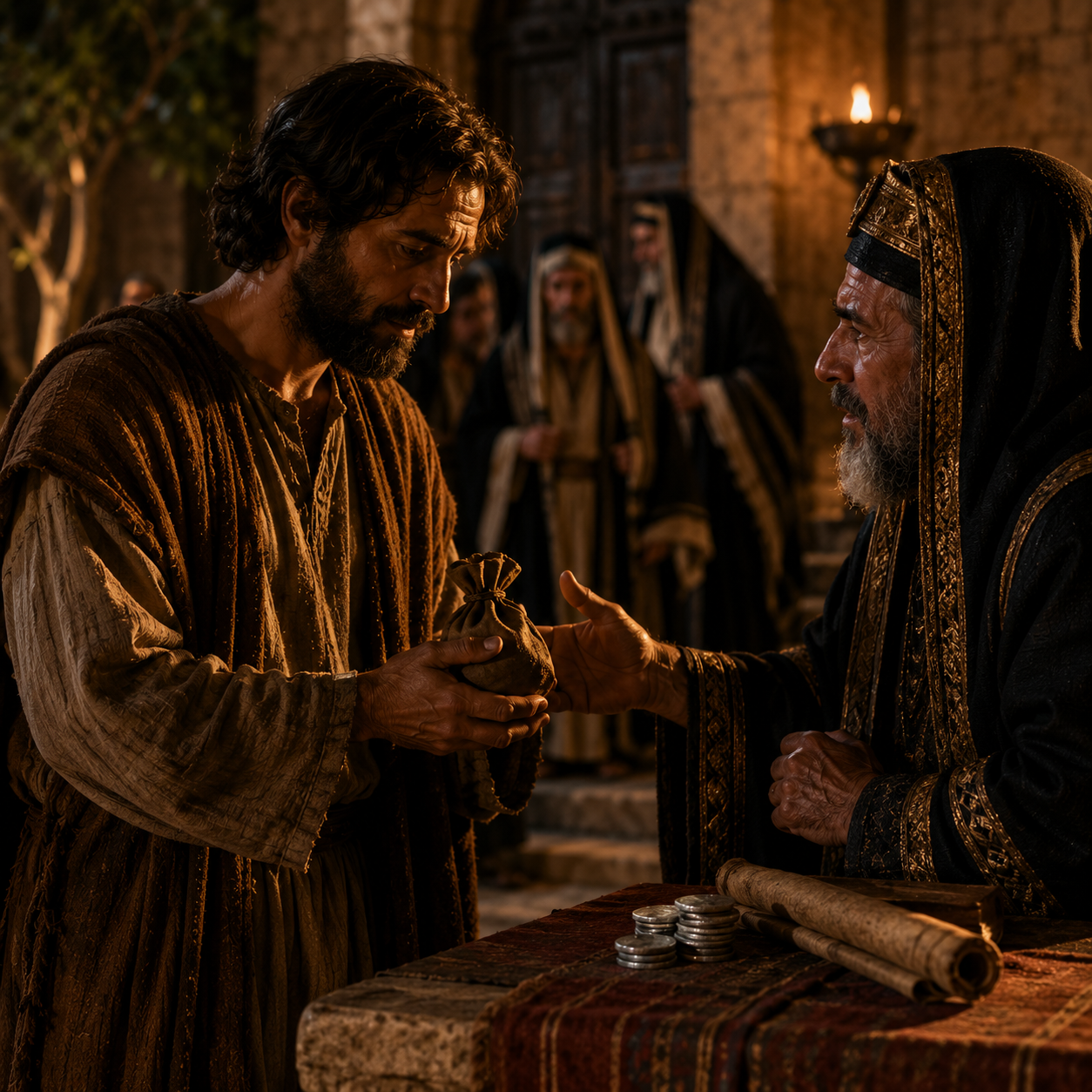
14 Then Judas Iscariot, one of the twelve disciples, went to the leading priests 15 and asked, “How much will you pay me to betray Jesus to you?” And they gave him thirty pieces of silver. 16 From that time on, Judas began looking for an opportunity to betray Jesus.
Matthew moves immediately from the beauty of what happened in Bethany into something much darker, and the transition is so abrupt that it almost seems designed to make us uncomfortable. The fragrance of that costly perfume has barely left the room when Matthew tells us that one of the twelve gets up and goes to the chief priests. He does not initially call Judas a traitor or describe him as an enemy. He reminds us that Judas is “one of the twelve,” because before Judas became the man whose name would forever be associated with betrayal, he was a disciple who had lived remarkably close to Jesus.
Judas had traveled the same roads as Peter and John. He had heard the Sermon on the Mount, watched Jesus touch people everyone else avoided, seen storms become still and crowds fed with almost nothing, and listened as Jesus described a kingdom unlike anything they had imagined. Judas had not merely heard about Jesus from someone else. He had been invited into Jesus’ life, entrusted with ministry, and given a place among those closest to him. That makes what happens next much harder to dismiss, because Judas is not an outsider who has finally decided to attack someone he never loved. Whatever has happened within him has happened while he has been walking beside Jesus.
Matthew does not give us a psychological explanation for what finally moves Judas toward the chief priests, and we should be careful not to provide one for him. We know from John that money had become a problem in Judas’s heart, but Matthew leaves us with the question Judas himself asks: “What will you give me if I betray him to you?” After watching a woman ask for nothing as she pours out something extraordinarily valuable, Judas walks into another room wanting to know what he can receive.
The word Matthew uses for what Judas proposes is paradidōmi. We usually translate it here as “betray,” and given what Judas is doing, that translation is entirely appropriate, but the word itself carries the very concrete sense of handing someone over, delivering someone into the hands of another. That makes the contrast with the woman even more striking. She has something valuable in her hands and gives it to Jesus because Jesus is worth more to her than what she is holding. Judas has access to Jesus and decides to hand Jesus over because something else has become worth more.
The chief priests weigh out thirty pieces of silver, and Matthew expects that number to carry a history with it. Centuries earlier, the prophet Zechariah told the strange and painful story of a rejected shepherd who finally asks the people to give him his wages, and they weigh out thirty pieces of silver. God responds with bitter irony to the amount, describing it as the magnificent price at which the shepherd has been valued. Matthew will return explicitly to that prophetic imagery after Judas gives the money back. The number is not incidental. The rejected shepherd has once again been assigned a price.
There is something almost unbearable about placing these two scenes beside one another. In Bethany, something worth nearly a year’s wages is poured upon Jesus, and the disciples wonder whether Jesus could possibly be worth such extravagance. A few verses later, Judas stands before the chief priests and allows them to put a price on Jesus himself. The woman sees something enormously valuable and decides Jesus is worth more. Judas looks at Jesus and asks what someone else is willing to give him in exchange.
Yet if Judas remains nothing more than the villain of the story, we can keep him comfortably at a distance. We can shake our heads at thirty pieces of silver and reassure ourselves that we would never do anything like that. Most of us are never going to walk into a room and negotiate a price for betraying Christ, but that does not mean we never face the deeper temptation Judas reveals. The danger begins whenever something else becomes valuable enough that faithfulness to Jesus starts becoming negotiable.
Sometimes what competes with Christ is money, but sometimes it is approval, comfort, ambition, control, resentment, security, or simply our determination to have life unfold according to our plans. The exchange is rarely announced as an exchange. We simply begin making small accommodations, telling ourselves that this one thing does not really matter, until eventually something we value has occupied a place in our hearts that belongs to Christ. A divided heart does not always reject Jesus outright. Sometimes it simply begins calculating how much obedience is reasonable when obedience threatens something else we treasure.
That is what makes Judas so difficult to look at. He forces us beyond the easy question of whether we love Jesus and toward the harder question of whether there is anything we love enough to make our loyalty to him negotiable. The woman has shown us what happens when Jesus becomes worth more than what we possess. Judas shows us what can happen when something we possess, desire, or refuse to surrender becomes worth more than faithfulness to Jesus.
And if Matthew were the only Gospel we had, we might leave Judas there, having made his choice and begun looking for an opportunity to hand Jesus over. But John allows us into another room before the betrayal is complete, and there we discover something that changes the question entirely. We have spent all this time asking what Jesus was worth to Judas. Perhaps we also need to ask what Judas was worth to Jesus.
When Jesus Knows and Still Kneels
John 13:1-10
13 Before the Passover celebration, Jesus knew that his hour had come to leave this world and return to his Father. He had loved his disciples during his ministry on earth, and now he loved them to the very end.[a] 2 It was time for supper, and the devil had already prompted Judas,[b] son of Simon Iscariot, to betray Jesus. 3 Jesus knew that the Father had given him authority over everything and that he had come from God and would return to God. 4 So he got up from the table, took off his robe, wrapped a towel around his waist, 5 and poured water into a basin. Then he began to wash the disciples’ feet, drying them with the towel he had around him.
6 When Jesus came to Simon Peter, Peter said to him, “Lord, are you going to wash my feet?”
7 Jesus replied, “You don’t understand now what I am doing, but someday you will.”
8 “No,” Peter protested, “you will never ever wash my feet!”
Jesus replied, “Unless I wash you, you won’t belong to me.”
9 Simon Peter exclaimed, “Then wash my hands and head as well, Lord, not just my feet!”
10 Jesus replied, “A person who has bathed all over does not need to wash, except for the feet,[c] to be entirely clean. And you disciples are clean, but not all of you.” 11 For Jesus knew who would betray him. That is what he meant when he said, “Not all of you are clean.”
When we leave Matthew and turn to John’s account of that final evening, John makes certain that we understand what Jesus knows before he tells us what Jesus does. Judas has already made his decision. The arrangement with the religious leaders has already begun, and John tells us that the devil has already put it into the heart of Judas Iscariot to betray Jesus. There is no surprise waiting for Jesus later that night. He is not going to look across the garden in Gethsemane, see Judas approaching with the soldiers, and suddenly realize that one of his own has turned against him. Jesus knows what is in Judas’s heart while Judas is still sitting at the table.
John tells us something else before Jesus ever reaches for the basin. He says that Jesus, “having loved his own who were in the world, loved them to the end.” The phrase translated “to the end” is eis telos, and it can carry the sense of love reaching its completion, going its full distance, being carried all the way through. John is preparing us to understand everything that follows as an expression of that kind of love. This is not love that lasts only as long as the people receiving it remain faithful. It is love that keeps revealing its character even when Jesus knows exactly what is happening in the hearts of the people around him.
Then Jesus gets up from the table, removes his outer robe, ties a towel around himself, pours water into a basin, and begins washing the disciples’ feet. Foot washing was a familiar part of hospitality in a world of dusty roads and open sandals, but the work itself belonged to the lowest places in the household. Scripture repeatedly speaks of providing water so that a traveler could wash his feet, and in 1 Samuel, Abigail describes washing the feet of servants as an expression of profound humility. Yet here there is no servant moving around the table. The one who takes the towel is the one everyone else calls Lord.
We usually remember Peter in this scene because Peter does what Peter so often does. He objects. He cannot comprehend Jesus taking this position before him, and his protest gives Jesus an opportunity to teach the disciples what his actions mean. Yet if we concentrate only on Peter, we can miss the disciple John has already made sure is somewhere in that room. Judas has not left yet. His departure will not happen until later, after the meal is underway. John never describes Judas being excluded from what Jesus does, which leaves us with an extraordinary implication: among the feet Jesus kneels to wash are the feet of the man who has already arranged to betray him.
That changes the scene. Jesus is not washing Judas’s feet because he does not know. He is not offering kindness to someone whose intentions remain hidden from him. He knows where Judas’s heart has gone, he knows what Judas has chosen, and he knows what Judas will soon do. Judas may be able to conceal what is happening from the other disciples around the table, but he cannot conceal it from the one kneeling in front of him. Jesus knows, and still he takes Judas’s feet into his hands and washes them.
For two movements we have been asking what Jesus is worth. The woman at Bethany answered by pouring out something extraordinarily precious. The disciples looked at the same gift and wondered whether devotion really needed to cost that much. Judas walked away from that room and asked how much he could receive for handing Jesus over. Everyone has been placing a value on Jesus, and every response has revealed something about the heart of the person making the calculation. Then Jesus kneels in front of Judas, and suddenly the question moves in the opposite direction. We have spent all this time asking what Jesus is worth to Judas, but John confronts us with another question: What is Judas worth to Jesus?
What does Jesus do with the person who has already decided to betray him? John’s answer is astonishing enough without adding anything to it. He washes his feet. Jesus does not pretend the betrayal is insignificant, nor does his love somehow turn Judas’s decision into something harmless. Grace does not require Jesus to call betrayal anything other than betrayal. Yet Judas’s failure does not determine the character of Jesus. Judas can decide what kind of disciple he will be, but he cannot decide what kind of Savior Jesus will be.
That may be where eis telos becomes more than an interesting Greek phrase. Jesus loves all the way through. He loves while knowing. He loves without requiring ignorance about the people he loves. There is nothing naïve about the towel around his waist because the hands washing those feet belong to someone who knows exactly where those feet are about to go. The love of Jesus does not depend upon his having an incomplete picture of Judas, and that means his love is revealing something about Jesus rather than making a statement about Judas’s worthiness.
There are moments when we resemble the woman at Bethany, when gratitude comes easily and we would gladly pour ourselves out in devotion to Christ. There are other moments when we stand much closer to the disciples, loving Jesus while quietly wondering whether faithfulness really needs to cost what it seems to be costing us. There may even be places within us where competing loyalties have begun negotiating for territory that belongs to Christ, where we would rather he not look too closely because we already know what he would find. John does not tell us that Jesus waits for all of that to be resolved before he reaches for the towel.
He knows the people around his table completely, including the one whose heart has already turned against him, and still he kneels. Judas’s betrayal tells us something terribly important about what can happen within the human heart, but Jesus washing Judas’s feet tells us something even more important about the heart of Christ. He knows, and still he kneels; he sees what is hidden, and still he serves; he understands exactly whose feet he is holding, and he loves them eis telos, all the way to the end.
Conclusion
We began this morning talking about value because we assign value to things every day. Some things are easy to price because the marketplace tells us what they are worth, while other things become valuable because of what they mean to us. We protect what we treasure, we make sacrifices for what matters, and when two things we value come into conflict, eventually we have to decide which one matters more. That is what we have watched happen throughout these passages. The woman looked at something worth nearly a year’s wages and decided Jesus was worth more. The disciples looked at the same gift and wondered whether devotion really needed to cost that much. Judas looked at Jesus and decided there was something he wanted badly enough to hand Jesus over for thirty pieces of silver.
Most of us will never stand before religious leaders and negotiate a price for betraying Jesus, which makes it easy to keep Judas at a comfortable distance. Yet his thirty pieces of silver force a question upon us that comes much closer to home: What are your thirty pieces of silver? What is so valuable to you that when faithfulness to Christ comes into conflict with it, you are tempted to protect it instead? Maybe it is money, but it could just as easily be comfort, reputation, success, control, a relationship, an old resentment, a particular way of living, or simply the right to make our own decisions without asking what Christ desires. The question is not whether those things have value. Thirty pieces of silver had value too. The question is whether anything has become so valuable that we would choose it over faithfulness to Jesus.
Comments are closed