There are certain moments in life that reveal something about our hearts before we ever have time to think about it. We hear about a promotion that went to someone else. We learn that a neighbor received a blessing we had been praying for ourselves. Someone who made poor decisions seems to catch a break while another person who has worked faithfully continues to struggle. In those moments, something begins to stir within us, and before we even realize it, we find ourselves asking a question that has echoed through every generation: Is that fair?
We usually think of fairness as a virtue, and often it is. Parents teach their children to share. Employers should treat their employees honestly. Judges should rule impartially. Scripture itself calls us to act justly and to love mercy. There is something within us that rightly longs for justice because we are created in the image of a just God.
Yet there are moments when our desire for fairness quietly changes into something else. We stop looking at what we have been given and begin measuring what someone else has received. Gratitude slowly gives way to comparison, and comparison has a way of reshaping our hearts without our ever noticing. The blessing we were thankful for yesterday suddenly feels inadequate today, not because it has become any smaller, but because someone else’s blessing has become the measure by which we evaluate our own.
It is no accident that Jesus tells this parable when He does.
Just a few moments earlier, a rich young man had walked away from Jesus because he could not imagine surrendering everything to follow Him. Peter watched the whole encounter unfold, and perhaps speaking for all the disciples, he asked the question many of us would have asked ourselves: “See, we have left everything and followed you. What then will we have?” It was an honest question. They had left careers, homes, families, and the ordinary security of life because Jesus had called them. Surely it was reasonable to wonder what awaited them.
Jesus answered Peter with a promise. He assured the disciples that their faithfulness would not be forgotten, that the kingdom of God would bring blessings beyond anything they could imagine. But before Peter could begin calculating what those blessings might look like, Jesus continued speaking.
“For the kingdom of heaven is like…”
That little word, for, matters. It reminds us that this parable is not an isolated story about vineyards and wages. It is Jesus’ answer to Peter’s question. Peter wanted to know what following Jesus was worth. Jesus answered by telling a story that slowly shifts Peter’s attention away from calculating rewards and toward discovering the heart of the One who gives them.
At first, it sounds like a story about workers.
Then it sounds like a story about wages.
By the end, we discover it has been a story about something much deeper.
It is a story about the joy of a generous Master, and about whether those who belong to His kingdom are willing to find their joy in the very things that bring joy to Him.
Perhaps that is the question waiting for us this morning as well. We all rejoice that God has been gracious to us. We all give thanks that He has forgiven our sins, welcomed us into His family, and poured out blessings we could never earn. But what happens when that same grace is extended to someone else? Can we celebrate mercy shown to those we think deserve less than we do? Can we rejoice when God is generous in ways we did not expect?
Jesus tells this parable because those questions reach much deeper than the economics of a vineyard. They reveal whether, over time, our hearts are beginning to look more and more like the heart of our heavenly Father.
The Joy of Inviting
Jesus answers Peter’s question in a surprising way. Peter has been wondering what faithful discipleship will ultimately be worth, yet rather than speaking immediately about rewards or crowns or the blessings awaiting those who have left everything to follow Him, Jesus begins with the character of a landowner. That is not an accidental detail, for throughout the parable our attention is continually drawn back to the master of the vineyard. Long before we are invited to think about the workers, Jesus invites us to consider the One who is calling them.
The story opens early in the morning as the landowner leaves his vineyard and walks into the marketplace in search of laborers. To modern readers, that may sound like little more than the beginning of a workday, but Jesus’ first hearers would have recognized the familiar scene immediately. Day laborers had no guaranteed employment, no weekly paycheck waiting for them, and no certainty about tomorrow’s provision. Each morning they gathered in the marketplace hoping that someone would choose them, because a day without work often meant a day without food for their families. Every employer who entered the square represented another opportunity, and every employer who left with someone else slowly diminished the hope of those still waiting.
The first group of workers receives what they had hoped for. The landowner agrees to pay them the customary wage of a denarius for the day’s labor, and they gladly leave for the vineyard. At this point the story appears to have settled into a predictable rhythm. The workers have been hired, the agreement has been made, and the harvest is underway. We naturally expect the landowner to remain in his vineyard and oversee the work for the rest of the day.
Instead, Jesus quietly introduces a detail that becomes increasingly difficult to ignore. Around the third hour, the landowner returns to the marketplace, where he finds more laborers still standing and waiting. This time there is no negotiation over wages. He simply promises, “Whatever is right I will give you,” and they trust his word enough to follow him. Then, as though this were the most natural thing in the world, Jesus tells us that the landowner repeats the journey again at noon and again during the middle of the afternoon. By now the pattern itself has become the point. This is not a landowner who is merely filling positions in a vineyard; this is a man who seems strangely unwilling to stop looking for people who have not yet been invited.
Then Jesus brings us to the eleventh hour. With scarcely any daylight remaining, the landowner once again leaves the vineyard and returns to the marketplace, where he discovers another group still standing there. His question is simple: “Why have you been standing here idle all day?” Their answer is even simpler: “Because no one has hired us.”
Those few words deserve more attention than we often give them. The workers offer no excuses and make no attempt to defend themselves. They do not claim they overslept or arrived late or turned down earlier opportunities. They simply acknowledge the painful reality that has unfolded throughout the day. While others were chosen, they remained behind. As one group after another departed for work, they stayed in the marketplace watching opportunity slowly disappear with every passing hour. By late afternoon they had every reason to believe the day was over and that tomorrow would simply begin the same cycle once again.
It is here that the heart of the landowner begins to emerge with remarkable clarity. He does not question their abilities or ask why another employer overlooked them. He does not calculate whether an hour’s labor will produce enough profit to justify hiring them. He simply extends the same invitation that others had received hours earlier: “You also go into the vineyard.”
The more I have lived with this parable, the more convinced I have become that this repeated invitation is the first great surprise of the story. We often assume that the shocking moment comes at the end of the day when the wages are distributed, yet before Jesus ever speaks about generosity, He shows us a master whose joy seems to be found in seeking people who are still standing outside the vineyard. Five separate times he leaves his own work behind to search for someone else who has not yet been welcomed in. Whatever else this parable will teach us, it first invites us to behold the persistent heart of the One who refuses to stop searching while there is still time to call one more person into His service.
Seen through the wider story of Scripture, it is difficult not to recognize the heart of God Himself. From the opening pages of Genesis, where the Lord walks through the garden calling to Adam and Eve, to the prophets whom He continually sends to a wandering people, to the coming of Christ who came “to seek and to save the lost,” the initiative has always belonged to God. Long before anyone sought Him, He was already seeking them. Long before anyone imagined returning home, He had already begun the journey toward them. Grace has always taken the first step.
That truth has brought hope to believers in every generation because there are still people who quietly wonder whether they have missed their opportunity. Some carry the weight of years wasted in sin, while others believe they have little to offer the kingdom after so much of life has already passed them by. Some have convinced themselves that God surely has more capable servants to choose, and that if He were still calling people into His work, He would pass them by just as so many others have done. Yet Jesus begins this parable by revealing a Master who continues walking back into the marketplace even as the day draws to its close, because His desire is not merely to complete the harvest but to gather people into His vineyard.
Peter had asked what faithful disciples would receive for following Jesus, but before Jesus says a single word about rewards, He invites Peter—and us—to marvel at something even greater. The deepest wonder of the kingdom is not that those who serve Christ will one day be rewarded. The deepest wonder is that the Lord of the vineyard continues to seek, to call, and to welcome people who never imagined there was still a place for them. Before we are invited to celebrate the generosity of His gifts, we are first invited to rejoice in the generosity of His invitation, for the joy of the kingdom begins with a Master who never tires of going out to find one more person to bring into His vineyard.
The Joy of Generosity
As the day draws to its close, the story begins to slow. The noise of the vineyard gives way to the quiet anticipation that always comes when work is finished and wages are about to be distributed. Every laborer gathers together, tired from the heat of the day, each expecting the outcome that seemed entirely reasonable when the morning began. Those who had worked since sunrise anticipated receiving the wage they had agreed upon. Those who had entered later in the day undoubtedly wondered what the landowner would consider fair. The final hour had arrived, and with it came the moment when every expectation would be revealed.
Yet even here, Jesus refuses to tell the story in the way we expect. The landowner instructs his foreman to begin with the last workers rather than the first. At first glance, that detail seems insignificant, but it quickly becomes clear that Jesus includes it for a reason. Had the first workers been paid immediately, they would have collected their denarius and gone home without ever witnessing what followed. Instead, they remain standing, watching every laborer who had entered the vineyard after them step forward to receive his wage.
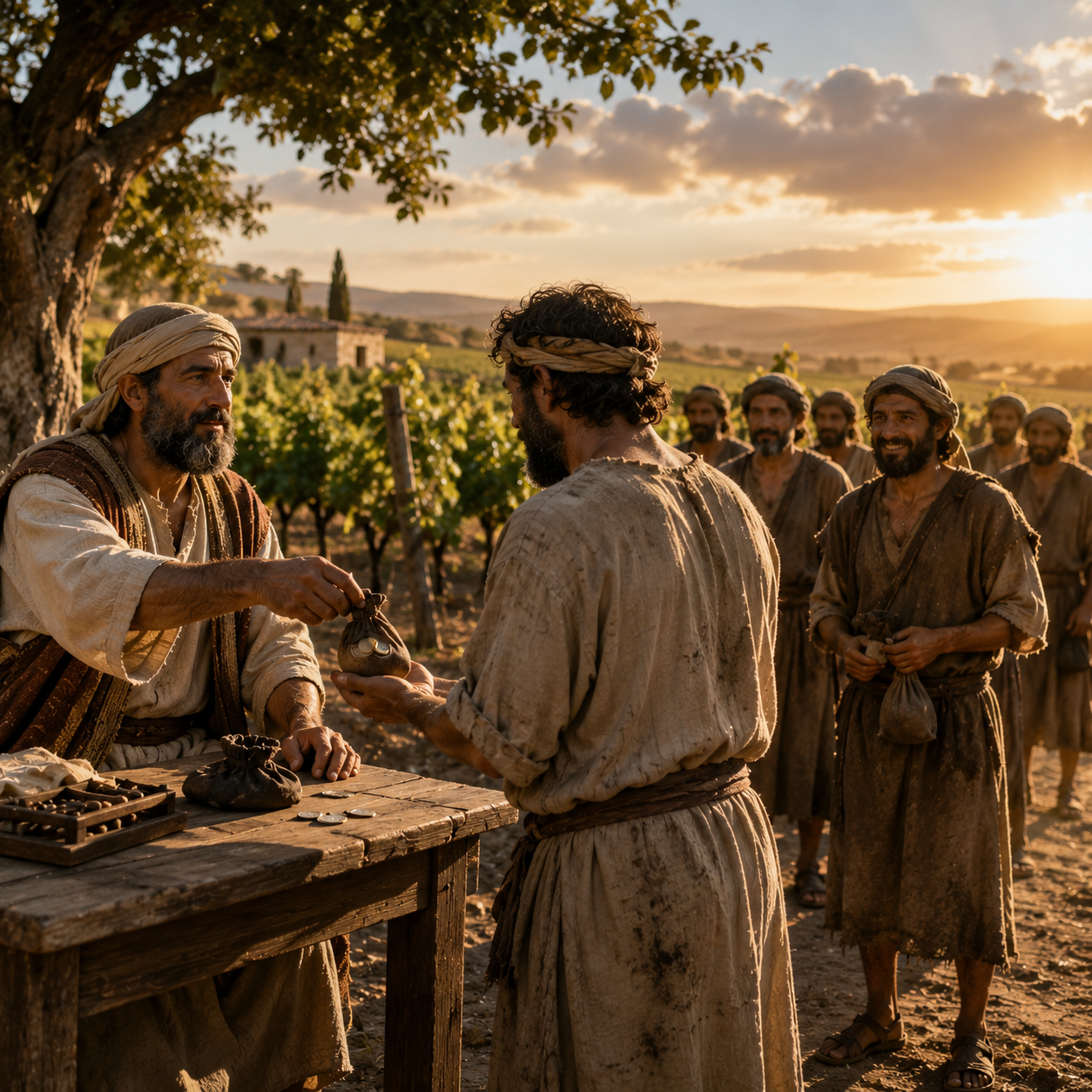
The workers who had arrived only an hour before sunset are called first. They approach the foreman with no contract to appeal to and no expectation beyond the simple promise they had received: “Whatever is right I will give you.” They have no way of knowing what that will mean until the coins are placed into their hands. Then, to the astonishment of everyone watching, each one receives a denarius, the customary wage for an entire day’s labor.
For just a moment, the vineyard must have fallen silent.
The surprise does not belong only to the last workers. The first workers are watching as well, and Matthew gives us a remarkable glimpse into what begins happening inside their hearts. He writes, “Now when the first came, they thought they would receive more.” That small observation deserves our attention because it reveals the turning point of the entire story. The landowner has not said another word. He has not hinted that their agreement has changed or suggested that he intends to reward them beyond what was promised. Nothing has changed except their expectation.
It is remarkable how quickly comparison can reshape the human heart. When the morning began, a denarius was enough. It was an honest wage for an honest day’s work, and they entered the vineyard grateful for the opportunity to earn it. Hours of faithful labor had not diminished its value. What changed was not the wage itself but the discovery that someone else had received the same gift. The blessing they had celebrated all day suddenly felt smaller, not because it had become less generous, but because they had begun measuring it against another person’s blessing rather than against the kindness of the one who had given it.
That temptation is not confined to a vineyard in first-century Judea. It quietly follows us into every generation because comparison has a way of shifting our attention from gratitude to calculation. We begin rejoicing over God’s faithfulness in our own lives until we notice the blessings He has poured into someone else’s. A ministry begins to flourish elsewhere. Another family seems to experience the joy we have long prayed for. Someone who has only recently come to faith appears to receive opportunities we have spent years hoping for ourselves. Without ever intending it, our eyes drift away from the goodness we have already received and become fixed upon what God has given to another.
Perhaps that is why Psalm 103 speaks with such power into this moment. David does not begin by counting what others have received. He begins by speaking to his own soul: “Bless the Lord, O my soul, and forget not all his benefits.” Gratitude always begins by remembering, because forgetfulness is fertile ground for comparison. David then reminds us that the Lord “forgives all your iniquity,” “heals all your diseases,” “redeems your life from the pit,” and “crowns you with steadfast love and mercy.” None of those blessings have been earned. None have been purchased through faithful service. They have all been received because God delights in giving what we could never deserve.
The psalm reaches its theological summit with words that have echoed through the lives of God’s people for centuries: “He does not deal with us according to our sins, nor repay us according to our iniquities.” Those words expose the deeper reality beneath the vineyard. If God were determined to give us only what we have earned, every one of us would stand in desperate need. The hope of the gospel has never rested upon receiving what is fair but upon receiving what grace delights to give.
It is worth noticing that Jesus has still not told us why the landowner chose to distribute the wages in this way. He simply allows us to stand among the workers and watch what unfolds. The last laborers leave overwhelmed by generosity they never imagined possible, while the first workers slowly lose sight of the generosity they had enjoyed since sunrise. The denarius has not changed. The character of the landowner has not changed. The only thing that has changed is the lens through which the first workers now view his goodness.
That realization prepares us for the question Jesus has been leading us toward from the very beginning. The issue is no longer how much each worker has received. The issue is whether the goodness of the master will become a cause for gratitude or a cause for resentment. By the time the first workers finally step forward to receive their wage, the greatest struggle in the vineyard is no longer taking place in the foreman’s hands. It is taking place in the hearts of those who have forgotten that every blessing begins with the generosity of the One who gives it.
Participating in God’s Joy
The first workers finally step forward, and the moment everyone has been anticipating arrives. They receive exactly what they had agreed to receive when the day began—a denarius for a day’s labor. The landowner has not broken his word, withheld their wages, or acted unjustly in any way. Yet Matthew tells us that they begin to grumble against him, insisting that those who worked only a single hour have been treated as equals to those who “have borne the burden of the day and the scorching heat.”
If we are honest, there is something about their complaint that initially resonates with us. We understand hard work. We appreciate faithfulness. We know what it means to endure while others seem to arrive only at the end. There is a part of us that instinctively nods along with their reasoning because we are accustomed to a world in which effort and reward are carefully measured against one another. The workers are not asking for charity. They are asking for what seems, at least from their perspective, to be proportional.
Jesus knows that we feel the force of their argument, which is precisely why He allows the landowner to answer so gently. He does not rebuke them with anger or dismiss them as ungrateful servants. He addresses one of them as “friend,” a form of address that is both gracious and searching, and then asks a question that settles the matter of justice once and for all: “I am doing you no wrong. Did you not agree with me for the usual daily wage?”
With those words the complaint loses its foundation. They have not been cheated. They have not been deceived. The agreement they freely accepted at sunrise has been honored completely. Justice has been satisfied, and yet their resentment remains. That alone should tell us that something deeper is happening in the vineyard. Their unhappiness is no longer rooted in what they have received but in what someone else has been given.
The landowner then asks a second question, and unlike the first, this one is never really answered. It simply lingers in the air, waiting not only for the workers but also for every reader of the Gospel to wrestle with it. Most English translations render it, “Are you envious because I am generous?” While that certainly captures the meaning, the words Jesus actually speaks are even more vivid. Literally, the landowner asks, “Is your eye evil because I am good?”
To the ears of those listening to Jesus, this was a familiar expression. An “evil eye” was never simply about what a person saw; it described the condition of the heart that shaped the way they saw everything else. Throughout the Scriptures it is associated with envy, stinginess, and a spirit that cannot celebrate another person’s blessing because it has become consumed with protecting its own. The problem was never that the eye failed to see clearly. The problem was that the heart had become so distorted that even goodness itself was viewed with suspicion.
That is why the landowner does not ask, “Have I been unfair?” He asks, “Has my goodness become offensive to you?” Those are two very different questions. The first concerns justice. The second concerns the human heart. The workers are no longer evaluating the fairness of the day’s wages; they are evaluating the goodness of the master himself, and they have reached the tragic point where his generosity toward others feels like a personal loss.
Once we begin to see that, we discover that this vineyard is not the first place in Scripture where such a struggle has unfolded. Jonah sat outside the city of Nineveh, angry because God had shown mercy to people he believed deserved judgment. The older brother in Jesus’ parable stood outside his father’s house while music and celebration filled the air, unwilling to join the feast because grace had been lavished upon the brother who had squandered everything. The Pharisees repeatedly criticized Jesus for welcoming tax collectors and sinners, unable to celebrate that the lost were being found because they believed such people had no place at the table. Each story is different, yet each asks the same searching question: Can you rejoice over the things that bring joy to God?
Perhaps that is why this parable follows Peter’s question so naturally. Peter wanted to know what faithful disciples would receive for leaving everything behind. It was not a sinful question, but it was still a question centered upon himself. Jesus answers by telling a story that slowly redirects Peter’s attention away from calculating rewards and toward contemplating the heart of the Master. The issue is no longer, “What will I receive?” The issue becomes, “Will my heart become like His?”
That is the invitation quietly unfolding beneath the surface of the parable. God is certainly inviting us to receive His grace, but He is inviting us into something even greater than that. He is inviting us to become the kind of people who delight in His grace wherever it appears. When heaven rejoices over one sinner who repents, we rejoice with heaven. When God restores the broken, welcomes the forgotten, or extends mercy to those who never imagined they could receive it, we celebrate rather than compare because our hearts are being shaped by the very character of the One we follow.
The title of this sermon is not Receiving God’s Joy. Every Christian knows something of that joy. The invitation of the kingdom is Participating in God’s Joy. It is allowing the Spirit of God to transform us so deeply that the things which delight the Father’s heart gradually become the things that delight ours. That is a far greater miracle than equal wages at the end of the day. It is the miracle of a heart that has learned to look upon the goodness of God, not with an evil eye clouded by comparison, but with grateful eyes that have discovered there is always enough joy in the Father’s house to celebrate the grace He gives to another.
Conclusion
Peter never receives the answer he expected. He asks Jesus what faithful disciples will receive for leaving everything behind, and instead of offering a careful explanation about rewards in the kingdom, Jesus tells a story that slowly draws Peter’s attention away from himself and fixes it upon the character of the Master. By the time the parable comes to its close, the question has quietly changed. Peter had wanted to know what awaited those who followed Christ, but Jesus has been asking something far more searching all along: What kind of heart is being formed within those who follow Me?
That question reaches beyond the workers in the vineyard because the story never tells us how they responded. Matthew leaves them standing before the landowner with his final question still hanging in the air. We never discover whether resentment finally gave way to gratitude or whether they walked away unable to celebrate the generosity that had been shown before their very eyes. The ending remains unwritten because the final response belongs not to the workers in the story but to the disciples who have heard it, and now, centuries later, to us.
The longer we walk with Christ, the more we discover that the Christian life is not simply about receiving God’s grace, although every day begins there. It is about allowing that grace to reshape our hearts until the things that delight the Father gradually become the things that delight us. It is one thing to rejoice because God has forgiven my sins. It is another thing altogether to rejoice because He has forgiven yours. It is one thing to celebrate that I have been welcomed into His kingdom. It is another to celebrate with equal joy that He continues walking into the marketplace, calling people whom no one else expected to find a place in His vineyard. That is the transformation Jesus is describing. Grace does more than change our standing before God; it slowly changes our affections until we begin to see the world through the goodness of the Master rather than through the comparisons of our own hearts.
In just a few moments we will gather around the Lord’s Table, and it strikes me that there may be no better picture of this parable than the meal Christ has prepared for His Church. We do not come because some of us have worked longer than others or because our faithfulness has earned us a greater place at the feast. We come because the invitation has been extended by the One who is both Lord of the vineyard and Host of the table. Some among us have walked with Christ for decades, while others are still learning what it means to follow Him. Some have known seasons of remarkable faithfulness, while others arrive carrying the weight of failure, grief, or regret. Yet when we come forward, no one receives a larger portion of Christ than another. The bread is broken for all. The cup is offered to all. Every hand is extended in the same posture of dependence because every heart stands in need of the same grace.
Perhaps that is why this table has always been called a means of grace. Here we are reminded once again that the kingdom has never been built upon comparison but upon generosity. The One who continues to go out into the marketplace is the very One who now invites us to His table, not because we have earned a place, but because He delights in welcoming His people into His presence. As we receive these gifts of bread and cup, may we receive them with grateful hearts, and may the Spirit who meets us here continue His gracious work within us until we not only rejoice that we have been welcomed into God’s joy, but find ourselves increasingly able to rejoice wherever His grace is found.
Comments are closed