Matthew 18:1-10
Matthew 18 brings to light another one of those moments in the Gospels when the disciples ask a question that seems so ordinary we almost pass by it, only to discover that it opens the door to one of Jesus’ deepest teachings. The disciples gather around Jesus and ask, “Who, then, is the greatest in the kingdom of heaven?”
It is an understandable question, but it is also a revealing one. Jesus has been teaching them about the kingdom almost from the beginning of His ministry. They have watched Him calm storms, heal the sick, cast out demons, feed the hungry, and reveal His glory in ways they could scarcely comprehend. More recently, they have witnessed the Transfiguration, where Peter, James, and John caught a glimpse of Christ’s divine majesty. They have heard Jesus speak again about His coming death and resurrection, though they still struggle to understand what those words truly mean. Even the miracle of the temple tax has reminded them that Jesus is no ordinary rabbi but the very Son of God.
Yet here they are, standing before the One who is walking toward the cross, wondering about their own importance and status in the Kingdom.
It is easy to smile at their question until we recognize how familiar it is. We live in a world that constantly measures greatness. We count achievements, titles, accomplishments, influence, and recognition. We compare ourselves to others almost without thinking. Even as followers of Christ, we can quietly begin measuring our lives with the same ruler the world uses.
Jesus does not answer their question the way they expect.
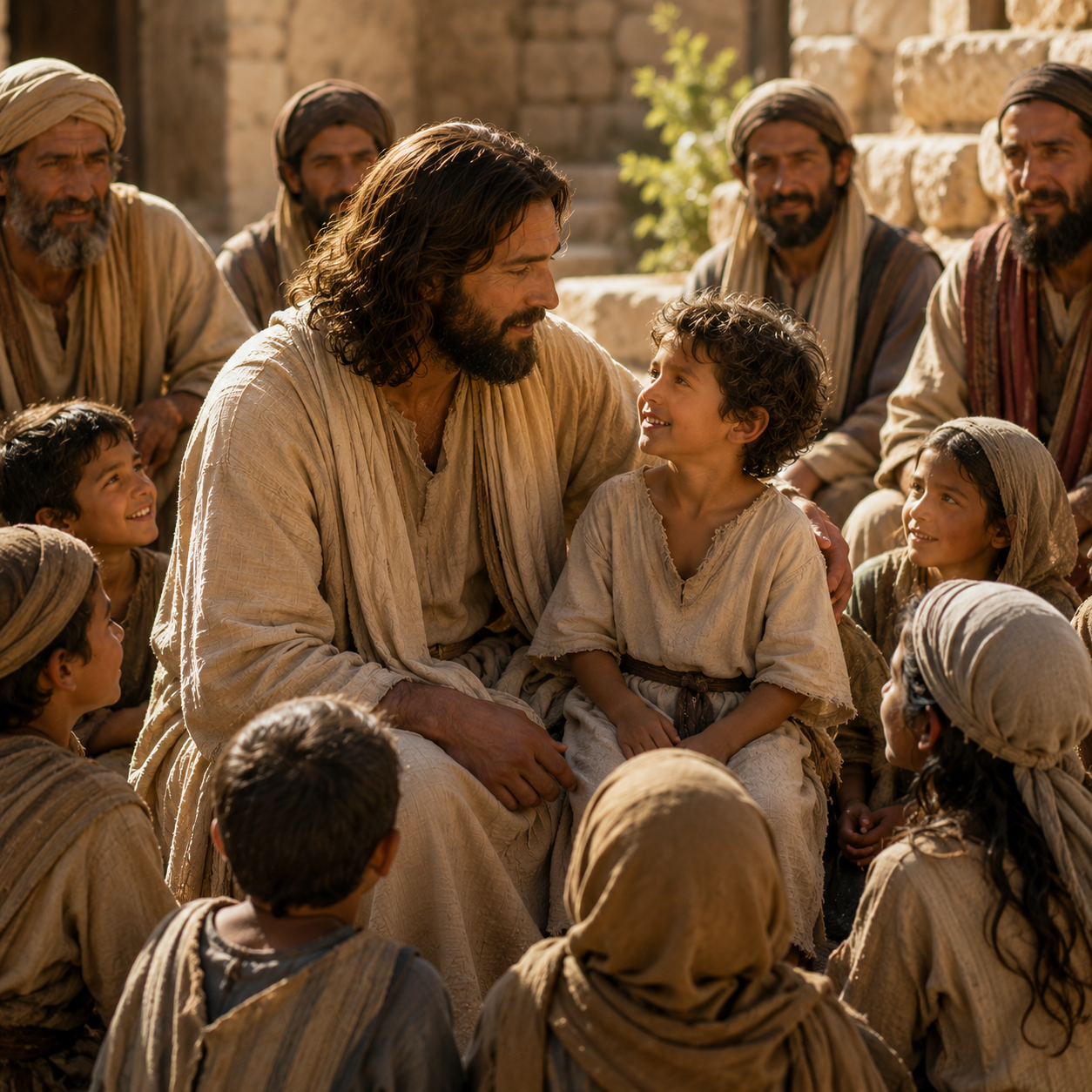
He doesn’t identify the greatest disciple. He doesn’t stack rank the Twelve or describe the qualities of an exceptional leader. He does something completely unexpected and He calls a child to Himself and places that child in the very center of the circle. Before anyone hears His answer, everyone is forced to look somewhere else.
Then Jesus says something even more surprising. “Truly I tell you, unless you turn and become like children, you will never enter the kingdom of heaven.”
Notice where Jesus begins. The disciples are asking about greatness in the kingdom, but Jesus first speaks about entering the kingdom at all. It is almost as though He is gently saying, “Before you wonder who is greatest in my kingdom, make certain you understand how anyone gets to go there.”
Humility Before God
“3 and said, “Truly I tell you, unless you change and become like children, you will never enter the kingdom of heaven. 4 Whoever becomes humble like this child is the greatest in the kingdom of heaven.” (Matthew 18:3–4)
If I had been standing among the disciples that day, I imagine this is where I would have expected Jesus to point toward Peter or perhaps John. Maybe He would have spoken about attributes like faith, courage, wisdom, or sacrifice. After all, those seem like the qualities we naturally associate with greatness. We even have the benefit of being allowed to look at the entire lives of Christ and the Apostles and know that Jesus would eventually tell Peter that on him He would build his church.
Instead of any of that, Jesus points to a child. Someone who wasn’t a scholar, religious leader or even one of those asking the question in the first place.
It is easy for us to misunderstand what Jesus is saying because our culture often views children differently than the people gathered around Him that day. We recognize children for what they are, precious gifts from a loving God. We admire a child’s imagination, innocence, and curiosity. Those are beautiful qualities, but they are not the point Jesus Himself makes. Notice that Jesus immediately explains what He means.
“Whoever humbles himself like this child…”
In the first-century world, children possessed very little social standing. They had no position to defend, no accomplishments to boast about, no authority to exercise, and no influence to leverage. In our culture kids experience life through the lens of travel sports, dance competitions, band performances and science Olympiads; all things to help them feel valued and demonstrate that they have worth. In the first century however it was very different. Everything those children had came through the care of another and their lives were marked by dependence.
That helps us understand why Jesus begins with the words, “Unless you change…”
The Greek word Matthew uses here, straphēte, carries the picture of changing direction. Picture yourself going down the road and realizing you left your cell phone at home and need to make a u-turn to go back and restart your journey fully prepared. The disciples are looking one way, asking how greatness is measured within the kingdom and Jesus tells them they should be looking somewhere entirely different. Before anyone can speak about greatness in the Kingdom of God, Jesus first wants them, and us, to understand how to enter the kingdom at all.
I love that Jesus doesn’t simply tell them that they need to act like children which is what many people think when they read this passage. Christ tell them that they actually must become like children; in essence give up everything that you hoped you’d gain as you grew in independence and return to the humility and lack of control that you had as a child. He’s calling us to remember that there is a world of difference between pretending to be humble and allowing God to shape a truly humble heart.
John Wesley often described humility as the soil in which every other Christian virtue grows. Pride quietly convinces us that we have arrived, that we have little left to learn, or that we can somehow stand on our own strength. Humility remembers that every step of the Christian life is sustained by grace. From the moment God first called us to Himself until the day we stand in His presence, we remain completely dependent upon Him.
Perhaps that is why Jesus never actually answers the disciples’ question about greatness. Instead, He helps them understand that life in the kingdom does not begin with climbing higher; it begins by kneeling lower.
The more we grow in Christ, the more clearly we see that everything we have; our salvation, our faith, our gifts, our opportunities, even our next breath, has come from the gracious hand of our heavenly Father.
Walking worthy of Christ always begins there.
Hospitality Toward Others
5 Whoever welcomes one such child in my name welcomes me.
What’s super interesting is that this poor child has not left the center of the circle, nor has Jesus finished teaching through this living illustration. I can almost picture this child looking around wondering what is going on. A few moments earlier, the disciples were looking at this child and learning what humility before God looks like, but now the Lord gently expands the lesson in a way they could not have anticipated. The child who first became the picture of the disciple’s heart now becomes the object of the disciple’s care, as Jesus declares, “Whoever welcomes one such child in my name welcomes me.”
There is something profoundly beautiful about the way Jesus moves from humility to hospitality because the two are inseparable in the life of every believer. Humility before God can never remain an inward virtue that affects only our private relationship with Him. As grace reshapes our hearts, it inevitably reshapes our eyes, and we begin to notice people we might once have overlooked, not because they have changed, but because we have. The kingdom of God always teaches us to see people differently than the world does.
The child standing before the disciples represented someone with no social standing to advance another person’s reputation, no influence to increase another’s importance, and no possessions that could offer anything in return. In almost every earthly calculation, this child had little to contribute to someone seeking greatness. Yet Jesus deliberately leaves the child standing in their midst and identifies Himself so completely with this little one that to receive the child is to receive Christ Himself. The values of the kingdom have once again overturned the values of the world.
There is, however, another phrase in Jesus’ words that is easy to read past because it has become so familiar to our ears. He tells His disciples to welcome one such child “in my name.” The Greek word is onoma. Literally it means “name,” yet throughout the Scriptures a person’s name represents far more than the way they are addressed. It speaks of their character, their authority, their identity, and even their reputation. To act in another person’s name is to represent them faithfully before the world. That hasn’t changed even today. How many times do we hear someone say that their “word is their bond” or that someone’s reputation has preceded them.
That gives new depth to what Jesus is asking of His disciples. He is not merely commanding them to welcome people because He has instructed them to do so. He is calling them to welcome others in such a way that His own character becomes visible through theirs. The compassion they extend should resemble His compassion. The patience they show should resemble His patience. The mercy they offer should resemble His mercy. When someone encounters the welcome of Christ’s Church, they should discover something that reminds them of Christ Himself because His people now carry His name into the world.
The Apostle Paul echoes this same truth when he writes to the believers in Rome,
“Welcome one another, therefore, just as Christ has welcomed you, for the glory of God.” Romans 15:7
Paul does not simply tell the church to be welcoming; he points them back to the manner in which Christ welcomed them. None of us entered the kingdom because we had become worthy of God’s grace. We were received while we were still in need of mercy, and it is only because Christ first opened His arms to us that we are able to open ours to one another.
Perhaps this is one of the clearest marks of a heart that has truly learned humility before God. We no longer ask what another person can contribute or whether they deserve our attention. Instead, we quietly ask whether our words, our actions, and our welcome reflect the One whose name we bear. Walking worthy of Christ means that His reputation is entrusted to His people, so that wherever His Church is found, the world catches another glimpse of the Savior who first welcomed us into His kingdom.
Holiness for the Sake of Others
6 “If any of you cause one of these little ones who believe in me to sin, it would be better for you if a great millstone were fastened around your neck and you were drowned in the depth of the sea. 7 Woe to the world because of things that cause sin! Such things are bound to come, but woe to the one through whom they come!
8 “If your hand or your foot causes you to sin, cut it off and throw it away; it is better for you to enter life maimed or lame than to have two hands or two feet and to be thrown into the eternal fire. 9 And if your eye causes you to sin, tear it out and throw it away; it is better for you to enter life with one eye than to have two eyes and to be thrown into the hell of fire. Matthew 16:6-9
The warmth of Jesus’ invitation suddenly gives way to one of the strongest warnings recorded in His earthly ministry. The child is still standing before the disciples, but now the Lord’s attention turns from welcoming this little one to protecting him. “Whoever causes one of these little ones who believe in me to stumble,” Jesus says, “it would be better for him to have a great millstone fastened around his neck and to be drowned in the depth of the sea.”
If you’re one of the disciples this has to be one of those moments where you feel you have whiplash, it quickly becomes one of those moments in life where you ask yourself “Where did that come from???” These are startling words, and they are meant to be. The tenderness with which Jesus welcomes the humble is matched only by the seriousness with which He protects them. Those whom the world considers insignificant are precious in the Father’s sight, and our Lord will not treat lightly anything that threatens their walk with Him.
Matthew records that Jesus uses the word skandalon. In its earliest usage, the word described the trigger of a trap. It was the small piece of wood that held everything in place until an unsuspecting animal reached for the bait. The danger was not the trap itself; the danger was the trigger that caused it to spring.
That image gives remarkable clarity to what Jesus is saying. He is not speaking about hurt feelings or personal disagreements. He is warning against becoming the means by which another person is drawn away from faithful discipleship. A skandalon is anything in our lives that invites someone toward a path that leads away from Christ rather than toward Him.
When we remember the previous verse, the contrast becomes even more striking. Just moments ago Jesus spoke about welcoming others in His name. We discovered that His disciples now carry His onoma, His character, His identity, and His reputation into the world. Now Jesus warns against becoming a skandalon. The One who entrusted us with His name now calls us to examine whether our lives faithfully reflect that name or whether, however unintentionally, they obscure it. Every follower of Christ represents Him before someone else. The question is never whether our lives influence others. The question is what direction that influence leads.
Years later, the Apostle Paul would wrestle with this same truth as he taught the early church about Christian freedom. He reminds the Corinthians that while many things may be permissible, not everything is beneficial, and not everything builds up the body of Christ. Christian maturity therefore asks a deeper question than simply, “Am I free to do this?” It also asks, “Will this help another believer follow Jesus more faithfully?” Love willingly surrenders even legitimate freedoms whenever they become obstacles to someone else’s growth in grace.
This is why Jesus immediately continues by speaking about cutting off the hand, the foot, or plucking out the eye if they become causes of stumbling. His words are not an invitation to harm ourselves but a vivid picture of the seriousness of sanctification. Whatever in our lives repeatedly pulls us away from Christ or quietly becomes a trap for those walking beside us is too costly to keep. The grace of God never asks us to manage sin comfortably; it empowers us to surrender it completely because Christ desires not only our holiness but also the flourishing of those He has entrusted to our care.
Conclusion
By the time Jesus finishes speaking, I cannot help but wonder what became of that child.
Matthew never tells us his name. We never learn where he came from or what became of him after that day. He simply appears in the middle of the disciples’ conversation and quietly becomes one of the greatest object lessons in all of Scripture. While the disciples were searching for greatness, Jesus was inviting them to become like this child. While they were wondering who deserved the highest place, Jesus was teaching them how citizens of His kingdom actually live.
As we have walked through this passage together, we have discovered that the journey begins with humility before our Father, because none of us enters the kingdom by our own strength or merit. We have seen that humility naturally grows into hospitality as we welcome others in the onoma of Christ, bearing His character and His reputation into the world so that people encounter something of the Savior through the lives of His people. Finally, we have heard the sobering warning that those who carry Christ’s name must never become a skandalon, a trap that causes another believer to stumble on the very path we have been called to help them walk.
Perhaps that is why Jesus concludes this section with words that are easy to overlook but impossible to exhaust. “See that you do not despise one of these little ones, for I tell you that in heaven their angels continually see the face of my Father in heaven.”
There is mystery in those words that Scripture does not fully explain, and it is wise for us not to speculate beyond what God has revealed. Yet Jesus makes one truth unmistakably clear. Those whom the world so often overlooks are never overlooked by heaven. The Father knows them. The Father sees them. The Father so treasures them that their welfare is continually before Him. If they matter that deeply to our heavenly Father, then they must matter just as deeply to those who bear the name of His Son.
Walking worthy of Christ, then, is not measured by how high we climb, how much influence we possess, or how many people know our names. It is measured by whether the life of Christ becomes increasingly visible in ours, whether His reputation is honored by the way we receive others, and whether our lives make it easier for those around us to follow Him with confidence and joy.
The disciples began this conversation asking, “Who is the greatest in the kingdom of heaven?” Jesus never gave them the answer they expected because He offered them something far better. He showed them what greatness looks like when a life is wholly surrendered to the Father, faithfully bears the name of the Son, and is continually transformed by the sanctifying work of the Holy Spirit. May that be the life to which Christ graciously calls each one of us, until the day we stand together in His eternal kingdom.
Comments are closed